

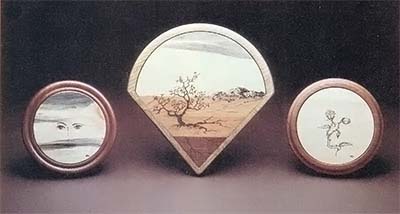
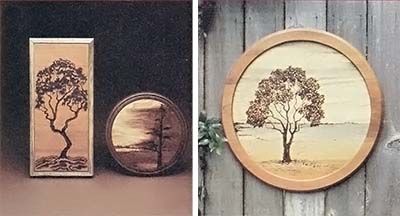
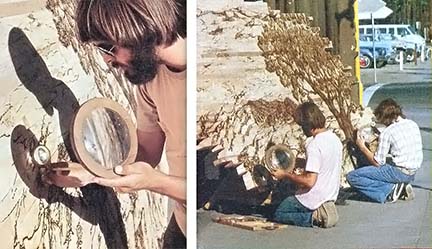
In 1976, I was working as a custom furniture maker in San Jose, California when I ran across an eight-inch plano convex lens in the wreckage of an old theater. The piece of salvage lay around collecting dust for several months before I realized its potential as a sun-powered wood-burning tool.
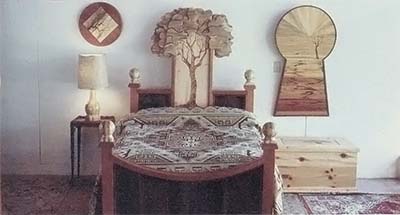
Even then, I initially thought of the lens simply as a means of adding detail to some of the lamps, beds, doors, etc. that I constructed… but I soon discovered that I could make a better living by selling the solar etchings alone!
Elaborate Preparations
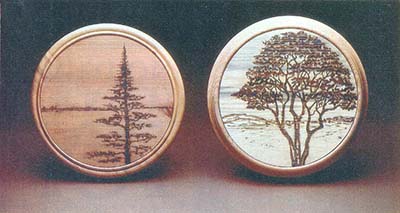
During the course of the following year, I figured out how to make circular frames and developed a method of “double-lensing,” where one lens acts as an amplifier for the focal point of a smaller lens in order to produce tiny lines. And, of course, my woodworking skills were an asset… because the more solar etching I did, the more elaborate my formats became.
Sometimes it takes five days of preparation before my wooden “canvases” ever reach the sunlight. I cut, laminate, and hand-plane the lumber, in addition to making the frame. Then, after the etching is done, I brush off the ash, sand the wood, clean it with an eraser, and put three coats of lacquer or Varathane on the surface.
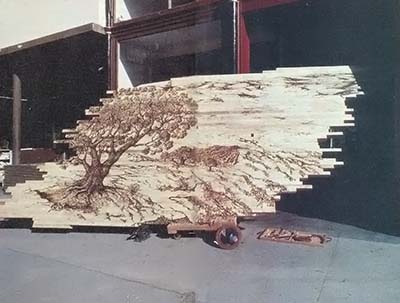
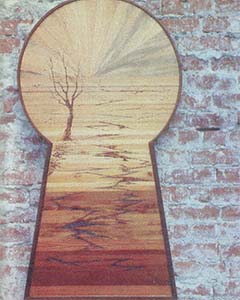
The composition which I call “Vision Through a Keyhole” incorporates, for instance, over 75 separate wood pieces, including a bentwood frame. And, in the summer of 1978, I started what may well be the world’s largest solar wood-burning project. With the help of an assistant, Daniel Ondrasek, I collected scrap 2 x 4’s from building sites and constructed an 18′ x 7′, 1,500-pound slab that had to be rolled out into the sunshine on a special platform. The etching, which took over a year to complete, depicts a 1920’s view of the Santa Clara Valley–then called “The Valley of Heart’s Delight”–from Mt. Hamilton . (Today, the area is full of tract homes, the sites for some of which provided the scraps for our giant artwork.)
Cooperative Nature
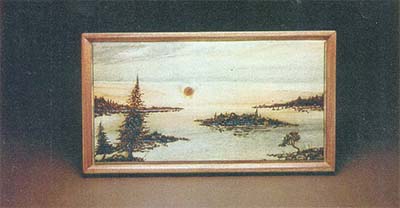
My chief subjects are boats, plants, trees, and landscapes… and are usually burned into the redwood and pine commonly found in California. Most of the time I’ll work along with the material’s natural grain, but I also laminate wood on occasion. I prefer to use Brooks pine, which has a lot of blue (as well as other natural colors) running through it, while I mostly use redwood for frames and as a color accent in some of the laminates. (I have no problem burning an image into dense oak, maple, or walnut… but such hardwoods are quite expensive in the West.)
I’ve found my salvaged lens to be so powerful that it can strike a flame the instant I bring it into focus, and the light is so bright that I’ve permanently installed a set of No. 5 welder’s lenses into the back of my sunglasses, for safety’s sake.
Most people are quite astonished when they first see the lens turn sunshine into fire, but they also seem to be a bit disappointed that I sketch in my image first with a pencil… somehow, my “audience” considers that to be a form of cheating. However, I prefer to predraw my designs, so that I can erase anything I don’t like before I burn the wood. (Erasing–or simply lightening the image–can also be accomplished by sanding the surface.)
A Way of Life
In 1977, I had to teach to supplement my “art” income, but a year later my solar etchings had made me totally independent… and my sales have doubled every year since I started.
I used to sell the pieces (priced anywhere from $10 to $500–sometimes even more–depending on the materials and time involved) at art and craft fairs. Now, however, I’m concentrating on marketing my work exclusively in art galleries. That way, I can spend more time at home experimenting with the many forms that sun, trees, and imagination can create.






