

With all the rapid changes in nature throughout springtime,
I wonder if four seasons are enough. After all, seasons are
time periods characterized by a set of events or states in
nature that are distinctly different from those of the
previous time period. Considering the many changes between
March and April alone, shouldn’t we add in an extra season
during this time? It might be nice to have something like
the six seasons of the Elves, which appear in stories
written by fantasy writer J.R.R. Tolkien. Between winter
and spring comes “stirring”; between autumn and winter
comes “fading.” After all, in much of the United States,
March (and at least some of April) are still extremely
cold, the trees are not fully leaved, and the time of
maximum blooming is still to come–conditions we
hardly associate with spring.
On the other hand, we must be careful not to distort
reality by forcing it into too many organizational schemes.
Many events in the natural world are not sudden. Like the
cold spells which persist in March and April, these events
just grow fewer and less severe. There’s also a positive
side to having four seasons; it makes the details of each
particular one more extreme. So as the cycle of seasons
rolls around again, the nature watcher can search for the
familiar details–patterns in nature and
life–and then delight in the recognition of seeing
them.
Bringing May Flowers
Over 600 years ago, Chaucer opened his Canterbury
Tales “Whan that Aprille with his shoures sote
[sweet]/The droghte [drought] of Marche hath perced
[pierced] to the rote [root]…” Everyone knows about the
infamous April Showers, but does the saying actually hold
up to meteorological scrutiny?
Yes. Of course the amount of rain you see depends
on what part of the country you live in, and showers seem
to be a phenomenon mainly of Eastern states. Keep in mind
that I’m not talking about the amount of
precipitation–March would probably win hands
down–but the frequency of come-and-go sprinkles and
downpours. Through winter and March, low-pressure systems
tend to produce widespread, not localized areas of
precipitation. But in April, the higher sun of longer days
starts heating the ground significantly, causing warm air
near the surface to expand and rise up into still-cold air
aloft: this “convection” makes cumulus clouds puff up and
grow enough to produce showers and thundershowers. As the
year progresses, convective activity by no means stops, but
a variety of factors usually prevents it from giving rise
to showers on as many days as in April.
The Living World
In addition to blooming flowers, May brings us the Season
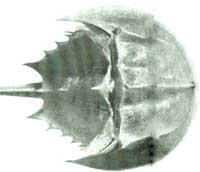
of the Horseshoe Crab, when the crabs make their big coming
out. This “living fossil,” which looks just like a walking
helmet, has virtually no living relatives in the animal
kingdom. From Maine to Mexico, you can see them traveling
the Atlantic beaches. (The only other place the horseshoe
crab exists in the entire world is Southeast Asia.) Perhaps
it’s strangest characteristic–aside from its blood,
which is a rich copper blue–is its extra set of eyes,
which can see in ultraviolet light. As for its most useful
characteristic, it would have to be the strange chemical,
limulus lysate, which is found in the horseshoe crab’s
blood. This life-saving chemical is used to test whether or
not medicines have become contaminated with bacterial
toxins.
This strange animal also provides an essential feast to
several species of migrating birds in May. The primary
location of this event is in New Jersey and the Delaware
shores of Delaware Bay for a brief period in late May.
Horseshoe crabs are then seen in enormous numbers on the
beaches, because this is when the females males lay eggs
for the males to fertilize. Enter hundreds of thousands of
birds, most in the midst of immensely long migrations, all
looking for horseshoe crab eggs and overturned horseshoe
crabs. One type of sanderling (a small type of shore bird),
called the Red Knot, travels 9,000 miles, from as far south
as Tierra Del Fuego in Argentina on its way up to northern
Canada.
Scientists believe that a significant part of the world’s
total population of bird species may show up in this one
place for overturned horseshoe crabs. If for some reason,
the horseshoe crab did not keep his appointment one year,
most of these birds would perish, and entire species could
actually be threatened. Only recently has the magnitude of
this migration feast and its significance been recognized.
SKY CALENDAR OF SPECIAL EVENTS FOR 1993
Astronomy
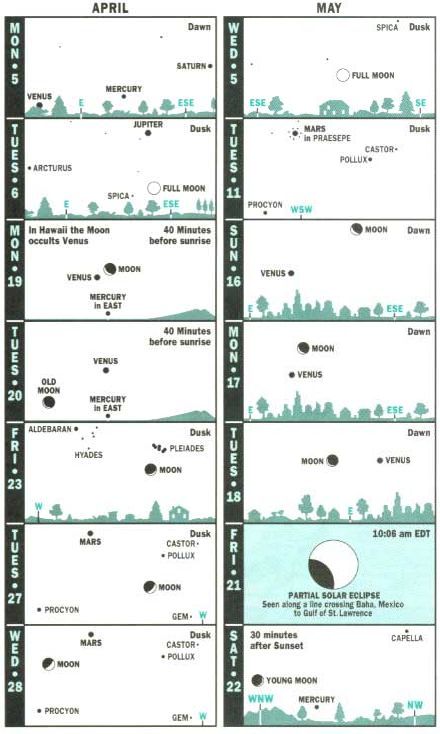
Morning Venus and Solar Eclipse . On April 1,
Venus rises in the East/Northeast only 35 minutes before
the Sun, but by the 10th it will rise an hour before the
Sun, and by the 30th, over an hour and a half. Always the
brightest point of light in the heavens, Venus gets even
brighter than usual this spring. It reaches “greatest
brilliancy” on May 7, but before then, we might see the
finest astronomical event of the spring: its close
encounter with the Moon on the morning of April 19 (see
“Sky Calendar”). If you can still locate the lunar crescent
towards midday, a small telescope or binoculars may show
the Moon approaching Venus until it moves right in front of
the planet. In Hawaii, the hiding before sunrise is
spectacular.
The partial eclipse of the Sun on May 21 is an early
morning event, visible from the northwestern two-thirds of
the United States. On the Pacific Coast, people can see the
Sun rise with a “bite” taken out of it. (Caution: Don’t try
to observe this eclipse without the proper filter.)
What else is in the heavens this April and May? The finest
constellation sight right now is the Big Dipper, upside
down and at its biggest in the north sky at night.
Special Days
Almost every American knows of Easter, Passover, and
Memorial Day, but there are plenty of springtime holidays
and traditions which have only had prominence across the
Atlantic, and which may seem odd to Americans.
Oak Apple Day (Restoration Day), May 29, is a commemoration
of the battle of Wooster in 1651. An oak apple (or oat
gall) is a swelling on a branch caused by larval infection.
The tradition was to carry oak branches with galls in order
to symbolize loyalty to King Charles II (who hid in an oak
tree for 24 hours after being defeated by Cromwell in this
battle. Village children would gather nettles and playfully
whip other children who weren’t carrying oak branches.
Then there are the days of “The Three Ice Saints of May” on
May 11, 12, and 13. The saints are Mamertus, Pancras, and
Servatius, respectively. Europeans considered these days to
mark the end of the time when killing frosts were likely to
occur. Not many Americans are aware of this tradition, but
it holds true for northern United States too.
Almanac for April and May 1993
April
May
1 April Fool’s Day. Venus nearest Earth, at inferior
conjunction–may be visible both before sunrise and
after sunset.
4 Palm Sunday. Daylight savings Time begins–set
clocks 1 hour forward.
5 Mercury at greatest morning elongation–but a poor
one for U.S. (Moon near star Jupiter at dusk–see Sky
Calendar.)
6 Passover. Full Moon (known as Grass Moon and Egg Moon).
(Moon near star Spica at dusk–see Sky Calendar.)
9 Good Friday
11 Easter
13 Last Quarter Moon
18 The Sun enters the constellation (not the astrological
sign). Aries; tomorrow it enters the astrological sign
Taurus.
19 Superb Moon-Venus conjunction at dawn, occultation in
day (see Sky Calender).
21 New Moon. Lyrid meteors from high overhead in
after-midnight hours today and tomorrow.
22 Earth Day
25 Mars at aphelion (farthest from Sun in
space)–something that happens about once every two
years. Sky Awareness Week begins.
1 May Day (Originally Beltane). National Astronomy Day (for
1993).
2 A few Aquarid meteors might be seen from southeast just
before dawn today and tomorrow.
5 Full Moon
6 Halfway point of spring.
7 Venus at greatest brilliancy in dawn sky.
11 Mars goes through north edge of Beehive star cluster
this evening and tomorrow evening. St. Mamertus’ Day.
13 Last Quarter Moon. Sun enters the constellation taurus.
18 Great eruption of Mount St. Helens, 1980.
19 Dark day in New England, 1780.
21 New Moon. Partial eclipse of the Sun.
29 Oak Apple Day (or Restoration
Day)
31 Memorial Day






