

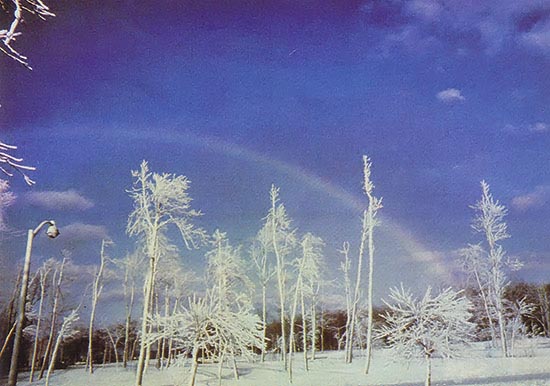
A rainbow is one of those delicate miracles that teaches that a greater-than-human mind had a role in the Creation. And, regardless of our religious beliefs, most of us find it astonishing that simple raindrops, falling in the rays of the sun, can separate white light into colors and suspend those vivid, glowing hues in a vast arc across the sky! What’s more, aspects of rainbow science — the relationship of rainbows to the environment in which they take place — are equally fascinating, particularly since having a better understanding of the whys and wherefores of these fleeting bridges in the sky can help us to find and enjoy more of them. And there are an amazing number of different kinds of rainbows. Taken together, they make up a wealth of wonders to equal any imagined pot of gold.
In this journey through the realm of rainbows, we’ll discover that many of the colorful arcs can appear in the sky at one time, and we’ll learn what happens to them as the sun sets. We’ll meet rainbows that lie on the ground and seem to stretch to infinity, rainbows that are as close as spider webs and lawn sprinklers, and others that can be seen a state away. There’s a red rainbow, a white version (which sometimes shows orange and blue), a rainbow pillar, a “rose” of rainbows, and a rainbow for each person — and even each individual eye! (And there are Diagrams of Rainbows I’ve put together so you can keep up with the discussion that follows.)
Where to Look
Rainbows seen in the western morning sky will usually mean that precipitation is headed your way. But the phenomena can be expected to appear most often on summer afternoons when a shower or thunderstorm system hastening away to the east is suddenly illuminated by the sun. They’re formed, you see, when light is refracted and reflected in raindrops. Because the various wavelengths of visible light (colors) bend at different angles when passing through the droplets, the colors separate and spread out in a band that’s about three times wider than the sun or moon (when these heavenly bodies are viewed from the earth). The result is an astonishing circular spectrum, which is cut into an arch by the horizon and which ranges from red on the top, through a series of hues, to violet on the bottom.
Normally, we think of a rainbow as being made up of seven different colors, but this isn’t strictly true. The variety of hues will depend upon a particular bow’s visibility and upon the color recognition of the observer.
The common, or “primary,” rainbow curves around a place opposite to the sun’s position in the sky (this is called the “antisolar point”) at an angular distance of about 42° from that spot. And, since your fist — held at arm’s length — is about 10° wide, 42° will equal approximately four widths of your fist. To locate the antisolar point, just stand with your back to the sun, and the point will be at your head’s shadow. Then, holding your arm straight out in front of you, you can measure four fist-widths up from that shadow to find the most likely location of the bow.
You’ll note, too, that the largest arcs are seen when the sun is setting, because at that time the antisolar point draws closer to the opposite horizon, and fully half of the rainbow’s circle can be visible. On the other hand, when the sun is at an angle greater than 42°, the rainbow will be completely below the horizon. Therefore, these colorful arches can never — in the U.S. and much of Europe, at least — be glimpsed around noon on a summer day. However, if the conditions are just right, you may be lucky enough to actually see the top of a rainbow begin to appear on the eastern horizon as the sun descends a bit, swelling into beauty like a sunrise.
Another strange sight sometimes occurs when you view a rainbow at sunset. As old Sol drops lower in the sky, the arch’s colors will fade, one after another, until only the red band remains. This scarlet rainbow can even be seen for a while after the sun goes down, because some of the raindrops are far above ground level and are thus still illuminated. Finally, however, the ends of the red band will slowly disappear until only the peak of the bow is left as a shrinking, glowing red spot in the darkening east.
The only way to see the bottom curve of a rainbow (or perhaps the full 360 ° circle of it) is to be in a position that places a great many rain droplets between you and the ground — as might be the case when looking down on a shower from the vantage point of an airplane. Don’t be fooled, however, if you notice several small, concentric circles of vivid color floating on the clouds below your window. They represent another wondrous (but far more common) sky phenomenon called “the glory.” And, since only red and green-blue are visible in that strange sight, it can’t be classed as a full-circle rainbow.
Multiple Rainbows
Many people are amazed when they observe a second ‘bow above the first, but traces of a “secondary” rainbow are almost always visible if the primary phenomenon is clearly seen. This second arch is usually fainter and wider than is the main one, though, and has the order of its colors reversed with red on the bottom and violet on the top. (Look for its red band about 51° from the antisolar point.)
The secondary bow is caused by light which is reflected not once, but twice inside the raindrops; it’s even possible to have more reflections and, therefore, more bows. The “higher-order rainbows” are, however, many times fainter than even the secondary types, and are rarely observed in nature. The third bow has supposedly been seen by a small number of people; the fourth—which, it’s been theorized, falls directly in front of the sun—by no one; and the fifth by (perhaps) only one person, the nineteenth century scientist Mascart.
The individual who first calculated where the third rainbow should appear was Edmund Halley, the great English astronomer, whose famous comet will be returning in a few years. It turns out this third arc is also seen between the viewer and the sun, but not as directly in front of that blazing orb as is the fourth bow.
As many as 19 rainbows were visible in a special apparatus made by the nineteenth century scientist Felix Billet, who was able to make a beautiful diagram of where all those bows might appear in the sky. Each higher-order arc is wider than the one before it, and if we were able to see them in nature all at once, we’d find that virtually the whole sky would be filled with them! Billet called his circular diagram “a rose of rainbows.”
Although these higher-order phenomena are extremely rare, there’s a common type of addition to the primary bow which consists of extra bands of color. These alternate pink and green stripes are found just under the violet (bottom) band of the primary and are called “supernumerary arcs”. They should not be considered true rainbows or even parts of a bow, because they’re actually caused by the wave nature of light and are related to the small rings of red and green which are sometimes seen whole (but often in patches) when clouds float over and around the moon’s face. These supernumerary arcs seldom extend along the entire length of the rainbow, but are more often seen under the highest point of the bow’s arch. However, as many as five have been seen with a primary rainbow, their number and spacing depending upon the size of the rain droplets involved. When these are quite small, the first arc sometimes appears to be continuous with the bottom of the primary, but it should still be quite distinguishable by its difference in color from the primary’s violet band. At other times, these supernumerary arcs can appear as virtually colorless curves of light.
Another interesting rainbow-related phenomenon, which is frequently and sometimes spectacularly visible, is “Alexander’s dark band.” First recorded a few centuries after Christ (by Alexander of Aphrodisias), this is a darker-than-normal patch of sky which occurs between the primary and secondary bow. (Even if the secondary is not visible, you should be able to see that the area just outside the top of the primary rainbow is darker than that under the arc.) This occurs because both the primary and secondary bows are refracting light away from this area, making it appear comparatively dark. (Whenever Alexander’s dark band is not clearly seen, it’s because the brightness or darkness of the background clouds masks the effect.)
Very Special Sights
Seeing rainbows in strange settings can be a special thrill, and not many such sightings could be more unusual than viewing a multicolored arc at night. (This phenomenon bears no close relation to the arcs or full circles which are fairly often seen around the moon and are known as lunar halos.) The moon is bright enough to create a night rainbow only when it’s full or nearly so, and even then the arcs will usually be too dim to show much color. But just imagine how mystical and delicately enchanting it would be to see one of these rare moon rainbows with a few stars peeking through the clouds, or maybe even through the bow itself! Remember to look for night rainbows in the same position in the sky relative to the moon as the daytime arcs are to the sun.
If you’re anywhere near a calm body of water, you may have a chance to see yet another marvelous sight: A reflected rainbow. There are actually two major kinds of phenomena that can be classed as such. The less frequent type is caused by the sun’s bright image reflecting off the water to produce a rainbow from moisture in the air. A primary “sun-reflection” bow is always higher than the “regular” primary type, so that if both occur at the same time, an observer can see the almost unbelievable pattern laid out upon the face of water and sky. (Of course, even more intricate patterns may occur if secondary rainbows are visible!)
Quite often, however, only parts of a sun-reflection bow are seen. (When a single piece appears above the primary, this is called a “rainbow pillar”.) Such effects can be caused by the location of the body or bodies of water involved. These lakes, ponds, etc. may be several miles from the observer and hidden from his or her view. It follows, then, that if pieces of a sun-reflection bow are missing, it might actually be possible to determine, from the bow, where the ponds or lakes that create the mini-arcs are located. Thus, little bodies of water can conspire to paint sections of a rainbow in the sky, which in turn reveal information about the local geography!
Though bows caused by a reflected sun are rather rare, another kind of reflection isn’t. It’s simply the reflected image, on the water, of a rainbow in the sky. But, strange as it may seem, the reflected rainbow that you see in the water is not the mirror image of the bow that’s visible in the sky; it’s the reflection of another one that you don’t see!
Before I make this phenomenon sound even more astonishing (and perhaps confusing), let me try to explain it. The reflection shows us what we would see if we were looking at the rainbow in the sky from that point out in the water. (Actually, this is only approximately true, but it’s sufficiently correct for our purposes.) That’s because a rainbow is not an object in space. Instead, it’s simply a function of light that’s coming to us from a certain angle. Therefore, if we were observing the light from that point on the water, the rainbow we’d see in the sky would be a different one from that seen in the sky by a person back on the shore. So if you ever spot such a reflected rainbow, you might want to note the often dramatic differences between it and the one up above. (It’s even possible for a sky rainbow to disappear, while what seems to be its reflection on the water remains visible!)
As a matter of fact, the bows seen by two people standing side by side will also be slightly different, in effect giving each person his or her own rainbow. Even the ones seen by each of your two eyes won’t be quite the same. (Sometimes when swimming or looking at a lawn sprinkler, it’s possible to get close enough to a light-dispersing spray to actually see twin rainbows —one for each eye!)
Near and Far
As you can imagine, given the rainbow’s elusive nature, it’s difficult to say exactly where one is! Many folks assume that the phenomenon takes place in the rain that’s producing it. In fact, though the processes that make a bow possible do occur in the downpour, the amazing display resulting from raindrops and sunlight is visible only at the apexes of cones along which the rainbow’s light travels from the droplets to the viewer. Each storm with an abrupt clearing behind it is trailing several cones at whose tips different rainbows can be viewed.
This strange situation doesn’t prevent us from ascertaining approximately how far away a certain rainbow is, provided we understand that we’re actually determining the distance to the moisture that’s causing it. In such a case, we know (for example) that the pretty arches can occur just a few feet from us in fountains, waterfalls, lawn sprinklers, or dewy spiderwebs.
But if these are the closest rainbows, at how great a distance can the arcs be seen? Well, generally speaking, the average distance of the rain causing a bow is about 1/2 to 1 1/2 miles from the viewer, but a friend of mine observed—in the clear air and flat landscape of the Midwest—a section of a rainbow in a storm that was a full 80 miles away (and he doesn’t claim that it would be any sort of record)! Furthermore, though most rainbows have rather ephemeral existences, one was seen in Dover, England on May 7, 1953 that lasted over an hour!
Finally, the rainbows that can occur in dew or fog are fascinatingly different from those that appear in the sky. When the sun is low behind you, the dew bows on the ground typically form a wide-open curve whose ends stretch off into the distance displaying all of the various rainbow colors.
This is not the case with the fogbow, since the minute diameter of fog droplets causes the refracted colored rays to overlap, forming what’s sometimes quite accurately called “the white rainbow” (though orange and blue can appear around its edges). Fogbows — appearing as phantom circles and misty arches — can be seen surprisingly often, on foggy nights, against dark backgrounds that are opposite streetlights.
It seems almost everyone has a memory of a favorite rainbow that was seen in a particularly beautiful setting (or during a special moment). One of my most memorable occurred in upstate New York when I saw the many-hued bands in front of a forested hill about a mile away. It was in October, and the trees on the hill were near the height of their autumn colors, so I was able to see the flame of orange and red foliage through that wonderfully transparent thickness of red, yellow, blue, green, and violet light!
Such spectacular displays have made the rainbow a rich subject for legend. It was said to be the bridge of the gods in Norse mythology, and was called the pathway of Iris — goddess of the rainbow and messenger of the gods — by the ancient Greeks. (Her name has come to describe the colored part of the eye and a genus of perennial plants, as well as being the root of the adjective “iridescent,” meaning “rainbow colored”.) In the Bible, the rainbow represents a pledge of peace after the flood of wrath. To this day, the colorful phenomenon can fill observers with deep peace and — perhaps precisely because it has no “practical” function — stir a sense of the mystery and wonder beyond our common day-to-day world.






