

Plant Geneticist Develops Potato Seeds for Growers in Poorer Nations
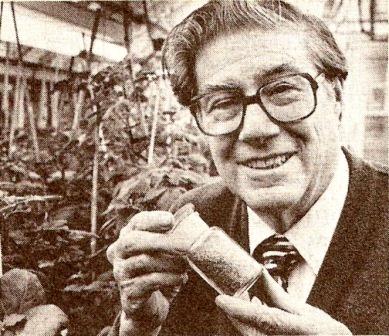
The option of planting potatoes from true seed–rather than from tuber pieces–recently became available to the gardener and Stanley Peloquin, of the University of Wisconsin in Madison, played a large part in this advancement. With the help of colleague Americo Mendiburu, the plant geneticist developed an unusual “clear slate” potato hybrid that has the ability to produce uniform seeds when crossed with other varieties. Peloquin explains that potatoes have traditionally been grown from eyes because “you could never get uniform offspring from the seeds.” The crossing of two varieties had always resulted in a batch of seeds with tremendous individual variations: Each one would be–as the scientist puts it–“as different as you and I.” But Stanley’s hybrid eliminated that problem, and potato growers can now opt for the convenience of planting a mere handful of seeds.
The achievement may be particularly significant for farmers living in countries that must import potatoes for planting. Peloquin believes that the use of seeds would greatly reduce the cost of raising potatoes–after all, it takes only two ounces of seed instead of 2,000 pounds of tubers to sow an acre–and he wants growers in poor nations to have the advantage of this reduced expense. For that reason, Stanley’s been cooperating with the International Potato Center in Líma, Peru. The center now sponsors programs in such countries as Ethiopia and Bangladesh to demonstrate the new method of cultivating the vegetable. “Our goal is to have true potato seeds widely distributed to farmers in underdeveloped countries by 1985,” says the dedicated geneticist, “and, so far, the evidence indicates that our program will be a success.”
— Bruce Shawkey
An Alternative Summer Camp for Low-Income Families
Sharon Newman Gomez grew up in a neighborhood where the experience of going to summer camp was virtually unknown. Because of limited income, the families of Sharon and her playmates couldn’t even consider sending their children away for a few weeks of organized recreation and education. Ms. Gomez later discovered the joys of the vacation camp when she obtained a job as a counselor while working her way through college. But she didn’t forget the many children who could only dream of trotting off for a pleasure-filled summer. Instead, when Sharon became the resident manager of a low-income housing complex, she decided to provide her needy young neighbors with an experience comparable to that of the traditional summer camp.
Gomez organized a program that features three “camp” sessions per week. Mondays are devoted to “storytelling” (reading or writing prose and poetry, as well as viewing films). Wednesdays are set aside for arts and crafts, and Fridays are reserved for “special events.” The last category includes such activities as a “backyard camp-out” (overnight!), a “treasure hunt” (for which the children dress in pirate costumes), the “neighborhood Olympics,” and a “talent show” (this is not a contest, so every youngster is a winner!). Sharon’s alternative to the middle-class camp gives children from low-income families the chance to join in constructive, creative, .enjoyable activities and–remarkably–operates on less than $15 per week.
–DM
Appalachian Science Organization Monitors Environmental Hazards
Al Fritsch is a Jesuit priest who’s concerned about environmental abuse. More important, he’s doing something about it: Fritsch founded (in 1977) Appalachia-Science in the Public Interest (ASPI). The association’s main purpose is to monitor environmental hazards through the organization and support of citizen groups, and it has set up a central Appalachian network of approximately 400 scientists and engineers to assist such groups. Father Al–who has worked with Ralph Nader–believes that “no land is so abused as my Kentucky homeland,” and he therefore chose a Kentucky town (Livingston) as the base for his new organization.
ASPI has several success stories to its credit. For example, it blew the whistle on a U.S. Army Depot’s improper disposal of PCP-contaminated products, persuaded the state to prosecute a case involving unlawful strip mining, formed (in 1981) Kentucky’s first community land trust, and succeeded in getting a federal investigation of a large mining company, whose negligence had resulted in a coal waste slide that killed a person. Fritsch’s group also sponsors workshops in which Appalachian people can learn how to build an inexpensive solar greenhouse, sample water, or choose crops that are compatible with the region’s soil and climate. Father Al asserts that “we are all stewards of the land.” His ASPI clearly is helping people to do a better job of serving the earth.
—M.Elaine Dillhunt
Veterinarian Recommends Natural Foods for Pets
Veterinarian Norman Ralston of Dallas, Texas believes that natural foods are as important for pets as they are for people. He maintains that the low quality of some commercial pet food is a contributing factor in a variety of animal illnesses. Dr. Ralston recommends a diet for dogs and cats that includes vegetables, herbs, and such grains as cornmeal, oats, brown rice, and barley. The holistic veterinarian also breaks with tradition by advocating the use of acupuncture to alleviate animal ills. He has employed this ancient art–which can often eliminate the need for surgery–in the treatment of pet problems ranging from paralysis and glaucoma to calcium deficiency and mange.
Valerie Harper Co-Founds Hunger Relief Organization
Valerie Harper, perhaps better known as television’s “Rhoda,” is involved in a new Los Angeles-based group named LIFE (Love Is Feeding Everybody). LIFE, which is also supported by Jack Lemmon and Dennis Weaver–plans to supply needy California residents with surplus food. In addition to working with this organization, Valerie devotes time to Save the Children and the World Hunger Project.
Rescue Greyhounds
Concerned about the plight of greyhounds that are either unsuitable for racing or too old to continue in the sport, Ron Walsek founded an organization to encourage the placement of these dogs as pets. Retired Greyhounds as Pets(REGAP) seeks loving homes for the purebred animals that are marked for destruction because the reject runners are considered “worthless” by those involved in the racing business. Walsek emphasizes that the dogs are intelligent, loyal, affectionate, and calm (not high-strung, as is often thought), and therefore have great value as pets. If you’d like more information–or an application to adopt a greyhound–contact REGAP directly.
Organic Materials and Soil Fertility
In his earlier days, Simeon Murren was quick to join protest groups that addressed problems such as the elimination of toxic wastes. Now, he concentrates on educating—ratherthan protesting–and is dedicated to teaching people about the valuable role that organic materials play in the restoration of soil fertility. Simeon (who operates a composting company that deals strictly in organic products) spreads the word by publishing a free monthly newsletter, the “Organic Times,” which offers gardening advice and gives detailed information on such soil enhancers as earthworm casts and bat guano. The publication is a labor of love for the Arcata, California resident, who describes the campaign to restore soil fertility as his “life’s work.”–DM






