

A people conscious of its hills has demonstrated the strongest impulse toward independence in history. Woe to this people, however, if it no longer lifted its head above the valley floor to the peaks, sought only its own advantage in the working day and forgot to survey the problems of life from a high point of vantage. Then it would bubble and stew over its own little problems and give itself over to a preoccupation with its own image. — Ehrenfried Pfeiffer
The Owner Built Homestead, Chapter 10: Woodland
Woodland management practices in this countty are not unlike agricultural practices: both are currently based on a ground-line philosophy. That is, the harvest, the cutting, the profit are secured at ground-line. Monoculture is the accepted ground-line agricultural practice, and the same mentality results in clear-cutting and even-growth production in woodland management. A top-of-the-ground harvest orientation even twists the minds of trained foresters who advocate such abhorrent practices as control-burning and crop-dusting.
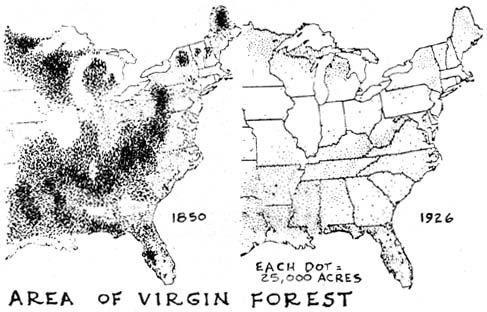
Bad forestry is in some respects more serious to a nation’s welfare than bad farming. For one thing, there is more to lose: the world contains twice as much forest area as it contains land under cultivation . . . a third of the earth’s surface is classified as forest soil. Originally in the U.S., before the white man came, over one-half of our two billion acres was in forest. Forests have been decimated in places like England for so many centuries that even the forest terminology has atrophied… forests become known as “woods.”
Every seriously operated homestead should contain within its bounds some percentage of woodland acres. Besides the obvious “ground-line” value of timber, firewood, fenceposts and pulpwood, a woodland helps to control wind and water erosion. Experiments in Wisconsin showed that soil losses were one hundred times as great from pastured land as from unpastured woodland, and water losses were sixty times as great. Protection and shelter from the wind can be an essential attribute of proper woodland planning. And the food and shelter offered to wildlife from a woodland can help to maintain one’s homestead as a balanced, complex association of plants and animals–which includes in its natural harmony birds, bacteria, insects and fungi–rather than attempting to eliminate them, something which never succeeds and only results in their lopsided development.
Woodlands can also influence the microclimate. Winds carry moisture that is lifted by the sun from large bodies of water. This moisture-laden air will move indefinitely or until it reaches a woodland. Trees transpire … cooling the air, spraying the sky, and multiplying the cloud cover. This upward rainfall rises until it meets the moisture-laden air and then drops down as precipitation. Trees located on hills and mountains offer the best obstruction to clouds and thereby increase the rainfall.
Traditionally, woodlands are located on land classed as non-agricultural because of inaccessibility, steepness, or poor soil. The ground-line “growth factory” concept keeps most farmers from planting trees and shrubs in rich, deep soils. No matter. Conifers are best planted on eroded, compacted, humus-lacking soils that perhaps once supported hardwood trees. In time the conifers will build up the soil to the point where hardwoods can become re-established. Trees differ widely in their soil and moisture requirements: where yellow poplar requires a deep and moist soil, black locust will thrive on a soil deep or shallow, moist or dry. Alders survive in wet, undrained soil while willows require wet, drained soil. Eucalyptus will dry up a swamp, but will also drain ground water on a water-needy land.
The inherent capacity of a tree species to withstand shade becomes a second factor that determines a woodland type. Again, the range of tolerance is very wide as accompanying charts indicate. Sugar maple seedlings require only two-percent full sunshine, and loblolly pine seedlings require nearly full sunlight to grow satisfactorily. Seedlings are generally more tolerant of shade than mature trees, especially if they are grown in a good exposure and on good soil. Shade givers grown near seedlings also provide valuable physical protection.
Someone once discovered that trees have one or another of three different-shaped root systems: a spear shape, as found in the oak which taps minerals from great depths; a heart shape, as found in the birch tree which lifts huge quantities of water; and a flat shape, which is designed for the support required by such trees as the Sitka spruce. Now it becomes obvious that a plantation of a single tree species would offer fierce competition at the same root level for food, moisture, or support. For this reason a homesteader should make certain that his woodland contains a mixed variety of trees–different evergreens and different deciduous trees- with a wide variance in age and growth. A mixed woodland is far less subject to insect damage mainly because mixed woods supply a mixed humus. A loose, crumbly layering of mixed leaves is certainly a better stimulus to germination and to growth than a dense, impermeable layer of a single variety of needles or leaves. Witness the fatal Dutch elm disease which totally wiped out mono-planted roadside elm tree plantings all over the East. A mixed woodland also provides a varied supply of materials for use and for sale. One naturally aims at producing the highest grade woodland products . . . such as black walnut furniture wood, hardwood veneer, or saw logs, poles, and pilings. Low-grade products such as fuelwood, pulpwood, or railroad ties can be mostly a by-product or culls from high-grade products. Each of these main woodland products will be discussed in detail below.
High-grading wood products from one’s own woodland is only possible where the homesteader does his own harvesting, as contrasted to selling “stumpage” (standing timber) to a contractor. Homestead-sized woodlands only attract the small “gyppo” contractor, who is notoriously destructive in his timber removal operations . . . destructive, that is, to the remaining woodlands that aren’t stolen by him. The sale of stumpage brings only about 15% of the timber market value. About 30% of the operation is allocated to felling and to bucking the trees. Another 40% is taken up in yarding and in hauling, with the balance in profit. There is no part of this timber harvest operation that cannot be handled–even single-handed–by the homesteader. In due course one learns that a tall, straight, well-tapered southern yellow pine or Douglas fir will bring more money sold as a pole than sold as a saw log; large, high-grade logs are best sold as veneer timber. Lower-grade timber can be high-graded, too, and sold as saw logs or finally as pulpwood, fenceposts, or cordwood. While contemplating this whole woodland operation, keep in mind two important factors: First, the work is performed during “slack time,” in the winter months when homestead chores are minimal. Second, the homesteader can supplement his income by utilizing to the best advantage the resources that he has at hand. They are, in order of availability, land, labor, management and tools. Unlike other members of our society, the homesteader generally does not have access to wages, rent, interest, or unearned profit.
Before delving further into the economics of woodland management, something should be said of woodlands as sheltering devices. My interest in windbreaks was first aroused years ago when I read about the Lake States Forest experiments at Holdrege, Nebraska. In these experiments exact fuel requirements were recorded in two identical test houses . . . one exposed to the winds and one protected by a nominal windbreak. With both houses maintained at a constant 70-degree inside temperature, the one having windbreak protection required 30% less fuel. It was also found that animals in a tree-protected yard gained 35% more pounds during a mild winter!
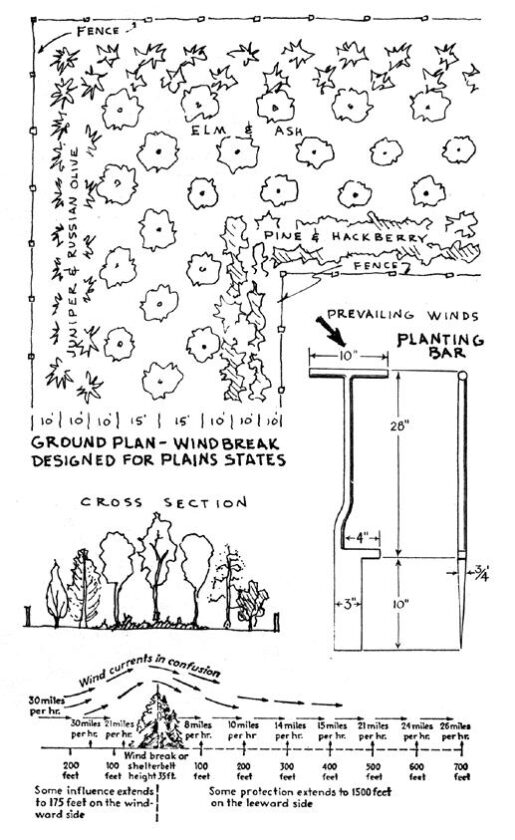
There is a distinct but thorough science to shelterbelt planting involving tree varieties, planting layout, and tree spacing. For example, poplars are often used as windbreaks because they are able to withstand high wind pressure, but poplars are great soil robbers. So it becomes prudent to alternate poplars with a complementary variety such as an alder tree. The alder brings nitrogen into the soil . . . being one of the few non-legumes which have this property. And for reasons mentioned earlier, it is important to combine coniferous and deciduous trees. A dense monoculture of conifers may successfully break the force of prevailing winter winds, but at the same time they may obstruct the flow of cold air, thus impeding natural air drainage. The winter-bared branches of deciduous trees will not obstruct this important air movement.
The most effective windbreak is in the form of an “L”, with the point to the prevailing winter winds. This layout is best both for preventing evaporation of soil moisture (thus raising soil temperature) and for catching and preventing drifting snow around walks and buildings. Snow in the shade of shelter trees melts slowly in the spring, conserving moisture for row and sod crops.
Row and sod crops benefit in other indirect ways by planting windbreak-woodlands in close proximity. The traditional treeless, field-crop pest is, of course, the sparrow. Its birds of prey are the buzzard, the owl, and the sparrow hawk, which cannot function without the protection and the vantage point offered by woodlands. Birds are attracted to woodlands, and this is important to the control (not ground-line eradication) of insects. The tomtit is known to consume 80 pounds of agriculturally injurious caterpillars in a summer; the starling destroys harmful larvae. The thrushes, jays, and starlings are all valuable tree-seed planters. Wherever possible plant shrub fencing–such as multiflora roses–where fencing is required, to encourage bird habitations.
Some form of fencing–shrub, wood, or wire–should definitely be installed around the homestead woodlands. Grazing a woods may help reduce fire hazard, but animals (especially sheep and goats) destroy young shoots and seedlings, compact the soil and, in general, disturb the physical structure of a woods.
Fenceposts, incidentally, are an important homestead resource, entirely available from a well-managed woodland. The involved process of growing, treating, and installing fenceposts and fencing will be discussed in the following chapter.
The demand for saw logs is greater than for any other timber product, and a well-managed homestead woodland produces a minimum of 500 board feet of lumber for each acre each year. The key word here is “well managed.” According to the Department of Agriculture, an optimum managed woodland with a good growing stock produces three times as much wood as the average untended woodland.
I can list three rules essential to the maintenance of optimal woodland conditions: [1] choose the best species, [2] keep the stand at optimum density and [3] correctly cut and prune. These factors will now be discussed in detail.
A conifer is preferred for construction because it is a softer wood and easier to work. Especially valuable, building-wise, are the pines, spruce, hemlock, and Douglas fir. In checking over current nationwide lumber prices one notes that hemlock and beech have a very low stumpage value, whereas birch and maple have a very high value. There is an even greater price range in lumber grade: select white pine sells for $300 a thousand board feet, while number 4 common grade sells for $100.
A high lumber grade is .best obtained by maintaining the woods at proper density. The younger the trees the greater the density. When forests are planted from scratch about 1,000 trees per acre are usually set out … the mature crop should contain about 200 trees. One should maintain a uniform rate of growth in a correctly managed woodland. If the trees are sparsely planted they will grow too fast. The faster a tree grows the more taper it will have. And, of course, the greater the taper the larger the knots. Lumber without knots brings three or four times more money. When a timber stand is crowded while the trees are young the lower branches naturally die and break off, thereby reducing knots. Conversely, a timber stand should not be allowed to grow too slowly . . . that is, in too crowded conditions. When a conifer or hardwood grows slowly the wood is light and weak and is, thus, a poor building material where structural strength is required.
Correct pruning, thinning and cutting practices constitute the final factor for maintaining optimum woodland conditions. Woodland thinning is done to reduce the density . . . maintaining a fast growing diameter and slow-growing height. It is better to make moderate thinnings at frequent intervals than heavy thinnings infrequently. And pruning and thinning should be done in early spring, just before the growing season begins.
Some thought needs to be given to the question of when to harvest a saw log. A four-foot-diameter log contains more board feet of lumber, but it is not economical to grow a tree to such a large size. Small trees increase in board-foot volume much more rapidly than large trees: as a tree grows from 10 to 11 inches in diameter the board-foot volume increases 33%; from 20 to 21 inches the volume increases only 10%.
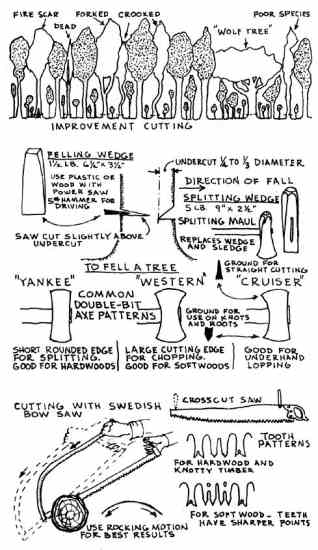
Before attempting to fell a mature tree, first consider the damage that may occur to surrounding trees on its way down. Keep in mind the slope of the ground, the lean of the tree, wind movement, and final positioning for removal from the woods. An undercut is first made to guide the direction of fall. On a conifer the undercut chunk should be about one-fourth the diameter of the stump; a hardwood tree should be cut one-third the diameter. The main cut is made on the opposite side of the undercut, slightly above its base.
Fuelwood is one of the neat cottage industry by-products of a well-managed woodland. From thinnings and prunings alone, about one cord of new wood is realized per acre per year. A cord of hardwood weighs two tons (twice the weight of soft wood) and, if dry, will give as much heat as 200 gallons of fuel oil or one ton of the very best anthracite coal.
Maple sugar production is practical in many homestead woodlands throughout the eastern U.S. I urge anyone interested in maple sugar to read Scott and Helen Nearing’s Maple Sugar Book. It contains everything one needs to know on the subject, as well as some beautiful and well-documented historical commentary. One of their references is quoted here . . . one which sums up the subject succinctly:
The maple grove that is planted by a young man may be enjoyed by him through more than half of an ordinary lifetime. With proper care it will perpetuate itself through a long course of years, and for aught we know (if the young growth is protected) forever. It will occupy broken grounds that could not otherwise be cultivated, and the timber, when taken out at greatest maturity, has a value which is gaining every year, aside from the annual revenue to be derived from the sap. The maple adorns and beautifies perhaps more than any other of our native forest trees … The sugar season comes at a time when farm labor is least employed, and the occupation presents amenities beyond those which any other form of farm labor can afford.
–Franklin Hough, Report on Forestry, 1884
A final word should be reserved for the most current get-rich-quick woodland production schemes . . . Christmas trees. The 1970’s Christmas tree craze reminds one of the chicken-ranch mushroom-growing enterprises of the 40’s; the fishing-worm rabbit-farm production of the 50’s; and the chinchilla-raising herb farms of the 60’s. To this day I still build fireplaces from used concrete block salvaged from nutria-raising pens constructed in 1948. Many entrepreneur homesteaders have lost life savings in these earlier schemes, but the homesteader who is “into” Christmas trees can stand to lose more than money. From my point of view he degenerates a possibly beautiful tree-growing experience for profit from a pagan ritual.
It has been calculated that 100 Christmas trees can be raised on one acre of land per year. On this basis, 600,000 acres will supply all the Christmas trees needed for the entire nation. But today, there are over 50 million acres of submarginal farmland ideally suited to Christmas tree production. A Christmas tree homesteader who invests in, sets out, and attends the seedlings (which includes annually shearing the trees to develop a thick and symmetrical foliage) can expect a $1.00 profit from each balsam fir at the end of a ten-year growing season. A loblolly pine, cut for piling, at the end of sixty years will net $50.00.
Economic advantage may hold the greatest appeal for many, but remember: windbreak, soil, and moisture-conserving objectives can only be attained with a proper form of woodland management which, incidentally, brings the greatest woodland income. Good harvesting . . . and look to your hills.
Ken Kern
Ken Kern, author of THE OWNER-BUILT HOME and THE OWNER-BUILT HOMESTEAD, is an amazing fellow and everyone interested in decentralist, back-to-the land, rational living should know of his work. Back in 1948 he began collecting information on low-cost, simple, and natural construction materials and techniques. He combed the world for ideas, tried them, and started writing about his experiments.
Eventually, Mildred Loomis started publishing Kern’s articles in THE INTERPRETER, WAY OUT and GREEN REVOLUTION. Ken has also issued a three-year series of pieces (called TECHNIC) on his own and a greenhouse-sun pit design of his has been featured in ORGANIC GARDENING.
This series of Ken Kern’s work is being taken both from OWNER-BUILT HOME and OWNER-BUILT HOMESTEAD. — MOTHER EARTH NEWS






