

When you’re known as “the Ralph Naders of the food industry,” people can get edgy about inviting you to dinner. Not long ago, a favorite aunt had us over and proudly served a loaf of “natural” bread she had bought especially for us. As it turned out, the loaf was made from chemically bleached flour colored to look like a dark whole grain, and included hydrogenated oil and artificial preservatives.
However, her mistake is quite understandable. In an age when dishwashing soap boasts real lemon juice and Jell-O contains artificial lemon flavor, it’s no wonder that words like fresh, light, and natural don’t men what our mothers always taught us.
Yet, a mass of information appears on the packages you buy, some of it federally mandated, some voluntarily supplied. One comic noted that food labels are getting so long he saw one that said, “Continued on next package.” Learning how to read food labels can help ensure that you’re buying what you really want.
A Label You Can Rely On
Unprocessed whole foods — apples, for example — don’t need labeling. But when foods are fabricated, the government demands that the makers tell us what they’ve done. (Foods sold across state lines adhere to federal regulations; products manufactured and sold within one state are subject only to state laws.) Specifically, the following information must appear — in English, even if the product is imported — on the principal display panel (the part of the label most likely to be displayed) or on the information panel directly to its right:
1. The name of the product.
2. The variety, style, and packing medium in conjunction with the name — for example, “sliced peaches in heavy syrup.” (If you’re cutting back on sugar, you now know to move on.)
3. If a food resembles another but is not nutritionally equivalent (as defined by the FDA), the word imitation followed by the name of the food being simulated. If the food is nutritionally comparable, however, a fanciful name may be used — for example, Salad Mate for a line of cellulose-based, vitamin-and mineral-fortified, extruded “leafy greens.”
4. For some foods, the percentage of a characterizing ingredient, or the announcement that a specific ingredient is or isn’t there, or the need to add ingredients.
For example, if “Juicy Fruit Drink” in fact contains no juice and no fruit, its label has to say so. If you are expected to add meat to a boxed beef-stew mix, the manufacturer must point that out.
5. The total amount, liquid included, in the container, expressed by weight, measure, numerical count, or some combination of these. (Looked closely at those “one-pound” cans of coffee lately? Most now hold 13 ounces— for the same price.)
6. A list of ingredients.
7. The name and address of the manufacturer. If the street address is listed in the phone directory, only the city, state and zip code are required. This doesn’t always make communication easy. (Points to companies who voluntarily list their complete addresses, double points for phone numbers, triple points for an 800 number.)
Our Sample Food Label Diagram pulls all this together for you.
Ingredients Labeling
To many health-conscious consumers, the list of ingredients is the most important part of the label. And in fact, ingredient labeling, which is federally mandated, is better today than it’s ever been.
One of the most useful rules is that ingredients must appear in descending order of predominance by weight — that is, what there is most of comes first, what there is least of comes last. If your breakfast muffin lists sugar as its first ingredient, then your morning meal contains more sugar than anything else. If sugar is listed fourth, there’s proportionately less of it. Scanning the order of ingredients is one of the best ways to comparison shop. (Who’d have thought that the primary ingredient in Lemon and Pepper Seasoning would turn out to be—are you ready—salt?)
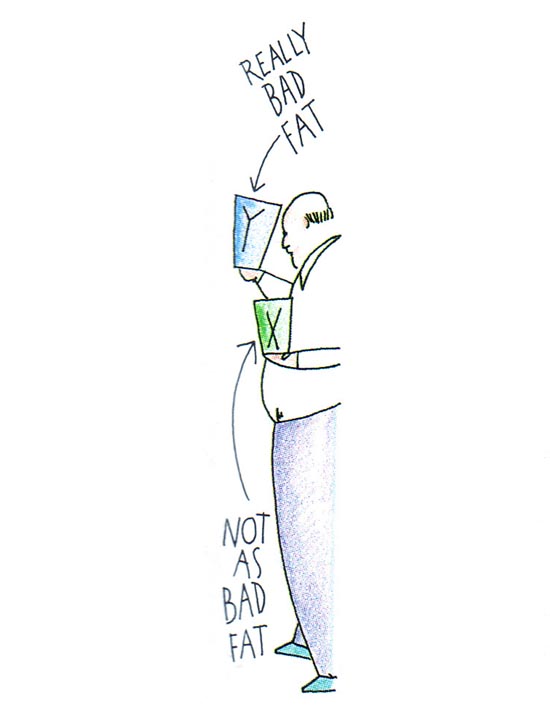
Still, there are some lamentable exceptions to the what-you-see-is-what-you-get rule. Added fat. When fat is a predominant ingredient, the specific type must be listed. But when it is less than 10% of the product, the manufacturer can list several fats that the package may (or may not) contain. For example, the label may state “oil (contains one or more of the following: soybean, partially hydrogenated corn, palm or coconut).” This leaves the consumer in the dark about whether the oil is highly saturated (palm, coconut), technologically modified (hydrogenated) or polyunsaturated (soy, etc.).
Manufacturers argue that, since the oil they select varies with availability and market price, printing separate labels would be too expensive. But considering the current emphasis on reducing saturated fat in the American diet, the defense seems inadequate. (We suggest that all the choices be printed on the label and then punched like a train ticket to indicate which type a particular batch actually contains.)
Flavorings. By a fairly complex formula, the manufacturer must reveal the general source of the product’s flavor. If the flavor is imparted by a food, no qualifiers are needed (“Blueberry Muffins”). If the flavor is usually imparted by a food, but the manufacturer has chosen to use a natural flavoring instead — for example, a distillate or extract of blueberries — the word flavored must be inserted in the name (“Blueberry Flavored Muffins”). The word natural may be included if the manufacturer desires. If any artificial flavor is used, the name must be accompanied by the word artificial or artificially flavored (“Artificially Flavored Blueberry Muffins”).
On the other hand, the list of ingredients need only mention “spices” or “flavorings” in general terms; what they are doesn’t have to be specified. For people sensitive to specific seasonings, shopping can be extremely frustrating.
Colorings. The label must state when coloring is added, but only FD & C Yellow #5 must be mentioned specifically, because of a high incidence of allergic reactions. Other colorings don’t have to be specified (even though studies suggest their safety varies widely).
Thanks to a powerful lobby, dairy products are exempt from the regulation about colorings. Processors may add natural or artificial coloring to cheese, ice cream, and butter without troubling the consumer with that information.
Incidental additives. “Ingredients within ingredients” don’t always have to be listed. For example, a product that uses a sweetened fruit as one of its ingredients may not list sugar on its label. Other incidentals include fumigants applied during storage, defoaming and clarifying agents used in production, fluoride and chlorine in water, and much more. The theory is that these additives need not be listed because they’re present in “insignificant” amounts or aren’t “functional.” But many consumerists suspect that processors are sneaking additives in through this loophole.
Nutrition Labeling
Nutrition labeling is mandatory when a processor makes a nutritional or dietary claim on the label or in advertising, when a food is fortified with a nutrient, or when the food is intended for children under four (baby and junior foods). Otherwise, nutrition information is voluntary.
When a product is meant to be further prepared at home (for example, a cake mix) or eaten in conjunction with another food (ready-to-eat cereal), a second set of figures can be presented to show the nutrient content after preparation.
For people interested in monitoring certain nutrients — fat, protein, sodium, etc. — nutrition labeling is invaluable. However, the system can be misleading. The fact that only certain select nutrients are included often gives the illusion that a processed product is comparable (or even superior) to the real thing. The law ignores the fact that a whole food may contain trace minerals, fiber, and as yet unknown components that don’t appear on a nutrition label. In fact, the current format gives fabricated foods a competitive edge if they’re highly fortified or enriched.
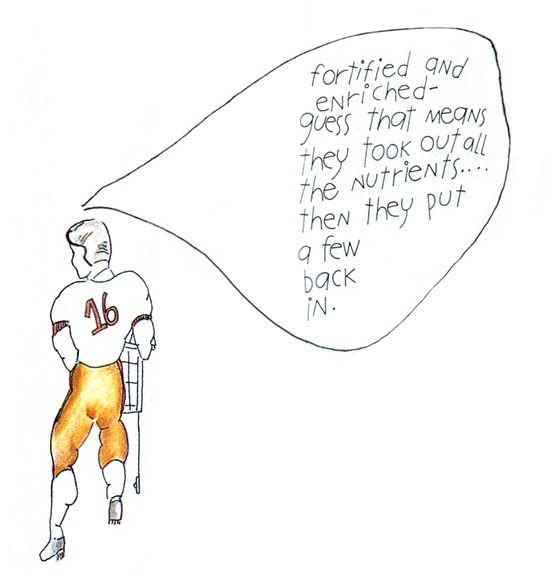
(A fortified food has been pumped full of nutrients it doesn’t possess in its natural state; adding calcium to orange juice makes it a fortified drink. Enriched foods have nutrients added to replace losses during processing. For example, white flour may be enriched with three B vitamins and iron to help compensate for the 22 nutrients lost when the bran and germ are milled off.)
Learning the Language
Perhaps the trickiest pan of reading a food label is deciphering the words it contains. Some have specific definitions established by the FDA, but others derive their meaning solely from the creative imaginations of advertising copywriters. In several areas that consumers care about, there is a mishmash of meaningful and meaningless terminology. It pays to know the difference.
Calories. A number of terms provide specific information for the calorie-conscious.
Foods labeled low-calorie contain no more than 40 calories per serving. A reduced-calorie product must be at least one-third lower in calories than a similar food in which the calories have not been reduced, and it must not be nutritionally inferior to the unmodified version. If the term diet appears with no further explanation, it must meet one of the two previous criteria.
Sugar. If a food is sugar-free, then it contains no added nutritive sweetener—no sucrose (table sugar), malt sugar, fructose, corn syrup, honey, molasses, maple syrup, or concentrated fruit sweetener. (If a food labeled sugar-free is neither low- nor reduced-calorie, it’s supposed to make that clear, perhaps with “intended to reduce tooth decay” or “not a reduced-calorie food.”)
On the other hand, no sugar added is not a federally regulated phrase and usually refers to sucrose alone; you may be getting ample amounts of sugar in its other forms. For example, one barbecue sauce that promises “No sugar!” lists corn syrup as its second ingredient.
Salt. Any reference to salt or sodium on the label mandates quantitative sodium labeling. In addition, some terms are federally defined. A low-sodium product has 140 milligrams or less per serving; very low-sodium , 35 mg or less; sodium- or salt-free, less than five. For a product to claim reduced sodium, it must contain 75% less than its regular version or than a competitor’s.
Watch out for unsalted and no salt added; they don’t necessarily mean sodium-free. Why? Because these terms don’t encompass other sodium-based compounds that may have been added—for example, monosodium glutamate (MSG), sodium benzoate and sodium propionate. (Watch for the word sodium.)
Cholesterol and fat. We’ve all seen “No cholesterol!” emblazoned across bottles of cooking oil, as if this one manufacturer had finally succeeded in removing it; technology marches on. While the claim is true, it’s not exactly news. No vegetable product contains cholesterol, which is manufactured in the bodies of animals (including ours).
Furthermore, what the “no cholesterol” claims don’t point out is that saturated fat is even more likely to raise your blood cholesterol level than eating cholesterol itself. So a product that promises no cholesterol but is full of saturated fat is no nutritional bargain.
“All-vegetable shortening!” Good, you think. No cholesterol, no saturated fat. Right the first time, maybe not the second. Vegetable oils such as coconut and palm kernel are highly saturated. And even if the manufacturer started out with an unsaturated oil, if he “hydrogenated” it — added hydrogen atoms so it would remain solid at room temperature — then he turned it into a saturated fat.
So much for language that’s at least partially meaningful. In the advertisers’ lexicon there are other terms that have no reliable meaning whatsoever. They suggest, entice, and sometimes mislead.
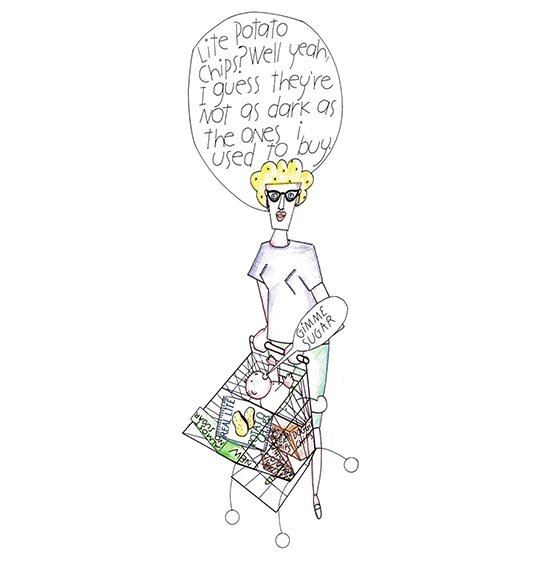
Light. Sara Lee, the dieter’s nemesis, has come out with Light Classics French Cheesecake. Before you dig in, the bad news is that it has more calories than the original version.
How can this happen? The words light and lite are unregulated in all but meat and poultry products, food companies can use them any way they want to. Some “light” products are reduced in calories — which is what we all expect — but they’re just as likely to be lighter in color (as in “light” oil) or taste, or lower in other ingredients (salt, sugar, breading, alcohol). By “light” cheesecake, Sara Lee was referring to texture.
Natural. Since the term has no official definition, almost anything goes. At one time it was an indication of quality; now it’s a warning flag.
“Natural” cheeses can contain artificial coloring and preservatives; “natural” ice creams are not only loaded with sugar but often include vegetable gums and mono- and diglycerides; “natural” breads may be made of refined white flour and fortified with synthetic nutrients; some “natural” cereals are more highly sweetened than processed ones; foods that are “naturally flavored” may also contain artificial flavoring, preservatives, thickeners, and colorants. Even margarine, a totally fabricated product, has been labeled “natural” by some manufacturers.
In fairness to the consumer, “natural” should be limited to a product that could be duplicated in a typical well-equipped home kitchen.
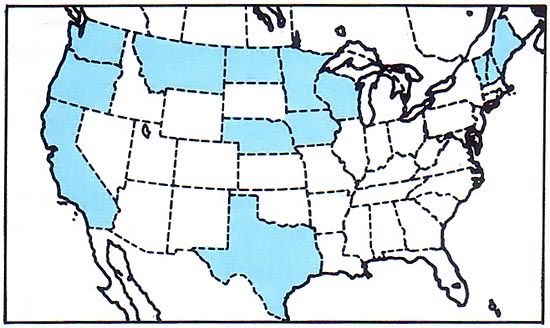
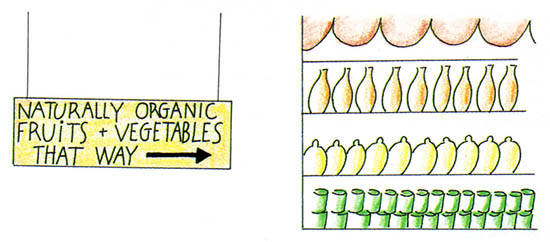
Organic. The federal government places no restrictions on this term when applied to produce. So consumers who buy food labeled “organic” in the belief that it has been raised without pesticides, synthetic fertilizers, or other related chemicals may or may not be getting what they paid for. (Thirteen states do have legal definitions of the term.)
The USDA does not permit the word on meat or poultry labels. If the animals were raised on feed and water free of pesticides and chemical contaminants and were treated with drugs only for illness, the meat may be labeled “naturally grown.” But the USDA also allows “natural” to describe meat and poultry products that contain no artificial flavoring, coloring, and preservatives and are only minimally processed. Many consumers mistakenly interpret this to mean no hormones, antibiotics, or feed additives.
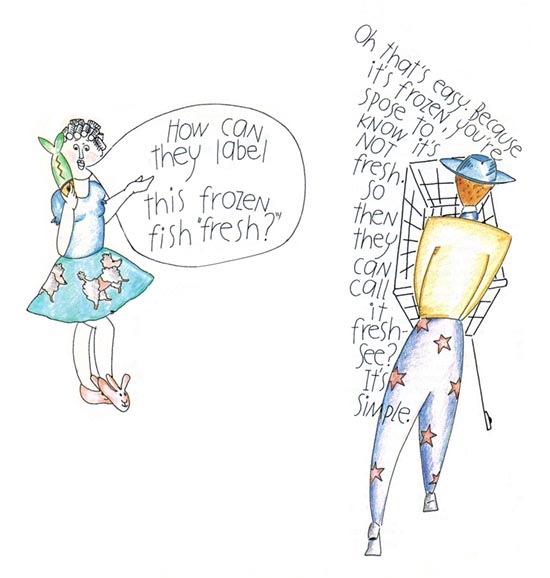
Fresh. You may begin to wonder about the term when it’s applied to canned clam chowder, vacuum-packed salad with a two-month shelf life, and aseptically boxed milk. The USDA ruled recently that “fresh” can apply to refrigerated processed foods that contain previously cured, canned, or frozen components, and can even be used in the names of cured, canned, or frozen products— “as long as it remains clear to the purchaser that the product is not fresh.”
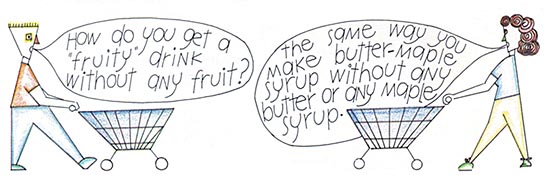
The “y“ words. Watch out for foods that are “fruity,” “chocolaty,” “buttery” or anything else ending in “y.” According to the dictionary, the suffix means “something like.” A “fruity” drink need contain no fruit.
Flavor. When the word follows a specific source, it means the flavor, not the source, was added. “Cherry flavor” tells you that the product has the flavor of cherries (synthetic or real), not cherries in the flesh.
Tastes like. When Brand X “tastes like” real peanut butter, don’t assume it has any.
Creme. The real stuff is spelled “cream.” Creme is usually made from corn syrup, gelatin, hydrogenated shortening, milk derivatives, mono- and diglycerides, artificial flavoring, and more. And don’t get your hopes up; it’s no lower in fat.
At our house, we maintain a museum of champion food labels. Our favorite is Roddenbery’s Butter-Maple Syrup. Guess what, folks? No butter. No maple syrup.
Nikki and David Goldbeck are the authors of six books on food, most recently The Goldbeck’s Guide to Good Food (New American Library, 1987).






