


What’s New
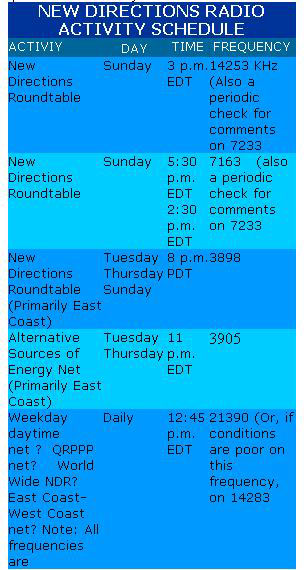
The Sunday afternoon New Directions Roundtable sessions continue, but now start an hour earlier than indicated in the January/February 1974 issue of MOTHER EARTH NEWS (for the new starting times, see chart that accompanies this article). Recent ham radio events of particular interest have included one in which Jim Stamper discussed his project to help poor people of southern Virginia through this winter’s energy crunch and another in which North Country Anvil’s Jack Miller returned for a talk about the media. Other highlights of the late winter: a women’s session; Wes Thomas (W21KQ), editor of Synergy Access, talking about networking; and raps on organic gardening.
Randy Brink (WA7BKR) and Bob Hickerson (WA6RRR) – two fellows who’ve been communicating seriously via ham radio for some time now – recently started a West Coast section of the Roundtable which meets Tuesday, Thursday and Sunday nights at 8 p.m. PDT on 3898 kHz. Randy and Bob are very stimulating people – into doing, not just talking – and we’re fortunate that they’ve made this considerable commitment of time and energy.
A group of us who are interested in alternative sources of energy started an ASE Net in late January. Sessions begin at 11 p.m. EDT on 3905 kHz. Although primary coverage is the eastern half of the U.S., the actual range depends on current propagation conditions, so don’t hesitate to give these meetings a try even if you live in the West. We’re hoping to have a fully national communication network.
Among the letters we’ve received recently was one from Godfrey Boyle (G30WC), who edits Undercurrents, a London-based alternative technology magazine. He wrote, “I’ve often been mind boggled by the fantastic possibilities of a planet-wide network of relatively self-sufficient alternative technology-type communities, linked to one another by low-cost, low-energy shortwave radio. The synergy a system like that could create would be tremendous!” Godfrey has no equipment at the moment – having gotten “bored with inane discussions about frequencies, DX, transmitters, etc. (ZZZZZZ . . . Z!)” – but we hope he’ll be back on the air soon. Getting these international communication links forged is one reason for the daily monitoring of 21.390 in the 15-meter amateur band. (See the schedule for a summary of all current on-the-air activities at the time – late January – this was written.)
Advice on License Exams
Jim Stamper just passed his General and Advanced tests in Washington, D.C. and has a few comments on the current procedure. “Have Form 610 filled out in advance,” he says, “arrive early and bring exactly $9.00 . . . the FCC staff doesn’t make change.” The test Jim took was given in an office – with all the usual distractions – and he suggests that you be able to copy solidly the 15 wpm transmissions from W1AW to counteract the anxiety of the scene. You’re no longer allowed (as I was) to go back and fill in blank spaces at the end of the code test. There were no “trick” questions on the General Class theory exam, and Jim thinks that portion of the test should present no problems if you can handle the questions in the License Manual.
Communication Reliability
In a recent letter, Roger Jacobsen (a former ham who’s getting involved again) ventured a guess that some people will be turned off by trying to communicate through the periods of interference common on the long distance”HF” bands. Also, Roger himself is bothered by the distortion of natural voice quality which commonly occurs in Roundtable operation when all SSB signals are not tuned exactly right.
Although hams put up with these drawbacks as part of the game, Roger is afraid that many newcomers won’t. Accordingly, he’s seeking to join others in developing some local and regional New Directions activities on the shorter distance VHF and UHF frequencies where limited range is compensated for by greater freedom from interference and more natural sounding voices.
It’s a big task to explore the communication reliability problem thoroughly, so I’ll just make a few general comments here. Convinced ham that I am, I have to admit that the U.S. telephone service – with all its faults – is nevertheless a pretty tough act to follow from the standpoint of consistent, interference free service. Just as we have become used to packaged food and fast transportation on demand, we’ve also come to expect instant, high reliability communication. (The current system’s stability is, of course, somewhat tenuous because it depends on a healthy industrial economy, the maintenance of which is out of the user’s control.) Those who grow their own food and walk or ride bicycles have opted for a measure of personal independence in these areas of their lives. The same can be said of those who’ve picked up amateur radio as a serious communication tool. The successful ham – like the successful gardener – learns to work with the rhythms and laws of nature. And his endeavor is rewarded with a similar kind of satisfaction because there’s enough randomness and possibility of failure in both activities to make each an adventure. (That’s more than you can say for taking a TV dinner from the freezer or dialing a telephone number.)
In short, those who expect ham radio to be another Ma Bell will be disappointed. Others, however – those who can muster a bit of wonder that signals from a rig they put together themselves can travel with the speed of light to another human a thousand miles away – won’t be put off by the technical problems. The only way to decide whether ham radio is for you is to spend a few hours actually trying it. That’s another good reason why you should track down a ham – or ham club – in your area.
Selecting Ham Radio Equipment
Once you’ve decided to obtain your license and get into the long-distance shortwave end of ham radio, you’ll eventually face the problem of outfitting yourself to transmit and receive. In years past, most hams used separate instruments for these purposes. The current trend – and the lowest-cost approach – is to a single “transceiver” that combines both functions. Such a unit permits single sideband voice and Morse code transmission, including reduced power code operation for Novice use. It can also be used (usually at reduced power levels) with slow scan TV and radio teletype attachments. Their variable frequency oscillators allow you to transmit on any specific frequency within a given band. You can acquire a transceiver by three basic routes and the first possibility – of course – is the purchase of commercially built equipment from a dealer or directly from a manufacturer. This requires the greatest cash outlay and is devoid of any pride of construction, but also involves the minimum technical hassle . . . especially since any item that doesn’t work when you get it is repaired by the seller under a warranty.
At the other extreme, you can gather up individual parts and build a transceiver from scratch according to information in a magazine article or from The Radio Amateur’s Handbook. I recommend this approach only for those with enough background in electronics to feel fairly confident of success. You need to know enough to trouble-shoot the gear, and you must also have the appropriate tools (including those required to cut holes in a metal chassis). Other negatives include the high cost of components when bought in small quantities and the very low resale value of home-brew equipment.
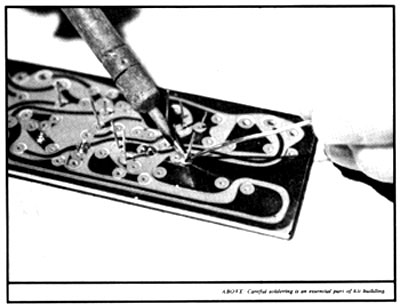
The third option is to purchase and build a kit (most likely one of the excellent Heathkits, since heath is just about the only company still in this business). This approach should be seriously considered if you have any familiarity at all with basic hand tools, can discipline yourself to follow directions meticulously and have more time than cash. A kit contains the ready-made parts for a complete unit, unassembled. All the holes in the metal are pre-punched and the panels are painted and lettered. The printed circuit board is provided ready for component insertion and soldering. (Heathkits contain wire and solder, but not tools.)
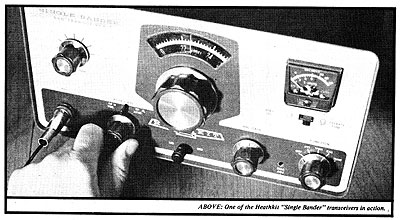
Jim Stamper just built Heath’s most complex transceiver – the SB 102 – and gives and excellent rundown of the project’s pros and cons. He’s a good judge, since his varied background includes several years as an electronics engineer and a number of previous kit-building experiences. To Jim’s observations I’d like to ass those of my father, Don Macdonald, who built the Single Bander in the above photo. Actual construction to 28 hours, plus another five or so for checkout and 12 more to build the HP-23B power supply and the connecting cable. Dad found the directions excellent, and underlines Jim’s admonition to go slowly, check and recheck.
I should also mention that my 14-year-old daughter Beth built a code oscillator kit with no previous experience of such projects and no knowledge of hand tools. She had some problems with the latter, particularly when tightening screws and nuts sufficiently and when making good solder connections. She also found the directions confusing in places (apparently because of first-time contact with unfamiliar words and procedures involving tools and hardware).
Which Transceiver?
Your choice of gear is one of those decisions that others can advise you on but can’t make for you. Think about your communication goals – now and over the next few years – when you pick your equipment. Here are some possibilities:
The Five-Band Transceiver: Most amateurs use equipment that covers all five ham bands between 80 and 10 meters (3.5 to 29.7 megaherts). This is certainly the route to maximum flexibility, since schedules are are then possible on any band that looks promising from the propagation standpoint.
The lowest-cost five-band transceiver kit available is the Heathkit HW-101. The copleted instrument requires and external power supply, for which Heath offers two build-it-yourself alternatives: the HP-23B which connects to the regular AC powerline, and the HP-13B which connects to a 12-volt storage battery of the type used in cars, trucks and some wind generator systems. Current prices for the kits are $259.95 for the basic HW-101, $51.95 for the AC power supply and $69.95 for the 12-volt DC unit. The Heath HW-101 transceiver is rated at 180 watts final stage input, and an output of 100 watts on all bands (except 10 meters, where output is 80 watts). The same company’s SB-102 model, at $385, has a few slightly better electrical specifications but runs the same power and covers the same bands as the HW-101. It’s probably not worth the extra cost to those with very limited cash.
There are, of course, many other brands of ready-built five-band transceivers on the market. If you’re considering a particular unit, ask around among the local hams you’ve been able to track down for info on its quality. I might mention that equipment made by the R.L. Drake Company of Miamisburg, Ohio has a good reputation for reliability and performance . . . and the factory is said to be very prompt in shipping replacement parts should trouble occur.
Most amateur equipment, by the way, still employs vaccum tubes instead of solid-state components. Part of the reason is the relatively high cost of transistors capable of putting out large amounts of frequency energy. Vaccum-tube circuits are somewhat wasteful of power, however, and the tubes themselves are less reliable than transistors in well-designed circuits.
Because of these problems, the five-band transceivers made by Ten-Tec Inc. of Sevierville, Tennesee are of particular interest to ecologically-minded folks. This firm’s Argonaut is a low-power unit that runs about 5 watts input and 2 watts output. It operates directly from a 12-volt DC source, and at $288 is even less expensive than the HW-101 plus power supply. The catch with this product is the power level. While many experienced amateurs enjoy lower-power (“QRP”) operation, Ten-Tec reports that newcomers tend to get frustrated because their relatively weak transmission all too often get overwhelmed by stronger signals from other stations on today’s crowded ham bands. Several Argonaut owners have tried the Sunday Roundtable sessions on 20 meters and have found the weekend interference levels too high to overcome.
One solution is to add a Ten-Tec Model 405 linear amplifier, which is priced at $149 and is also powered directly from 12 volts DC. This device raises the power of the Argonaut to 100 watts input/50 watts output. Or you may want to invest in one of Ten-Tec’s two new higher-powered transceivers: The Triton I (rated at 100 watts input and priced at $519) and the Triton II (200 watts input, $606).
Even if you have AC current available, incidentally, a 12-volt car or motorcycle battery and “trickle charger” is a good approach to the powering of a rig of this type . . . because the fully charged battery is always there to provide communication if the AC source should fail. The Argonaut – without power amplifier – can even be run from a 12-volt lantern battery and has found a home in more than one backpack.
The Single-Band Transceiver: Let’s assume for a moment that your money supply won’t stretch to a five-band rig . . . and that your communication needs don’t require all those bands anyhow. A possibility for you is the Heathkit Single Bander series, which contains three models, each covering portions of a single phone band. The HW-12A covers 3.8 to 4.0 MHz in the 75 meter band; the HW22A, the general Class phone portion of 40 meters (7.2 to 7.3 MHz); and the HW-23A, 14.2 to 14.3 MHzin the 20 meter band. The price of each is an amazingly low $112.50 plus power supply cost (these units use the same Heath power supplies as the HW-101 and SB-102).
The final stage input power of the Single-Bander is 200 watts, but output power is not rated and tests indicate that the efficiency is somewhat lower than five-band transceivers. Another drawback is that these models have o provisions for code transmission, so they can’t be used for Novice Class operation. Nevertheless, they still have their advantages. The 74-meter units would be ideal to tie together a group of intentional communities located within two of three hundred miles of one another. Or such equipment would suit an individual who has moved from a particular area but would still like to keep in touch with friends there.
The choice of which Single Bander to purchase depends on the distance to be covered and on the time of day when communication would normally be attempted. (See my first article in the November/December 1973 issue of MOTHER EARTH NEWS for a rough guide . . . or better yet, check CQ magazine’s “Propagation” column.)
Novice Rigs: Heath offers two transceivers for code-only (CW) operation. The HW-16 kit, priced at $99.95 has a built-in 120-volt AC power supply and an adjustable power input of 50 to 90 watts. This model offers variable receiver tuning of the code portions of the 80- 40- and 15-meter bands but “crystal control” of the transmit frequency. This means that you must purchase a $3.00 to $4.00 crystal for each specific frequency you want to use. The other kit – the H7 – sells for $69.95. This is a low-power (2 to 3 watt) code-only transceiver which covers the 40- 20- and 15-meter bands. Since it measures only 4 1/4 by 9 1/4 by 8 1/2 inches and operates from 12 volts CS, it too has backpack possibilities. The low power capability , however, could be discouraging to the Novice, and the receiver is less sensitive than those of the other instruments I’ve mentioned.
You won’t be a beginner forever, of course, and local hams are a good potential source of “temporary” gear to get you through this period. Most obsolete AM phone equipment is quite usable for code operation in the Novice bands, and a lot of such gear is still around in basements and attics.






