

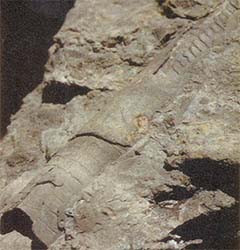
I’m the sort of person who seldom leaves a stone unturned … because I’ve found that rocks contain a great deal of
history as well as profit potential in the form of valuable
fossils. Indeed, fossil hunting is my passion.
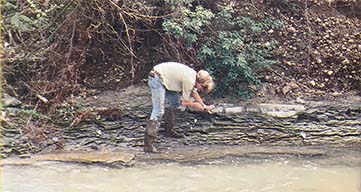
In the creek bed near my house, for example, I’ve
discovered sandwiched between layers of gray shale hundreds
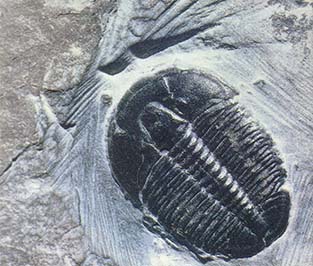
of specimens of a certain species of trilobite (Ampyxina bellatula). Many of the preserved
creatures now grace shelves in my home … and I’ve sold
my extras to dealers, for $5.00 each!
What to Look For
Fossils can be the petrified remains or impressions of
entire animals or of their bony parts, skin, feathers, or
tracks … in short, the term is used to describe almost
all bits of evidence that indicate the presence or passing
of creatures long ago. Among the most interesting (and most
valuable to collectors and museums) of such preserved
beasts are the trilobites, which ruled the oceans some 500
million years back, and ranged in size from less than an
inch in length to 18 inches or more. Though such life forms
haven’t been around for about 230 million years, their
fossilized remains are commonly found all over the country
… often exquisitely preserved and showing all their
original detail.
Trilobites are not, of course, the only fossil “game in
town.” A local rock shop owner pays me $4.00 each for
preserved segments of a straight cephalopod a shelled
forefather of the squid and octopus that lived in Missouri
some 400 million years ago. Another large and perfect
cephalopod specimen (which is worth several hundred
dollars) takes up three feet of floor space in my study.
Where to Look
Fossils can be found almost everywhere. Each hillside,
quarry, road cut, outcrop, and stream bed is a potential
“mine.” Even the rocks in your field or garden may contain
some of the time travelers. Certainly, though, the more you
know about fossils and the geological formations in which
they’re likely to be located, the more specimens you’ll be
able to find.
The best “hunting ground” is sedimentary rock that was laid
down under a prehistoric body of water and is
characteristically (and usually recognizably) layered. Many
of the organisms that lived in the lake, pond, or sea will
be preserved within the solidified sediment …
particularly if they had hard parts such as shells,
carapaces, or bones. The creatures will have “survived” the
millions of years since their deaths as impressions (molds
or casts), or will perhaps have been partially or wholly
replaced by dissolved minerals. Since organic matter often
disintegrates very slowly, such replacement can sometimes
create an exact replica in stone … even down to the
animal or plant’s cellular level. Occasionally (though
rarely), some of the ancient life form’s original organic
matter may survive as well.
The fortunate fossil forager will find his specimens
“weathered out” on the exterior of rocks. More often,
however, it will be necessary to split the strata in your
search (but there’s certainly no need to dig ugly holes in
the landscape in order to make finds). Securely embedded
specimens should, of course, be extracted with care, but
since erosion would eventually wear away the unprotected
mineralized organisms anyway, prospective hunters shouldn’t
feel guilty about collecting and preserving them, if they
do the job properly and with a minimum of disruption.
Remember, too, that fossils are usually near (if not
within) what was once the creatures’ natural habitat,
and–since ecological communities always support a variety
of life–the discovery of one preserved organism will
suggest the presence of others.
You may find the identification of different species
difficult at first, but the search for knowledge in this
area is actually a great part of the pleasure of collecting
fossils. To educate yourself, however, it’s necessary to
keep an exact record of where and at what depth each
individual specimen is found. (See the accompanying sidebar
for identification sources and markets for your finds.)
Top Treasures
The following are the most popular and therefore the most
valuable fossils among the commonly found varieties.
TRILOBITES look like fat insects and are commonly one to
four inches in length. There are variations on the basic
model, but if you have a clear mental picture of one type
of trilobite, you’ll recognize them all. The heads
(cephalons), segmented middles (thoraxes), and tails
(pygidia) are often found separately, since the creatures
shed their shells to accommodate growth just as do
crustaceans (crabs and lobsters, etc.) today. Usually,
however, only whole specimens are prized … and species,
size, rarity, and the state of preservation will dictate a
fossil’s value. (The “take” can be as little as the $3.00
to $5.00 that my relatively common Ampyxina will
bring … or as much as the $300 recently offered a
friend of mine for a perfect four-inch Isotelus. )
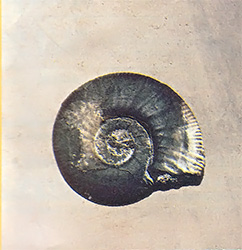
CEPHALOPODS have large, cylindrical shells that
are either straight or coiled. (In the latter types, the
coil is flat and is, therefore, distinguishable from those
of the more common snail fossils … which tend to be
somewhat spiral.) Cephalopods (a group which includes
ammonites, nautiloids, and straight cephalopods) often have
delicately ornate markings and ridges, and are among the
most spectacular of ancient creatures. Their shells can
range from a few inches to several feet in diameter or
length. In life, these members of the mollusk family
sported tentacles. They reached their zenith at the time of
the dinosaurs, and very few species still survive.
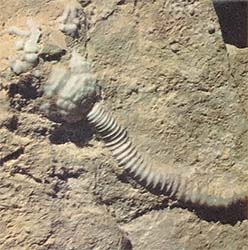
CRINOIDS are flower-like sea animals that have
stems, heads, and arms. Stem sections are extremely common
and virtually valueless to the collector … but an
intact, whole crinoid (I found one last week in a road-cut)
will bring $80 or more. Occasionally, when found on a slab
in groups, they are all but priceless.
SHELLS of various kinds are very common and, as a
result, are difficult to sell. Some dealers will pay a
little for groups of 100 or more, but the effort of
collecting so many separate specimens is hardly worth the
return. Such mundane fossils are, however, indicators of
ancient marine communities which may also have supported
trilobites, cephalopods, and crinoids … and some of the
larger brachiopod shells are worth adding to your own
collection simply for their beauty.
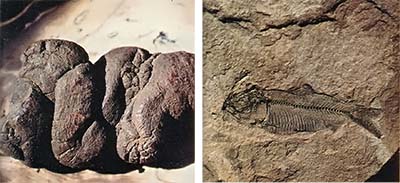
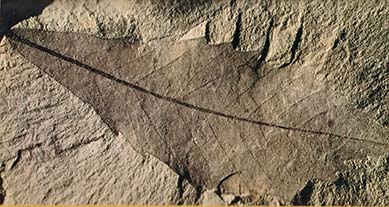
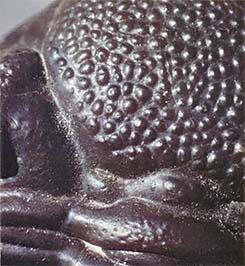
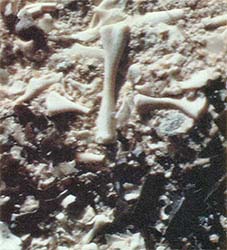
Other fossils which are common only in specific locations
around the country may include fish skeletons, insects,
animal and bird tracks, leaves, petrified wood, sharks’
teeth … and even reptile remains, although collecting
the latter “finds” is a process best left to professional
paleontologists (such valuable relics are too easily
damaged to be safely handled by amateurs).
From Pastime to Avocation
The more exotic fossils, of course, are especially
difficult to locate, but they’re around. As ( and
if) you progress from the casual overturning of rocks to a
strong desire for more specific knowledge, your state’s
geological survey can provide maps and data on the age and
identification of the native sedimentary strata. (Some such
agencies will even offer information on actual collecting
areas and the types of fossils likely to be found there.
Local rock shops (they’ll be listed in the Yellow Pages)
are also good sources of information, as are the somewhat
rare experienced collectors who don’t mind revealing their
own hunting sites. Such people will often buy specimens,
too, as well as aid you in learning identification and
methods of cleaning and matrix (or surrounding rock)
removal. (Though most of the fossils you’ll find will be
sufficiently exposed by natural erosion, the techniques for
any necessary cleaning are best learned locally, because
rock types and appropriate cleansing methods vary from
place to place.)
As a pricing guide, I use the Geological Enterprises
catalog. For fossils that will be
resold, I quote half the price listed for similar
specimens. When selling to collectors, though, I try–not
always successfully–to get the full price.
Before embarking on any substantial hunting expedition,
it’s worth your while to check local laws. A few states
prohibit fossil collecting on some if not all public
property. (Utah, for example, does so.) It’s always a good
idea, too, to ask permission from local landowners before
trespassing on their turf.
Then, as you gather your rock-bound treasures, keep in mind
that fossil hunting by careful and aware amateur
paleontologists has made significant contributions to our
total knowledge of archaic life forms and the geological
history which they record. On a more personal level, my
profitable hobby adds a whole new perspective to my life
… because each fossil that I find gives me access to a
moment of almost inconceivable antiquity, which in turn
leads to thoughts about time, space, the universe, and my
own peculiar place in the scheme of things. I know of no
other way of being quite so overwhelmed.
Resources for Fossil Hunters
IDENTIFICATION SOURCES
Index Fossils of North America by Harvey W. Shimer
and Robert R. Shrock (M.I.T. Press, $45). This ultimate
reference is available in most libraries.
Local natural history and geological museums.
University geology departments.
Rock shops (locally listed in the Yellow Pages under “Rocks
for Collectors,” and nationally listed in the annual April
issue of The Lapidary Journal, which can be
purchased in most rock shops or found in your library).
Your state’s geological surveys.
Local collectors.
DEALERS
Ward’s Natural Science Establishment
A source for new dealers, as well as rock shops around the
country, is (again) the annual April issue of The
Lapidary Journal. The classified lists in this
magazine are comprehensive and well organized.
Additional markets for your prehistoric wares may be found
by visiting rock dealers, collectors, museum shops, rock
shows … and some department stores. Another
approach you could take for peddling the fossil finds would
be to run an ad in The Lapidary Journal or another similar
magazine. And ultimately, of course, you could even set up
your own shop.
EDITOR’S NOTE: An excellent beginner’s book on rock
identification, tools, map study, and fossil
protection–which also lists the best fossil areas state by
state–is The Weekend Fossil Hunter by Jerry C. LaPlante,
Drake Publishers, Inc.






