The Challenge of a Changing World
Habitat management generally assumes that, absent major disturbances, the habitat within an area will persist more or less unchanged once the area is protected or managed or the habitat restored. Although successional processes may move the habitat away from (or toward) a desired state, these changes are generally thought to be gradual and at least to some degree predictable.
Spatial variation may create heterogeneity in successional states at multiple scales, but this is often viewed as variation about a long-term equilibrium, as envisioned in shifting-mosaic steady-state concepts of succession (Borman and Likens 1979; Turner et al. 1993). Of course, ecologists and managers recognize that environments vary over time in ways unrelated to ecological succession; neither still believes in a strict equilibrium view of nature. The expectation that such variation occurs around a stable, long-term mean, however, is encapsulated in the concepts of stationarity (in aquatic environments) or historical range of variation (in terrestrial systems). Both concepts have been discredited (Milly et al. 2008; Wiens et al. 2012); even the average conditions are not stable and unvarying over any time scale relevant to conservation or management.
Consequently, many of the factors determining “habitat” vary over multiple scales in time and space, burdening habitat management with cascading uncertainties. Unpredictable extreme events such as hurricanes and floods (Dale et al. 1998; CCSP 2008) only add to the uncertainty.
This is the current situation. While the future is by definition uncertain, the changes now underway are sure to create additional uncertainty in habitat-based management and conservation by altering not only the environmental context of habitats but the very nature of the habitats that people wish to manage, whatever the targets. Changes in global climate are projected to have profound effects on regional and local precipitation, temperature regimes, and the frequency and magnitude of extreme events. Changes in land use, driven by the combination of climate change, local and global economic forces, and changing societal demands for resources and commodities, will alter landscapes over multiple scales.
In some cases, ecological responses to these changes may be gradual, as species expand, contract, or shift distributions. Species-distribution modeling for a variety of taxa (e.g., Iverson et al. 2008; Lawler et al. 2009; Stralberg et al. 2009) has shown how extensive these distributional changes may be. The effects will differ among species, disrupting the composition of local communities and the trophic webs of ecosystems. In other cases, the changes may be sudden, as systems are pushed beyond thresholds of resilience or tolerance to drought, temperature, disturbance, or other factors.
Such changes have already occurred, for example, in the shift from shrub dominance to grass dominance in shrub steppe ecosystems (West and Hassan 1985) or from grassland to mesquite (Prosopis glandulosa) shrubland in the Chihuahuan Desert (Buffington and Herbel 1965). In both situations, grazing by domestic livestock, the invasion of exotic vegetation, and/or increased fire frequency and extent have shifted the ecosystems into an alternative state, as envisioned by state- and- transition models (Bestelmeyer 2006; Bestelmeyer et al. 2011). The habitat changes are potentially irreversible.
Whether the changes are gradual or sudden, however, they will produce a continuing disassembly and reassembly of biological assemblages, resulting in novel combinations of species and “no- analog” ecosystems that neither we nor the species have seen before (Williams and Jackson 2007; Stralberg et al. 2009; Hobbs et al. 2013). Over the ecological time scales that are relevant to conservation and management, bedrock geology may not change (unless there are major tectonic events), but everything else that we associate with habitat–vegetation composition and structure; the composition of prey, predator, and competitor assemblages; food- web dynamics; and even the soil or hydrology–will change, creating new mixtures and new habitats. The new habitats, in turn, will provide opportunities for the establishment of species new to the area, some of which may further disrupt the ecological systems while diminishing prospects for other, desirable species. The novel habitats and ecosystems of the future will require novel approaches to conservation and management.
Does the uncertainty about what habitats will exist in the future mean that the age of habitat-based management and conservation is past? Not necessarily. The habitats that exist in the future will still be habitats– places in which organisms can find the essential resources to survive and reproduce, populations can persist, and ecological processes can continue to operate. They will be habitats for something; we just may not know what.
A Way Forward for Habitat Research and Management
We have discussed some of the difficulties in simplifying habitat research and management to assure that investments are justifiable while still providing what is needed to maintain habitat and prevent further loss. The array of confounding factors we have discussed is daunting. Although not all need be included in all research designs or management plans, their potential impacts on habitat assessments should be acknowledged and given careful thought, instead of falling prey to the desire for simplification. For example, once one accepts that a landscape includes places that are changing at various rates in ways that alter habitat quality for species or communities, simple management rules that place bounds on economic and recreational activities, prescribe habitat restoration practices, or detail treatments for recognized threats such as fire must be adapted to a variety of current and expected conditions. Effective management may require using complex models to project future habitat conditions in landscapes at multiple scales, based on the gradual and/or sudden changes that are expected.
Such models are always imperfect, but they may provide useful estimates of what is likely to take place in the landscape. Resource managers and conservationists are faced with an increasingly complex and demanding task. As managers pursue their larger mission, which may involve managing lands for national defense, mining, energy development, recreation, hunting and fishing, or other activities, they must also manage habitat to avoid harming species of concern. In addition, managers must work with diverse landowners with multiple interests, which requires using an array of management practices that address habitat conditions across the broader landscape. This work is messy, involving many societal and legal agendas and goals. Our current institutions (state and federal land management agencies, conservation organizations) are not generally organized to support and facilitate such approaches.
The ideal solution for protecting habitat would encompass large landscapes with multiple owners and with multiple management goals. It would affirm the importance of habitat and biodiversity conservation goals and support the use of science and modeling to establish and project habitat conditions over time and space, while applying decision support approaches (Marcot 2006; Heaton et al. 2008) to manage competing goals for the landscape. Tools in remote sensing, geographic information systems, and statistics now enable us to incorporate more of the complexity of nature into management and conservation practices.
Cooperative approaches to habitat management (e.g., Collaborative Forest Landscape Restoration Program, Title IV of the Omnibus Public Land Management Act of 2009; Bagstad et al. 2012) are also increasing. The best approach would be to combine the focused, set aside reserve approach with a cooperative approach to habitats over entire landscapes.
To conclude, we suggest several elements of an approach that may help to resolve the tension between simplification and complexity in habitat research and management. Although this is not a comprehensive list, we hope it will provide a useful starting point for identifying what we should be thinking about as we work to understand and conserve the elusive entity we call “good habitat.”
1. Acknowledge that creating a mix of dominant vegetation types across a large landscape does not by itself ensure a diversity of animals. Additional information about ecological processes and species requirements is needed to evaluate the potential of habitat to support current and future biodiversity.
2. Maintain multiple trophic levels, including desired vegetation, herbivores, and predators. As Aldo Leopold observed long ago (1949), a functioning ecosystem requires all the parts.
3. Implement management over broad areas and multiple ownerships to consider processes occurring at broader scales while also addressing the objectives of the multiple parties involved. Fuel buildup in western and Rocky Mountain forests, declining water tables in the desert southwest or the upper Columbia River basin, or the lack of early successional habitats for grassland birds in the northeastern United States are examples. Search for the shared objectives!
4. Consider how plant and animal species move across a landscape that is changing and create movement pathways. Habitat linkages need to be designed to facilitate seasonal and dispersive movements of a wide variety of species, while filtering out invasive species.
5. Consider the roles of protected areas in the context of larger complex landscapes. Use your best models to project conditions on these landscapes through time and consider how this context will influence biodiversity, species of concern, and conditions in the protected areas.
6. Use spatial modeling and statistics but don’t get bogged down in complexity and esoterica. Always keep the objectives and the degree of certainty required in mind. Greater detail and precision are not always better. Ask what is good enough to meet your objectives with acceptable scientific certainty.
7. Recognize contingencies and thresholds that define the limits to resiliency. Resiliency may depend on replacing species that have declined or disappeared with other species with the same or similar functions, which will be dependent on processes such as water flow, soil building, and trophic interactions. Active intervention may be needed if process thresholds have been crossed, so understanding the processes is, once again, the nub of the problem.
8. Learn to live with, or even embrace, uncertainty. Weigh actions in terms of the consequences of being wrong. Couch actions in the context of risk, both ecological and economic.
9. Recognize the economic limits you face and prioritize where the costs are in line with the projected long-term benefits. Benefits should be defined by the interests of multiple stakeholders.
10. And finally, use the best current climate- change and land-use-change predictions to tailor management for the next century, not just the coming few years, while you ensure that the management design includes appropriately targeted scientific monitoring to allow you to learn from management activities and adapt to this new knowledge.
Including these considerations in cost-effective research and management won’t be easy, but it will go a long way toward ensuring that “habitats” will persist into an uncertain future.
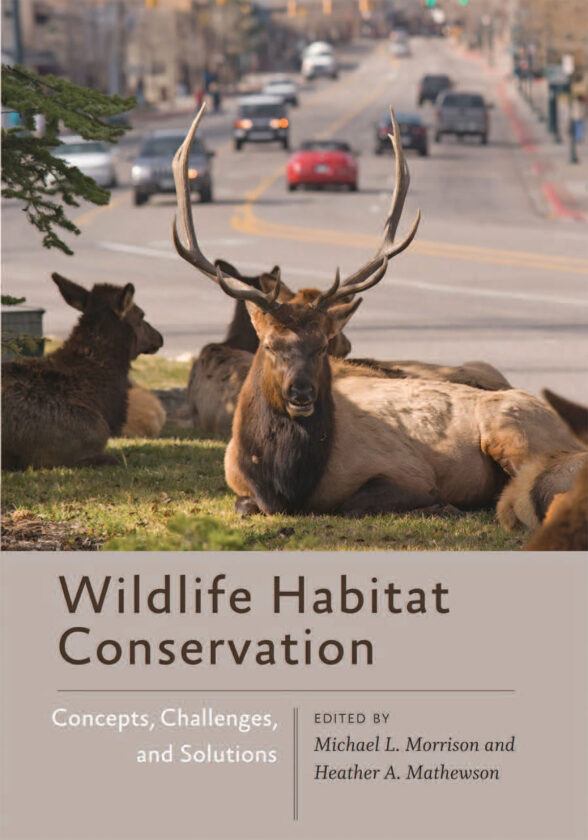
Excerpted from Wildlife Habitat Conservation. Used with permission of the publisher Johns Hopkins University Press. Copyright © 2015. For more information on their wonderful scholarly work, follow Johns Hopkins University Press on Twitter and Facebook.