

The rate of extinct species may now be as high as one
per day.
Environmental Failures: Endangered and Extinct Species
June 17, 1987, is not a date most people will remember for
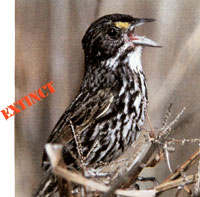
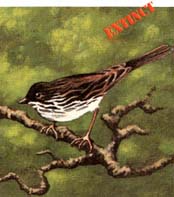
long. On that day, the last dusky seaside sparrow in the
world was found dead of old age in its cage in Florida. His
species had fallen victim to the space program, a
mosquito-abatement project, fire and Walt Disney World. It
is the latest species to be declared officially extinct. It
won’t be the last.
There’s nothing quite so final, so irrevocable, as
extinction. There’s no appeal, no rematch, no instant
replay to see who should be penalized. And driving
thousands of species from the face of the earth is as big a
crime as we could possibly commit against the future.
Besides–and ultimately more important than–the
loss of directly exploitable economic benefits when a
species becomes extinct, the continuing smooth operation of
our planet is threatened. Biologists sometimes liken the
diversity of species on earth to the numerous rivets in a
piece of equipment. The dispersion of the load through the
rivets makes the machine flexible and durable; a few of the
rivets can be lost without disaster. Once a certain number
pop out, however, massive failure occurs. The diversity of
species in the earth’s ecosystems provides this flexibility
and serves humans by stabilizing the climate, processing
wastes and returning nutrients, generating and maintaining
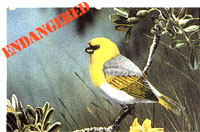
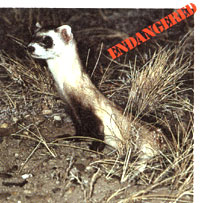
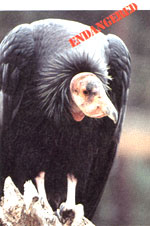
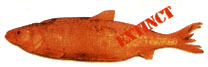
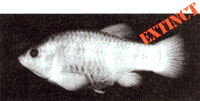
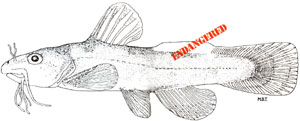
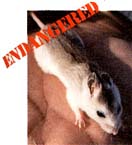
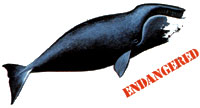
soils and controlling pests and diseases. (See the photos of endangered and extinct species in the image gallery.)
Cataloguing the Species Morgue
In the 108 issues (and 18 years) since MOTHER began her
life, several thousand species have been extinguished
worldwide. The number is unknown and unknowable. Estimates
vary widely. Norman Myers, an Englishman who has spent his
life studying the wildlife in East Africa, estimates that
we may be losing a species a day at present. That extinct species rate
could increase to a species per hour by the year 2000.
We do know some facts about extinction rates, thanks to the
Endangered Species Act of 1973. That law set up an
elaborate system for listing various species worldwide as
endangered or threatened. Species are added to the list
after a review by officials in the Fish and Wildlife
Service’s (FWS) Office of Endangered Species.
This is a fiercely political process, and greed often wins
out over biology. The presence of an endangered species can
halt any development that might threaten that species’
habitat, so there is incentive to prodevelopment types to
keep that list as short as possible. (During the first
three years of the Reagan administration, for example, only
two species were added to the lists, despite near-unanimous
agreement that there are thousands of as yet unlisted
species in need of protection.)
In addition, it’s often impossible to determine precisely
when a listed species finally does vanish: One cannot prove
a negative. A species is removed from the endangered list
only when there is scientific consensus that the species is
gone.
On rare occasions, there is good news, as when on May 5,
1986, ornithologists announced that they had positively
identified two ivory-billed woodpeckers in Cuba–birds
that had been feared extinct for two decades.
Official Body Count
Only five species have been declared officially extinct and
removed from the endangered species list since it was begun
in 1973: the Tecopa pupfish (1982), the longjaw cisco (a
Great Lakes fish, 1983), the blue pike (1983), the Santa
Barbara song sparrow (1983) and the dusky seaside sparrow.
During the same period, three were taken off the list for
the better reason: They had pulled back from the brink of
extinction. These were all birds that live on Belau
(formerly spelled Palau) in the western Pacific.
The Fish and Wildlife Service’s international list of
endangered and threatened animals, fish, amphibians, birds
and insects now numbers around a thousand. (There are at
least 200 endangered plants in the United States alone;
data aren’t good for the rest of the world.) Many of them
are teetering on the brink of extinction, and a variety of
government agencies and citizen groups are working to
rescue them before it’s too late.
What Now?
The extinction of species, as those who help the process
along like to remind us, is a natural phenomenon: “The
dinosaurs passed from the earth without meddling by humans,
didn’t they?” Yes, but the point is irrelevant. Extinction
is now happening at an unprecedented rate, and it’s
accelerating. There are economic and medical reasons to
stem the tide–as well as the ecological and moral
ones. We can do it, but not unless we increase our efforts
enormously–and do so quickly.
Tom Turner is staff writer for the Sierra Club Legal
Defense Fund in San Francisco.
Endangered Species
California condor
Gymnogyps californianus
The last
wild California condor was taken into captivity on Easter
Sunday 1987, officials having determined that the
wilderness was a threat to the species’ survival. As is the
case with many species that have already disappeared,
the condor was once common, ranging from Canada to Mexico
and from the Rocky Mountains to the Pacific. It has been
poisoned, shot, and had its lands systematically
appropriated by hu mans for their purposes. Faced with a
population of condors that has plummeted from thousands a
century ago to around 30 a decade ago, the FWS and the
National Audubon Society embarked on a “condor recovery
program” that aimed to restore the species by taking eggs,
young birds and adults from the wild and rearing them in
captivity. After 20 years, perhaps, the birds will be
returned to the wild. Estimated population: 0 wild, 28
in two zoos.
Palila
Loxioides bailleui
This Hawaiian
honeycreeper (all native Hawaiian birds are legally
endangered) is threatened by competition for food and
shelter from feral sheep and goats that have been moved
into its only range: the upper slopes of Mauna Kea on the
island of Hawaii. Some years ago, the Sierra Club Legal
Defense Fund brought a suit with palila itself as the lead
plaintiff–the first time a court had allowed such a
case to be prosecuted. The palila prevailed, and the court
ordered the government of Hawaii to remove one of the
species of goats from the birds’ habitat. Now the Legal
Defense Fund is back in court to seek removal of another
species of goat in palila country. Estimated
population: 2,000.
Black-footed ferret
Mustela nigripes
This weasel was thought
extinct until 1984, when a colony was discovered in
Wyoming. Black-footed ferrets live exclusively with prairie
dogs, their principal food. The ferrets have been nearly
exterminated by poisons aimed at the prairie dogs, by
epidemics of dog distemper, and by a renegade virus that
struck them recently. The ferrets’ lot, though still
tenuous, may be improving. Captive breeding experiments
have finally yielded survivors, and there have been
confirmed sightings in the wild. Estimated population:
35-40.
Sciota mad tom
Noturus trautmani
This small catfish from the Ohio
River may already be extinct. It was last seen in 1958 or
’59, though it was very difficult to find. This is a good
illustration of how the FWS is loath to actually declare a
species extinct. The regulations on this point read as
follows:
“Extinction: Unless all individuals of the listed species
had been previously identified and located, and were later
found to be extirpated from their previous range, a
sufficient period of time must be allowed before delisting
to indicate clearly that the species is extinct.”
Estimated population: Unknown.
Perdido Key beach mouse
Peromyscus polionotus trissyllepsis
This species
was discovered during studies of the environmental impact
of building condominium on Perdido Key off the coast of
Alabama. Biologists counted the little rascals, determined
that their population stood at around two dozen, and
immediately had the mouse added to the endangered species
list. Construction of the condos is currently under
court-ordered injunction pending the outcome of a lawsuit.
Estimated population: 24.
Bowhead whale
Balaena mysticetus
Driven to the edge of
extinction in the last century by Yankee whalers, the
bowhead is now hunted only by Inupiat Eskimos in Alaska.
While it’s still in peril, it provides an interesting
example of the hubris of Western science. In 1977,
responding to scientific estimates that the population had
plunged to between 800 and 1,200 whales, the International
Whaling Commission voted to ban all hunting of bowheads,
whether for commercial or subsistence purposes. The Eskimos
reacted sharply, saying that there were far more than 1,200
bowheads still alive, and that native people weren’t stupid
enough to kill the last remnant of a species vitally
important to their survival. The Eskimos were permitted to
hunt, and as of 1986, owing entirely to enhanced counting
capability, the total population of towheads is now
considered to be in excess of 7,000. Estimated
population: 7,000.






