

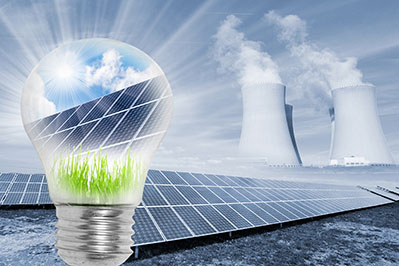
Nothing enrages the oil companies’ publicity hacks more
than the statement we’ve often made: “Giving inexpensive
and abundant energy to Americans today would be like giving
a machine gun to an idiot child.” However, that view
— as much as it may conflict with the corporate
cheerfulness of the multinationals — simply reflects
our own concern about the energy-intensive assaults that
this society has launched (and continues to launch) upon
Earth’s life-support systems.
If humanity hopes to preserve the planet’s vital
interrelated support systems (instead of paving them over
or plowing them under), two important decisions must be
made: How much energy should we mobilize, and how
should we mobilize it? Such decisions can be intelligently
made, however, only if one completely understands energy costs, or the costs that accompany the benefits of each
energy technology.
It’s a well-known economic principle that “there ain’t no
such thing as a free lunch,” and that maxim applies to
the energy field as well. No source of energy — no
matter how clean or abundant it may be — comes
without its costs, which must be taken into consideration
right along with the technology’s positive
effects. So, to guide you in the continuing debate over
energy use, we’d like to present a “score card” of the
liabilities of a number of potential power sources.
Fossil Fuels
The operation of our present energy economy depends upon
fossil fuels (oil, coal, and natural gas), and there
are, as you know, a considerable number of liabilities
associated with their use. Occupational hazards —
such as coal mine explosions and the dangers involved in
drilling and transporting oil and gas — make such
combustibles rather nasty to mobilize.
The use of fossil fuels also incurs direct health
costs primarily as a result of the air pollution
produced by their combustion. The greatest overall
liability of fossil fuels, however — and that which
poses the most immediate threat — is the negative
effect of their use on environmental systems. The full
danger presented by oil spills is not yet totally
understood, but is certainly worthy of concern; aquatic systems in the western U.S. will be damaged as
water is diverted for use in coal and oil shale operations; and, of course, few human activities are more
directly destructive of the environment than strip
mining for coal.
Acid rains (which are a product of air pollution caused by
burning fossil fuels) are now threatening the lakes,
streams, and soils of vast areas, and the same
phenomenon will probably have an increasingly harmful
effect on future crop production and forest growth. Worst
of all, the by-products of petroleum combustion —
carbon dioxide, nitrogen oxides, and particulates —
have the potential to alter global weather patterns. As
physicist John Holdren has written, “A CO2 climate-induced
famine, killing a billion people before 2020,
certainly cannot be ruled out.”
Finally, it’s impossible to ignore the political
liabilities of our dependence on oil: Current struggles
over supplies of that precious fuel could very well
escalate into World War III, an event that, obviously,
would be the ultimate public health and
environmental calamity.
Nuclear Energy
Nuclear fission shares some of the liabilities of fossil
fuels, but it also has unique problems of its own. The
ecological hazards of using atomic power are actually
slight: It has been shown — as we’ve
pointed out in previous columns — that ecosystems are
quite resistant to the effects of radiation, even at quite
high levels. The hazards involved in obtaining such fuel
are also relatively small, since fewer miners are
needed to extract uranium than coal and the nuclear
fuel is mined in much smaller quantities than the fossil
product. In addition, the direct health threats
associated with routine operation of nuclear power plants
may actually be smaller than those associated with
burning fossil fuels (although this question has not yet
been adequately explored).
A major liability of nuclear power, though, is our
inability to estimate hazards from non-routine occurrences,
such as the narrowly averted disaster at Three Mile Island. Although the number of immediate deaths
from a major nuclear accident probably wouldn’t total any
more than those resulting from the explosion of an LNG
(Liquid Natural Gas) tanker, nuclear power also carries the
long-term threat of lingering deaths from cancer,
and of making substantial areas essentially permanently
uninhabitable.
Another problem unique to nuclear fission is the disposal
of long-lived toxic wastes. Most experts
maintain that the dilemma can be solved, but
we haven’t yet seen a viable solution. And the problem of
radioactive waste may prove to be politically
insoluble, anyway, thanks to the nuclear establishment’s
now well-known incompetence and dishonesty. Because of
this, very few people may be willing to live near a nuclear
waste dump even if there are solemn promises of
safety by the government.
Most important, nuclear power — like fossil fuels
— can have political consequences. The widespread use
of such energy would likely accelerate weapons
proliferation, which could lead to atomic attacks
even by terrorist groups … a development that, once
again, could possibly contribute to the ignition of World
War III.
Renewable Sources
Many people — in the face of such dangerous costs
— are rejecting combustion and fissile fuels in favor
of renewable energy sources. But even such
relatively benign technologies are, especially when
considered on any but an individual scale, not
without serious liabilities. (Although the “lunch” in this
case may be more palatable, it still isn’t free!)
Of all our renewable resources, hydropower is the only one
that has been used on a scale large enough to project its
costs. Large dams literally wipe out the terrestial
ecosystems that end up under water, and the huge structures
can also have a substantial negative effect on agriculture
and fisheries (as has Egypt’s Aswan High Dam).
The most obvious hazard of hydroelectricity,
though, is dam failure: Such a disaster would kill many
thousands of people. (In fact, we feel that having to
choose between living downwind from a nuclear plant or
downstream from a large dam would involve a tough decision,
indeed!)
Solar power doesn’t offer a completely free lunch, either.
Most home applications of sun energy — such as space
and water heating — are certainly labor intensive
(which is clearly a plus for unemployment), but that
very factor results in a high occupational hazard
per unit of energy produced.
The health cost of domestic solar usage is difficult to
compute, since it’s necessary to calculate the number of
man-days lost in installing solar devices minus
those that would have been lost by those workers in
non solar employment.
Generation of electricity by central solar power plants
would also accrue health and environmental liabilities … both as a result of procuring and constructing the large
amounts of equipment required, and of operating
backup technologies during those periods when storage
capacities weren’t able to see the plants through extended
nonsunny intervals. Such power-producing plants would also
require enormous banks of solar collectors in desert areas and would operate, obviously, to the detriment of
fragile desert ecosystems.
Solar power via biomass (which requires growing large
quantities of plants for direct burning or for conversion
to liquid fuels) also presents a variety of costs.
Occupational accidents could occur in the harvesting and
conversion of the vegetable matter. The problems of
soil preservation — and perhaps of pest control
— that are associated with any form of
high-yield agriculture would certainly raise their ugly
heads. And, of course, land used for biomass would be
unavailable for food production (which could lead to
serious political consequences in this hungry world).
Most renewable energy sources are now used on such a small
scale that any hazards they might entail in wider
applications can — at best — be only
conjectural. Windplants, for instance, could have dangerous
structural failures; ocean thermal energy conversion
(OTEC) devices may leak their working fluids or eventually
alter seawater temperatures; and geothermal systems can
produce both air and water pollution. As you might
expect, such methods also present occupational hazards, and
they would have adverse environmental impact as a result of
the procurement of materials for their construction.
Nuclear fusion power has been widely hailed as the
newest “miracle cure” for our energy problems, but
that particular lunch, too, has its price tag. Fusion, if
it ever proves practical, could present a formidable
radiological threat, along with some occupational hazards.
Breeder reactors, another of the nuclear industry’s pet
projects, could greatly extend the life of Earth’s
uranium reserves. But such facilities share the liabilities
of nuclear fission plants and may be even more
subject to both catastrophic accidents and diversion of
fissile material for bombmaking.
Conservation — on the other hand — is
considered by many people to be the cleanest, safest, and
most readily available “source” of energy now available to
us. Even that sensible option involves certain liabilities,
however. Sealing up houses to save energy only intensifies
such internal air pollution problems as cigarette smoke,
gas from cookstoves, solvents that evaporate from plastics,
and so forth. The production (and often the use of)
insulating materials also involves occupational and
environmental hazards. And lighter, more fuel-efficient
cars may be physically dangerous to drive. Truly
no lunch (not even a wholesome, carefully planned
one) is ever free!
Comparing and Choosing Options
It’s important to note, however, that some options on the
energy menu are much more prohibitively expensive (in terms
of liabilities) than others. For instance, comparing the
occupational hazards connected with installing solar
collectors on roofs or the possibility of leaking fluid
from an OTEC system on one hand with the dangers of acid
rains or nuclear proliferation on the other is equivalent
to comparing the perils of catching the flu with those of
contracting lung cancer. While the precise
quantitative difference may be difficult to
measure (is the cancer a hundred times worse? a thousand? a
million?), only a fool would fail to recognize the
qualitative disparity.
In conclusion, then (at least when approached strictly from
a health-and-environment point of view), our best energy
options may lie in a combination of renewables, nuclear
fusion (provided the right technology for it can be found),
and strong conservation measures. Despite their
liabilities, those choices present a path that is generally
safer — and more sustainable — than that of
fossil fuels and nuclear fission.
There are, however, other important criteria to bear in
mind when making energy decisions, which we’ll discuss
in another column.
A detailed discussion of the health and environmental
effects of energy technologies can be found in
Ecoscience: Population, Resources, Environment , by
Paul R. Ehrlich, Anne H. Ehrlich, and John P. Holdren
In December 1981 Anne and Paul Ehrlich, and their
friend and coauthor John Holdren, will join MOTHER EARTH NEWS for a
unique South Pacific Seminar on the idyllic islands of Bora
Bora and Raïatéa.
Paul Ehrlich (Bing Professor of Population Studies and
Professor of Biological Sciences, Stanford University) and
Anne Ehrlich (Senior Research Associate, Department of
Biological Sciences, Stanford) are familiar names to
ecologists and environmentalists everywhere. As well they
should be. Because it was Paul and Anne who–through
their writing and research–gave special meaning to
the words “population,” “resources,” and “environment” in
the late 1960’s. (They also coined the term coevolution, and did a lot to make ecology the household word
it is today.) But while most folks are aware of the
Ehrlichs’ popular writing in the areas of ecology and
overpopulation (most of us–for instance–have
read Paul’s book The Population Bomb) . . . far too few
people have any idea of how deeply the Ehrlichs are
involved in ecological research (research of the type that
tends to be published only in technical journals and
college textbooks). That’s why it pleases us to be able to
present–on a regular basis–these
semi-technical columns by authors/ecologists/educators Anne
and Paul Ehrlich.






