


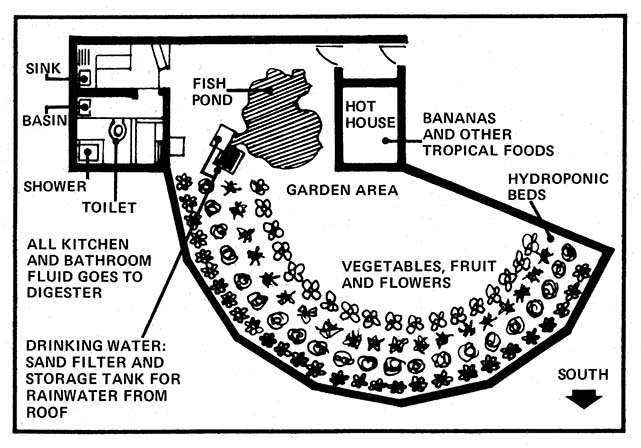
What in the world are the professions coming to? First
radical lawyers, then young physicians who thumb their
noses at the AMA and now a troublesome breed of architect
whose avowed aim is to provide–as one of them puts
it–“a realistic alternative to the exploitational
vision of the environment”.
The writer of those words, a young English designer named
Grahame Caine, belongs to an anarchist architect group
called “Street Farmer” and startled the British wing of the
profession back in 1971 when he entered a competition for a
housing development with a plan for a self-growing bamboo
shelter. Now he’s up to a new scheme that has been two
years in the planning and is likely to have much more
widespread applications than the bamboo effort. In fact,
his current project is receiving a good deal of publicity
in England (as well as a surprising amount of support from
municipal authorities).
Caine’s new idea is his final examination project for the
Architectural Association of London, where he’s a
fifth-year student . . . but the structure he’s erecting on
the corner of an athletic field in Greenwich (for under
$2,000) will also be his home for the next couple of years.
This kind of testing is essential because the Caine
Eco-House–unlike a conventional building–is
planned as a self-contained working system that
incorporates plant and animal life (Grahame’s own) in
harmonious interdependence. Since the 37 X 40-foot timber
and plastic dwelling will include a garden that is to
supply most of the householder’s food, the
architect–single and a vegetarian–is his own
ideal guinea pig.
Grahame’s principles of design–conservation of
resources, independence from wasteful, dirty public power,
and respect for natural ecosystems–are shared by
growing numbers of people in the U.S. and Canada . . . and
I’d like to comment on his plans with an eye to how they
might be modified for use on the North American Continent.
The Plan of the Eco-House
No one should use Grahame Caine’s exactly as
they are. . . unless, of course, he lives next
door to Grahame. If you want to build such a dwelling from
scratch, you must consider the climate of your site and
modify the design accordingly.
The difference of even one degree of latitude, or 1,000
feet of elevation, will affect some key points in the plan
of an Eco-House. The building should be in a position to
get maximum sun in cold climates, for example, but might
need shelter from the heat in the South. Again, insulation
will be needed to keep the house warm with minimum fuel use
in the North, and cool without air conditioning in the
South . . . but on an island in the tropics, insulation
might be unnecessary. It all depends on where you are.
Water Collection and Management
Grahame’s water source–the key to his own health and
the life of the greenhouse plants that will supply most of
his food–is the rain that falls on his
600-square-foot roof. The notoriously damp British climate,
which dumps 25 inches of precipitation on London per year,
should provide Caine with about 20 gallons or so a day.
This is only about half the amount one person uses in an
average home . . . but Grahame’s dwelling is a long way
from average. (The normal toilet, for instance, uses two
gallons of water when flushed. The Caine model takes two
pints.) Nevertheless, the father of the Eco-House is a
realist and is installing pipes to city water as a backup
“just in case” of drought.
Though the quantity of London’s rain is ample for
collection by householders, its quality is a drawback.
Besides the sand filter that will clean the dust and
impurities from his water supply, Grahame is considering
more sophisticated devices to remove some of the high lead
content of the precipitation from a dirty urban sky.
In a cleaner area, though, rainwater may well be freer of
pollution than well water. Caine’s method of supplying
himself with water also has other advantages worth
considering. For one thing, rain is sure to be more
pleasant to the taste than chlorinated city water,
and–as generations of farm women know–it’s very
soft and excellent for washing everything from hair to the
family laundry.
Is reliance on rainwater practical in North America?
Clearly, that depends on the area, since rainfall on this
continent varies from 80 inches annually on the extreme
West Coast to less than 5 inches in the deserts. If you’re
considering rainwater for your own household use, find a
precipitation map in your nearest library and check the
average yearly figure for your location. If it’s more than
30 inches, the supply is ample . . . if it’s less than 5,
give up the idea.
How much water you can gather depends, of course, on how
big a surface you have to catch it. The area of roof needed to supply one person with 25
gallons of water per day ranges from 3,000 square feet if you get five inches of rainfall per year to 500 square feet if you get 30 inches per year. Twenty-five gallons is much less
than an average individual uses . . . but then, our pioneer
ancestors got by with bucketing 5 gallons a day each, and
there’s no reason why we can’t limit our consumption with a
little care.
The water supply, as it comes from the roof, should pass
into a setup that allows the first few gallons to run away
after washing the collecting surface clean. What’s gathered
thereafter should go through a sand filter–to remove
any dust washed out of the atmosphere–and then into a
storage tank with an outflow that sends the water through
an activated charcoal purifier before use.
To store enough water to supply four people for 60 days (a
surplus that allows for two months with hardly any rain)
you’ll need an 800-cubic-foot vessel. Probably the most
practical form is a concrete tank in the ground. A
rectangular container 9 X 9 X 10 feet would do, and so
would a cylinder 10 feet in diameter and 10 feet deep.
A single use for kitchen or bathroom purposes is all the
conventional household gets out of any one gallon of water.
In a home like Grahame’s, though, that’s just the beginning
. . . and what happens to the used fluid, and the other
normal “wastes”, is the most unusual feature of a very
unusual house.
     Roof Area Needed to Catch 25 Gallons
      Per Day at Various Rainfall Levels
 ----------------------------------------------
 Rainfall, inches/year         Sq ft. of Roof

         5                         3,000
         10                         1,500
         15                         1,000
         20                           750
         25                           600
         30                           500
The Waste Recovery System
All the waste water from Grahame’s kitchen and bathroom, as
well as all organic solid wastes, are passed on to an
ingenious system that converts the material to methane gas
for cooking fuel and liquid nutrients for the greenhouse.
The wastes first enter a two-compartment
(one mainly for solid fuel, the other for liquids only)
digester. The double container resembles an ordinary septic
tank, with two important differences. First, Grahame’s
version is airtight to provide a happy home for the
bacteria that convert part of the raw sewage and garbage
into methane. Also, since the optimum temperature for the
gas-producing bugs is between 70° and 95°
Fahrenheit, the receptacle is insulated and equipped with a
solar heating panel.
The material from the liquid compartment in the digester
next passes to another tank . . . this time airy and sunlit
to accommodate the tiny, fast-multiplying algae plants that
devour organic matter still in the waste. The algae also
add oxygen that helps bacteria digest the sewage and
nitrogen that enriches the end product (which eventually
becomes plant food). Also, any dangerous microorganisms in
the human excreta portion of the sewage should perish at
this stage, killed by the oxygen and the ultraviolet
radiation of the sun.
Since the algae need warmth, as well as light and air,
Grahame will keep them comfortable in the dull, cold London
winter by extending part of their tank into his house in
the form of a loop. This indoor section of the algae pool
is to be continuously illuminated with electric light (only
500 foot-candles are needed, so one 40-watt fluorescent
tube should suffice).
When the plants have done their work, the liquid passes
on–algae and all–to a final tank . . . another
digester in which the contents are kept at 110° F by
means of a solar panel. This temperature kills the algae
(which are soon replaced by the fast-growing colony in the
open pool) and decomposes them to furnish more methane.
The gas from the first and second digesters collects in the
tops of the tanks and is piped to Grahame’s kitchen stove .
. . which will also have cylinders of store-bought fuel
standing by, since the young designer has no illusions
about how much methane a single person’s wastes can
produce. To be precise, some large sewage-disposal outfits
(which use methane to run their power plants) count on one
cubic foot of gas from each individual’s daily wastes.
Though Grahame expects to do better than that–since
he’ll be using kitchen garbage as well as sewage–he
certainly won’t be able to heat the house, run an electric
generator or fuel a car from his output. He’ll be lucky if
he gets enough to cook with. A family or commune, of
course, would produce more methane and would also use it
more efficiently, since approximately the same amount of
fuel goes into cooking one potato or ten.
And what about the liquid that remains in the second
digester after the methane is piped off? That’s Grahame’s
plant food . . . his replacement for the mixture of
commercial fertilizers that’s normally used in hydroponic
gardening. If Caine finds that he can rely on the algae
pool to free his personal wastes of harmful bacteria before
the sewage is passed on to the greenhouse, he’ll have
attained one of his ideals: a complete cycle of organic
material based on the interaction of plant and animal life
as it occurs in nature.
As you may know, waste-recycling dwellings are being
attempted in our own country. The
main difficulty is keeping the digester tanks at their
correct temperatures, since they might overheat in the
southern summer and–though they generate some heat of
their own–require protection and added warmth in the
cold North. (One possible solution is to surround the tank
with a warm-water jacket.) Anyone who imitated Grahame’s
use of an algae pool in a severe climate would also have to
take extra measures to keep the plants alive during the
winter.
The Greenhouse
The cycle of organic material in Grahame’s ecosystem is
completed in a 500 square foot greenhouse next to Caine’s
own living space. Here the vegetables the young architect
will rely on for his main food source, and the flowers he’s
planting among them just for fun, will be raised
hydroponically with household wastes for their fertilizer.
(This inventive Englishman has even planned a
hothouse–above the main growing space to catch the
rising heat–where he intends to cultivate bananas and
other tropical fruit.)
Hydroponics, as it’s usually practiced, is the antithesis
of organic gardening because the plants live in an inert
medium like sand and are nourished entirely by a water
solution that contains plant food. The
technique–though valuable in lab studies of plant
nutrition–is seldom used commercially except
sometimes to produce fine chrysanthemums and other flowers.
Because my own feeling is that organically grown food
tastes better than hydroponic products, I’d be interested
to know whether Grahame obtains any improvement in flavor
by watering the plants with natural instead of synthetic
fertilizers . . . an innovation that brings these two
schools of gardening a step closer together.
In any case, people who have no soil–because their
land is hard rock, too full of moisture or otherwise not
tillable–could certainly grow their food by Grahame’s
method where an organic garden would be impossible.
Grahame expects 250 square feet of cultivated space in his
greenhouse to provide him with eight pounds of vegetables
per square foot . . . enough to feed him all year round
with no trouble. I myself question the need for so much
indoor growing area, because in most cultivated regions an
outdoor garden will produce enough of many vegetables
(potatoes, for instance) to last the winter. On the other
hand, the greenhouse does allow controlled growing
conditions and more efficient recycling of waste . . . and
this is probably important in a demonstration project like
the Eco-House.
If you want to follow Grahame’s example and grow all your
own food under shelter, you’ll need to work out the space
requirements carefully. For instance, a family of four
would require 1,000 square feet of greenhouse space. A
structure, let’s say, 20 X 50 feet . . . which is perfectly
practical now that large plastic sheets are cheap and
readily available.
Your local climate, however, may force you to make some
alterations in the greenhouse project. While a solar-heated
growing area is practical all year round in England, the
extremely cold winters of the Northern States and Canada
would require artificial heat for the plants during the
coldest months of the year. Certainly, it would be
difficult to make Caine’s overhead hothouse work when the
outdoor temperature is zero. (New Alchemy Institute
East — located on Cape Cod —
is experimenting with winter indoor growing
environments that also incorporate fish and animals.– MOTHER EARTH NEWS)
The Sun as a Heater
Naturally, Grahame will have to keep himself warm, as well
as his plants, and he’ll need hot water for household use.
He plans to fill both these needs–partly,
anyhow–by trapping the heat of the sun in an array of
black-painted hot-water radiators (the kind that are used
for central heating) on the south wall of his dwelling . .
. though it seems to me that a 100-foot coil of black
plastic pipe would be simpler, cheaper and lighter. While
an April test run for this system produced a hot-bath
temperature of 140° F in a 30-gallon tank of water,
this result can’t be hoped for in winter, especially during
the long gloomy periods which are common in England.
Therefore, Caine is hooking into the public electricity
supply as a backup source of heat until he gets started
making his own power.
And how about using Grahame’s hot-water system in this
country? Well, in the South, of course, his form of solar
heating is perfectly practical . . . and even in the North,
on a bright day in January or February, the sun can feel
very warm in a sheltered spot. Apart from the fact that
such bright days are none too common in some parts of the
country, though, the difficulty is the coldness of the air.
The radiators could, of course, be placed behind a screen
which would allow them to collect the sun’s heat without
losing to the air more warmth than they gain . . . but,
even so, there’s still the problem of keeping the water
from freezing overnight. Still, solar
heating–in a somewhat different form–is being
attempted in cold climates such as Vermont.
Power Generation
Grahame is using public-utility electricity at the outset
to light his Eco-House and–as I’ve said–to help
his radiator array on cold days. Eventually, however, he
hopes to install a wind generator and power-storage system
to make the house independent of the electric grid and
fossil fuels.
When he does undertake this project, I’ll be interested to
know how he tackles the problem of storing energy for
windless days. This is the difficulty that every user of
alternative power runs into. To show you its dimensions,
I’ll use my own house for an example, even though I don’t
heat electrically: Just 1,000 square feet of old
farmhouse–well insulated–needs the equivalent
of 20 kilowatts of heat during the coldest days of winter.
Now, to store 20 kilowatts as electricity for one hour
would require 20 car batteries . . . and, to provide for
three consecutive windy days, you’d need 1,440 of the
storage units!
In short, there’s a great reward coming to anyone who
devises a practical, light, small energy store. The
standard car battery holds about 1 kilowatt-hour or 1 1/3
horsepower-hours. What we need is a device that will cost no
more, occupy the same space and contain at least 10 and
preferably 100 kilowatt-hours.
Since no such device now exists, though, let’s look at some
of the alternatives Grahame might use when he undertakes to
make his own power.
Grahame could–for instance–use the windmill’s
energy to heat water to a temperature of 80° to
180° F by means of a 20-kilowatt immersion heater
that’s made for this purpose. Power stored in this form
won’t light Caine’s house, but it will give him
heat. How long it will do so depends on the volume of his
storage area. A tank of 125 cubic feet will hold 230
kilowatt-hours . . . one of 500 cubic feet, nearly 1,000
kilowatt-hours . . . and a container of 800 cubic feet (10
X 10 X 8 feet) will retain enough warmth to keep a house
the size of mine comfortable in the depth of winter for
three days.
In many ways, water is an attractive heat store. It’s safe,
and–in most areas–it’s cheap and plentiful.
What’s more, it can act as its own pump and will heat the
radiators in a house by thermosiphoning. However, it does
have a couple of drawbacks: It’s bulky, and it won’t store
heat above water’s boiling point. (If you hold power as
steam under pressure, the Man will–rightly–send
his inspector ’round to see that your “pressure vessel”
isn’t a danger to you or to innocent bystanders.)
Sand, used as a heat store, can outperform water by holding
a much higher temperature . . . but bulk for bulk it will
retain only half as much warmth. What’s more, it won’t
flow. To get the heat into the sand in the first place,
then, Grahame would need something more complex than a
common immersion heater, and he’d also have to devise a
network of pipes or the like to get it out. In short, I’m
dubious about the sand storage idea in practice.
Well, as you can see, it’s quite a challenge to overcome
the sporadic nature of wind power and turn its energy into
a reliable household servant. Still, Grahame Caine is an
inventive man, and maybe his solution to the power-storage
problem will be as novel as his use of algae in the
Eco-House’s waste-recycling system. This, and the other
ideas he’ll be working on during his life on that corner of
land in Greenwich, may go a long way toward freeing us all
from the cumbersome wastefulness that’s built into modern
housing.
Many of us think a new kind of housing design is long
overdue in our society . . . and, to judge from the
response Grahame’s been getting from official circles in
London, at least some urban authorities are worried enough
to agree. Just possibly, then, the Caine Eco-House may turn
out to be one revolutionary idea that came along at exactly
the right time.
Quotes From Grahame Caine
“The ‘Ecological House’ is a domestic unit, independent of mains supply, attempting to rely on the solar infrastructure to generate a life-sustaining biological cycle and assist in creating comfort conditions.”
“The provision of shelter as a provision of mortgage merely extends the potential for exploiting the individual and endorses the myth of the ever expanding GNP.”
“The organic or biological nature of the technology involved is a deliberate attempt to opt out of the concept of developing yet more ‘super technology to save the world’ and also reduces the dependence on a centralised supply source.”
“I consider the project not to contain a romantic attitude but a revolutionary one in that it indicates both a possible means to revolution and the stimuli, in that it exhibits a realistic alternative to the exploitational vision of the environment.”





