


Should anyone care to sow the seeds of agricultural
revolution in this country, he or she would probably get
them from Wes Jackson. For the past 16 years, the
freethinking geneticist and his colleagues at the Land
Institute in Salina, Kansas, have searched for plants that
will see us through the next century. These plants, Jackson
believes, will produce bountiful crops year after year
without pesticides or fertilizers. More important, however,
they won’t need annual tillage, a practice used since men
quit chasing mammoths.
Jackson’s influence goes beyond mere seeds. In three books
and numerous essays, this descendant of four generations of
Kansas farmers has excoriated modern agriculture for
ravaging land and people. The 58-year-old scientist has
been dubbed a “maverick geneticist,” a “prairie prophet,”
even “the father of sustainable agriculture.” He dismisses
labels with the wave of a callused hand. “I’ve told people
I’m not a prophet; I’m head of a nonprofit organization,”
he chuckles.
Yet it is hard for Jackson not to sound Isaiah-like when
the damage wrought by agriculture has reached biblical
proportions. The topsoil that makes U.S. farmers the
greatest producers in the world currently erodes at 20
times its rate of replenishment. Iowa, the backbone of the
Corn Belt, has shed half its topsoil in the last 150 years,
while the nation on average has lost a third. A recent
geological study suggests that the world’s farmers displace
the same amount of soil each year as the glaciers of the
last ice age.
The natural fertility and pest resistance inherent in
healthy soils have largely been replaced by fertilizers and
pesticides made from fossil fuels. Farmers apply some 20
million tons of fertilizer and more than one billion pounds
of pesticide each year, traces of which have been detected
in the waters of at least 40 states. Concern over the
long-term effects of these substances recently prompted the
National Cancer Institute to launch a 10-year, $15 million
study of 100,000 farmers, chemical applicators, and their
families.
Most researchers look toward technology to solve these
problems. Jackson looks to nature, specifically the hardy
prairie perennials that he hopes one day will replace frail
corn and wheat. In less than two decades of selections and
crosses, Land Institute researchers have achieved yields of
Illinois bundleflower and wild senna comparable to wheat
yields in the region. They have demonstrated greater yields
in polycultures (mixtures of species) than in monocultures,
as well as natural reduction of certain pests and diseases.
These findings prove that a new agriculture is possible,
Jackson says–one without soil erosion, without
chemical contamination, and with little fossil fuel input.
In place of an eroding Breadbasket, Jackson envisions a
domestic prairie that nurtures land, people, and community.
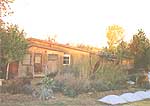
To understand the human element, Jackson has focused on
Matfield Green, a not-quite-dead ghost town in the Kansas
Flint Hills. He calls the project “setting up the books for
ecological community accounting.” By studying the hamlet as
part of the prairie ecosystem, he hopes to gain insight
into the decline of thousands of towns that dot the Great
Plains.
These towns, he argues in his latest book, Becoming
Native to This Place (University Press of Kentucky,
1994), offer the perfect opportunity to repopulate rural
America. Twenty-five years after the back-to-the-land movement
spawned MOTHER, Wes Jackson calls for a third of the U.S.
population to move closer to the source that sustains it.
“The binge the developed world has enjoyed is about over;”
Jackson writes. “It’s time to find our way home and use
what little time is left for partial redemption of this
prodigal generation.”
We spoke with Jackson as he prepared for his greatest
challenge: convincing a skeptical U.S. Department of
Agriculture to embrace perennial polyculture research. He
may be up to the task. The renowned geneticist was selected
as a Pew Conservation Scholar in 1990 and a MacArthur
Fellow in 1992. He has written two previous books, New
Roots for Agriculture (University of Nebraska Press,
1980) and Altars of Unhewn Stone: Science and the
earth . (North Point Press, 1987).
On the road to
Salina I saw a sign that read, “One Kansas farmer feeds 101
people and YOU!” I suspect you feel this is not a source of
pride.
That’s a sign of failure. You
have to ask, so now what is everybody else doing that’s so
important? What is it that is more important than taking
care of the land that sustains us? The Buddhists believe
that the purpose of work is to come together with others in
a common task in order to overcome our egocentricity. They
don’t see work as merely a utilitarian thing, rather it’s
to help us toward a becoming existence.
You and your friend Wendell Berry and other leaders in the
movement to reform agriculture have often been criticized
as merely being nostalgic for pastoral America. How do you
answer that charge?
What are we really talking about when we talk about people
being associated with farming? Aren’t we talking about
being in an environment in which there is a combination of
biotic, abiotic and cultural diversity, and at the same
time understanding the nature of our source? The idea that
the majority of citizens don’t need to know where their
food comes from, or to know it only at an intellectual
level without sensing it at what we might call an emotional
level, places our culture in spiritual danger.
Last night I was reading Liberty Hyde Bailey, the grand old
dean of the school of agriculture at Cornell University.
Here is a teacher’s leaflet, dated June 1, 1897, in which
Bailey defined, “What is nature study”: “It simply trains
the eye and the mind to see and to comprehend the common
things of life; and the result is not directly the
acquirement of science …but the establishment of a living
sympathy with everything that is ….”
This is what we’re talking about. It’s not a matter of
whether there is some kind of utilitarian meeting of
physical needs. We’re talking about a living sympathy with
everything that is. The leaflet asks, “Now why is the
College of Agriculture of Cornell University interesting
itself in this work? It is trying to help the farmer, and
it begins with the most teachable point–the child.
The district school cannot teach agriculture any more than
it can teach law or engineering or any other profession or
trade, but it can interest the child in nature and in rural
problems and thereby fasten its sympathies to the country.”
You see, there’s the word sympathy showing up twice. “The
child will teach the parent. The coming generation will see
the result. In the interest of humanity and country, we ask
for help.”
We’re not talking about a matter of mere nostalgia. We are
talking about a practical necessity. We are losing the
cultural seed stock. I think that was Wendell’s phrase
originally. It’s the beginning of a decline in the
civilization.
Here you have the dean of one of the
most prestigious agricultural schools in the country
talking in 1897 about the very things that concern you
today. How did we get so far away from this ideal?
I’ll call it an operating hypothesis.
It may even be a law. High energy destroys information, of
both the cultural and biological varieties. In other words,
with the industrialization of society, including the
industrialization of agriculture, we have an eroding of
information. The war against cultural diversity, indigenous
cultures, subsistence farming–places where there is a
lot of cultural information–is the same war that is
being waged against tropical rain forests. Cultural
information, like biological information, is hard won
through disease, death, anguish–a consequence of hard
experience. But it is vulnerable during periods of
affluence. It just gets jettisoned. It wasn’t until after
World War II that the benefits of the industrial revolution
visited an entire culture.
Look, here is the entire
collection of The Land Quarterly , a journal
published from 1941 to 1954 by Friends of the Land, “a
nonprofit, nonpartisan society for the conservation of
soil, rain, and man.” In here it tells about two field days
in which people were looking at eight soil conservation
projects in Ohio. I believe Hugh Hammond Bennett, the
founding chief of the Soil Conservation Service, set a
stone. How many people do you think attended that field
day?
When was this?
I think in 1946 or ’47.
I have no idea.
Eighty thousand! Now if we had 8,000
show up at a rally, we would say we’ve got a movement. But
here is passion that affluence has effectively destroyed.
At the risk of reducing this to sound
bites, I wondered if you would give me a handful of reasons
for abandoning industrial agriculture.
Number one. It creates a brittle
agricultural economy. When fossil fuel is gone, it leaves
us vulnerable.
Number two. There is a dependency on the chemical industry
that leads to contamination of water and soil that
ultimately gets back to us. What we’ve tried to do through
chemistry is what we used to do by hand, that, 135 years
after Darwin, ignores the implications of a Darwinian world
view; i.e., don’t put chemicals out there we haven’t
evolved with without counting them guilty until proven
innocent.
Then there is the loss of cultural seed stock from the
countryside that makes us vulnerable. I have heard that one
of the things that made Americans so formidable during
World War II was that when the equipment broke down, there
were enough farm boys around who were able to get the
equipment up and running again. They knew about motors and
drive trains and so on. The Germans on the other hand, had
excellent engineering and specialization, but the
run-of-the-mill German did not know how to fix the
equipment. So that was that.
While most of your colleagues in the
field of genetics have enthusiastically embraced the new
technology of gene splicing, you have called for a
five-year moratorium on biotechnology. Why?
Let’s say you have a knife, and the
knife is in the hands of a person who cuts and serves
homemade bread. Then the knife is in the hands of a mugger.
Could be the same knife. In a similar manner the plant
breeder may decide to put his or her talents to use for
Monsanto.
Biotechnology, like all technology, is ultimately at the
service of a dominating social organization. Now if the
biotechnologist could be subordinate to the ecological
paradigm only, I would not be so bothered. My worry is that
something that involves such speed is another example of
overrunning our headlights. So I’m cautious. And it is so
tempting to the one who comes in and wants to use it for
exploitative purposes rather than ecological requirements.
But as a plant breeder aren’t you
just as tempted by the power of genetic manipulation as
your colleagues? What if USDA offered you millions to use
biotechnology to establish perennial polycultures?
There is a difference though. You can
be infatuated with what you are able to do and be caught up
in the elegance and power that goes with gene splicing, or
you can see it as simply a tool to transfer genes from one
organism to another. I would have to say I would stick to
the five year moratorium for myself as well. We really
haven’t had a discussion about this. What I think we can do
is raise the consciousness of the whole culture about the
nature of technology. You have to ask who is going to
control that technology? Can it be controlled exclusively
by the public? Or is it susceptible to being controlled by
interests that will exploit people, land, and community.
There is the social justice side of it. At the same time,
how long will it be before the biotechnologists come up
with the ozone hole equivalent? If you start with the idea
that we are fundamentally ignorant, it forces us to
remember things, hope for second chances, and keep the
scale small. All this is part of the discussion.
We have not had ecological interests in mind as we have
sought technological tools. Historically the interests we
have had in mind have been profits. That is where the knife
has wounded us, rather than cutting bread that will sustain
us.
You recently began a new project at
the Land Institute called Sunshine Farm. It’s not
permaculture,but it incorporates many techniques of the
sustainable agriculture movement, including natural
fertilizers, draft animal power, and tractors running on
“biodiesel.” What is your goal there?
Fifteen years ago when people asked
how are you going to feed the world with perennial
polycultures, I knew that we needed an even playing field
for discussion. If we have an agriculture that runs on
contemporary sunlight, and receives no subsidies from the
extractive economy, then let’s talk. So here are the
conventional crops: sorghum, wheat, sunflowers, alfalfa,
and so on. Now we’ve got a standard against which we can
judge the merits of perennial polyculture.
So it’s a control.
In a way it’s a control. We’ll just
see what these yields are without subsidies and make this
as close to a sun-powered system as possible. We’ll use the
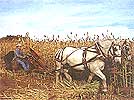
draft animals, and we will use the tractor run on vegetable
oil. We will get the land to sponsor the energy. Now we’ve
got something to compare. My bet is perennial polyculture
will beat the pants off annual monocultures grown in a
sustainable way.
In your new book, Becoming Native
to This Place , you speak of the marriage of ecology
and agriculture. The assumption that nature is something to
be conquered is deeply imbedded in the human psyche. How
does society go about changing that?
I don’t know. In the book I give a
glib history lesson. When the church dominated our thinking
we built cathedrals, supposedly to the glory of God, but
mostly to the glory of those who built cathedrals. Then
comes Enlightenment and the nation-state as that which
organizes our lives. This time we built national capitals.
That peaks in World War II with Hitler. Then economics
comes on as that which organizes our thinking. We still go
to church. We still vote as the nation state. But with NAFTA
and GATT, Boeing can go to China and GM can go to Mexico,
so the nation-state is not important anymore. Just as the
church built cathedrals and the nation-state built national
capitals, now economics builds the shopping mall to the
glory of the gods of secular materialism.
So what’s next? I think it’s ecology. But this time what
will our icon be? Not a cathedral, not a national capital,
not a shopping mall. It will be wilderness: alpine meadows,
prairies, things not made by human hands. Now that we’ve
recognized the nature of the extractive economy, we will
look to nature’s economy that is fundamentally renewable.
Alpine meadows, tropical rain forests, prairies, coral
reefs–those are economies that run on sunlight and
feature material recycling.
This is the whole purpose of Matfield Green. We call the
project “setting up the books for ecological community
accounting.” We want to get a sense of carrying capacity
and the ecological cost of our livelihood.
As I understand it, you are
attempting to compare the economy of the tall-grass prairie
to the economy of a tiny prairie community. Isn’t that like
comparing an apple to a Model A?
An accountant is a student of
boundaries. As a student of boundaries one must decide what
is relevant that goes through any particular boundary.
That’s what we are trying to do in Matfield Green with the
things we take for granted. Take a loaf of bread. Throw a
boundary around that loaf of bread and let’s get some sense
of what the ecological cost of that bread is if it is made
in a Tuscan-style wood-fired oven. See? We call bread the
staff of life. We think bread is benign. But bread may come
at a great ecological cost, if you count in soil erosion,
chemical contamination, fossil fuel dependency, fossil
water. Then put a similar boundary around Matfield Green
and then measure what goes through that boundary. We’ve got
all the chattel mortgage books going back to 1867. I bought
them for three dollars apiece. In there you see the coming
of the European mind–the human economy–smack
dab into nature’s grassland economy.
We have a chance to look at the superimposition of an
economy which is the product of the European mind being
imposed upon an economy that has been running on sunlight
and look at what kind of externalized cost we are willing
to pay to put that system in place in order to carry out
our vision. As Wendell says, we came with vision but not
with sight. That’s the kind of thing I want to do down
there: to get some idea of the overlay of the European mind
on the great grassland community.
Once you throw this ring around
Matfield Green and study every in and out, what do you
think you will find?
We won’t, of course, measure every in
and out, but I hope we can reveal where we might take our
more important first steps. Will it mean that we remove
ourselves? Do we become more community oriented and engage
in more barter? Do we hold more community dances and get
our solace from one another? Do we sign a pact that says we
turn the TV off certain nights of the week and visit with
one another? Are we going to trade potatoes for tomatoes?
What kind of relationship are we going to have with one
another?
It sounds like rural anthropology.
In a way it is. But I want to see how
far we can stretch the ecological paradigm. The native
prairie there runs on sunlight and it features material
recycling.So if the natural ecosystem community is going to
run that way, why shouldn’t the human community look to see
what principles are at work that have allowed those systems
to follow certain rules for millions of years.
MOTHER EARTH NEWS was born on Earth
Day 1970 as an outgrowth of the back-to-the-land movement.
In Becoming Native you have called for a similar
movement but on a much larger scale. How many people would
you like to see back on the land?
I don’t think the countryside can take
more than 80 million people. That is less than a third of
the current U.S. population. But 80 million people on the
land would change the nature of our political economy. It
would be a very different world.
How do we teach young people to dig
in, as you suggest, to go some place and begin “the long
search to becoming native?”
I’d like to get universities to
recognize their obligation. I’m amused to contemplate
university professors offering a major in homecoming.
That’s going to expose this culture more than anything. How
do you prepare the young to live sustainable lives? We lack
the skills. All of our skills in teaching are primarily
oriented to a major in upward mobility. If it weren’t so
tragic it would be uproariously funny to watch the
universities thrash around to make that happen.
What words of encouragement do you
have for MOTHER readers who are already back on the land?
The people who read the Whole
Earth Catalog, Coevolution Quarterly , and MOTHER,
that fooled around with ram pumps and yurt houses and
communal living and all sorts of things, created cultural
information that is still around. I would say that they are
the examples. They are the prototypes. They are the people
who have been running the necessary experiments. Even
though they may have failed, at least they have the
ideology. They know the promises and pitfalls better than
anyone else in the culture. They are seed stock. Maybe
these are the saving remnant.
In the last 25 years we’ve seen the
rise of environmentalism as well as conservatism. Do you
see us moving closer together toward a sustainable future
or are we heading for the poles?
I don’t know. I’ve tried to understand
how this culture has become in such a short period of time
the most fundamentalist that it has ever been. It is
serious because fundamentalism takes over where thought
leaves off. I’m worried about fundamentalism of any type,
including eco-fundamentalism, or religious fundamentalism or
politically correct fundamentalism. Instead of thinking and
being informed by affection and passion for the creation we
seem to be shrinking from it and we worship the gods of
secular materialism I mentioned earlier. I think Ted Rozak
said many years ago that the deterioration of the
environment is an outward mirror of an inner condition.
Like inside like outside. On the other hand there are some
signs that we recognize this can’t go on. Until we have the
physical manifestation of sustainable livelihoods
demonstrated in enough places, we are going to continue the
folly. So the good examples, whether they are the good
examples among organic farmers, or the good examples among
research efforts, or just the good examples of ordinary
right livelihood give us a standard. If we don’t have those
examples I think we’ll opt for nuclear power as a way of
preventing social upheaval. And we’ll do that without
giving a thought to whether or not we can repeal “Murphy’s
Law.” How many Chernobyl-like accidents can the world
afford? Do we have to have one of the reactors in Chicago
go, and lose Chicago, in order to develop the information
that says “anything is better than this.”
Let’s contemplate the future for a moment. Your great-grandfather was one of the pioneers
who plowed the Kansas prairie. What kind of Kansas do you
think your great-grandson will see?
I have my first grandchild due in
February. In 2036–100 years after my birth–the
grandchild could be 41. Maybe there will be perennial
polycultures on the eroding lands which represent
seven-eigths of the tilled land across our countryside.
Maybe farms will run on contemporary sunlight. Maybe it
will be a world in which cultures everywhere understand
that community is the locus for connecting. Perhaps a major
feature will be a sophisticated form of tribalism, so
culturally rich that flying an airplane or going to a
shopping mall will be boring. Maybe we will have a world
full of music and art and poetry and tinkering.
Another possibility is that what’s happening now in the
cities–homelessness, drive-by shootings,
drugs–amounts to a faint foreshadowing of the norm.
No wilderness. No opportunity to sit on a grassy bank and
watch a bee at work. No community warmth. Little love,
little affection.
It’s within our reach–ecotopia
on one hand, urban hell on the other?
I think we have the potential for both
in us. We have a chance for the first time in human history
to put together an agriculture in which there is no soil
erosion, no chemical contamination of the countryside, no
fossil fuel dependency. A near totally non-extractive
economy is possible in agriculture. That puts us right up
against the buzz saw. Because here is the extractive
economy on one hand and the far, far less extractive
economy on the other.Who is going to support this work? Not
big industry. Who is left? Well, there is government. Even
though government is tied to the corporate sector, the
people still have a chance to say `this is what we want:
What is humbling to me, absolutely humbling, is to realize
the choice is in our hands. There will not be any one
individual that leads the pack into a safe and sustainable
future. It will be a culture that decides, and the
grace of God stands ready to assist, provided we honor
Darwin’s great evolutionary ecological insight.






