


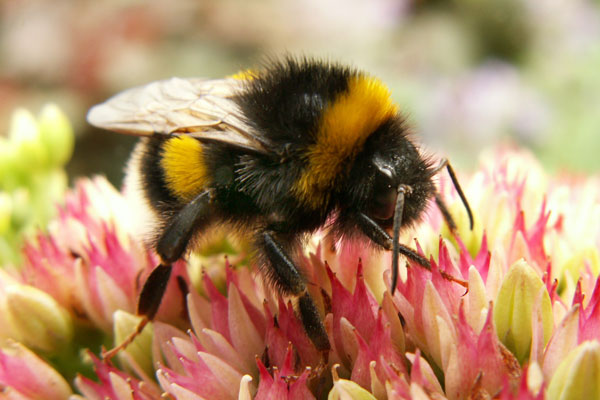
Author Joan Dye Gussow leans on her garden as a therapist, friend and confidant after losing her husband. In her book Growing Older (Chelsea Green Publishing, 2010), Gussow finds self-reliance in the ever-changing world around her. In this excerpt taken from chapter 19, “Bees,” Gussow reflects on the deeper effect that the disappearing bees will have on crop pollination and the future of our food supply.
I’m fairly certain that I’ve worried longer about bees than most people who don’t actually keep hives or study insects for a living. I’ve been uttering Cassandra-like warnings about the vulnerability of honeybees to pesticides for thirty years at least, but I don’t think I really got it until a particular June morning more than a decade ago when Alan was still alive. I was taking a very early walk in the garden as I do at the least opportunity on the long June days leading up to the solstice. I stopped at each bed, pulling weed seedlings in one, leading a bean tendril to its climbing pole in another. A giant zucchini plant tumbled out of one of the beds, sprawling over the path, its flamboyant yellow-orange flowers gaping to welcome their pollinators.
And, surprised by an unusual lack of activity, I suddenly remembered that that summer no honeybees were likely to arrive for an embrace by these lascivious blossoms. In a recent Sunday paper, the garden writer had reported that New York’s honeybee colonies, already reduced from more than two hundred thousand after World War II to less than a quarter of that, had succumbed in horrifying numbers to the year’s hard winter. The season’s record snows were apparently not their only problem. The bees were weakened by parasitic mites, and — after a dry fall — had been short of honey going into what turned out to be a long cold winter. A local beekeeper was quoted as saying that 50 to 80 percent of his hives were dead.
I wasn’t entirely surprised. During the 1980s, I was on a sustainable agriculture listserv that very often alerted me to things I never dreamed I would need to know about. Warnings of coming honey shortages and of the spread of two kinds of bee mites (varroa and tracheal) had appeared in recent weeks. So the garden writer’s story, emerging briefly from the daily firehose of information that threatens to drown us all, hadn’t really jolted me. Now, in the garden, the reality of the loss made me stop short. The warm buzzing that should have been part of the morning’s background wasn’t there.
I looked around. Instead of nodding collectively under the weight of bees, the lavender blossoms stood erect, quivering occasionally at the landing of a solitary insect. Walking down the brick paths between the vegetable beds, I didn’t have to push carefully by umbels of flowering coriander bent into the path by eager foragers. No small bodies hummingly bumped my arms as I reached in to tug a weed from the alyssum patch. I’m not bee-sensitive. I have always walked and worked among them without concern, brushing them aside when they’re busy in a place I need to be, as they often are . . . or used to be.
My husband, who was alive then for what we did not know would be his last summer, called a local apple farmer who keeps hives to pollinate his crops. His apples had been fertilized, and he didn’t plan to rent his hives. Then Alan called the local Cooperative Extension Service to locate a hive we might rent for our crops and those in the community garden next door. We spoke on the phone to the local beekeeper whom the service recommended — the one quoted in the newspaper — and he came to see us the next day. The year before, he had set out more than thirty hives around the county, he said. All of them were dead. Now he had brought six fresh ones up from the South. He told us that when he got our call, he had contacted his Georgia supplier to see if they would send another hive. They refused to send any more bees through the Chicago airport, because, to be safe, the Chicago mail minders had shrink-wrapped his last mailing, bees and all!
And he wasn’t sure he dared risk relocating one of his own new hives to our land; the bees might not have enough nectar sources to lay down their winter stores. But he agreed to think about it. Of all the people Alan and I had spoken to about the bee disappearance, he was the only one who expressed any serious concern. It was not other people’s disinterest that surprised me most, however, but my own prior inattention. Most folks are sufficiently removed from the land to have forgotten the importance of bees, but I spend a lot of time in the garden now that I am semi-retired.
Thirty years ago I had unexpectedly learned something about loss after spending the late nights of the same deliciously elongating pre-solstice days working on a review of the candy industry for my father-in-law. The candy trade paper he published was celebrating its twenty-fifth anniversary, and he thought he would give his ex-reporter daughter-in-law a little something professional to do. He had not counted on my compulsiveness — honed by years as a Time magazine researcher. If I was going to write Candy Industry’s history, I was bound to at least glance through every issue. It was deadly work — ancient moldy-in-a-fortnight insider news about an industry in which I had, if anything, a negative interest. I was not yet a nutritionist by profession, but I was concerned with healthful eating. Candy did not rank high on my preferred food list.
I bring up this painful story now because managing my father-in-law’s assignment, with two young sons and a stay-at-home artist husband, required me to do most of my concentrating at night. Toward the end, when my failure to finish would have wrecked our family vacation, I stayed up pretty late. And I remember panicking when I would hear the first scattered calls of the noisy bird chorus that indicated the imminent arrival of dawn. The sound would rise and rise in waves — screams, whistles, cries, peeps, caws, trills, as if every bird in the neighborhood were joining in to welcome the sun. The birds warned me that the man and boys would be up soon; once again before I had finished my writing work.
And then I got older, and so did my children. I went back to school to get a degree so I would no longer need to accept any more writing assignments from men, and ended up as a very busy professor of nutrition education. And one spring morning when, unusually, I had a few minutes to lie in bed after I woke, I noticed suddenly that there was no bird chorus. I had no idea how long it had been gone.
By now I was depressing students every fall, telling them about human-induced threats to the biosphere, including the threat to songbirds posed by the disappearance of their winter roosts in Central and South American forests. Yet I had never noticed that in my own world, much of the spring’s morning chorus was silent. Twenty years later the morning of the absent bees reminded me that I hadn’t missed the absent birds for a long, long time. Which is how it is when we self-absorbed humans change the sensory world around us. We are too busy to notice what used to be; our children will never know what they missed.
One more ancient tale. In my book The Feeding Web, published twenty-plus years ago, I wrote the following bee story, trying to explain how everything is connected:
Some time ago a method was developed of encapsulating a highly toxic pesticide (parathion) in a time-release capsule. No pesticide was released as long as it was in solution, as it was while being applied. Only when the capsule got onto the plant and dried off was the pesticide released. This was very good for the agricultural workers. Unfortunately for the bees, the capsules turned out to be about the same size as pollen grains, so they adhered to foraging bees, who carried them back to the hives and promptly wiped them out. When a local specialist was contacted by the bee-owners, his memorable comment was that the bees were “trespassing” on the sprayed orchards.
I went on,
Teaching a bee not to trespass surely presents a significant technological challenge. With any luck, we will meet that challenge before the bees are wiped out. But we had better hurry. Pesticide “accidents” have already caused a striking loss in bee colonies throughout the country, and especially in California. And bees — as those of us who remember our sex education will recall — are still required to fertilize everything from almond orchards to hybrid soybeans.
Because I am a born optimist, I keep thinking that my fellow humans will learn not to continue doing things that are identifiably stupid. So for some years after I read that story about encapsulated pesticides, I assumed that the comment about trespassing bees was merely one person’s casually bizarre opinion. But as it so often does, reality exceeded my wildest expectations. Ten years later the Maryland Pesticide Applicator Manual contained the following helpful information:
If bees in hives are killed as the result of drift, the applicator is held legally responsible and often must pay damages. If bees contacted the pesticide in sprayed fields, the applicator usually is not liable; the courts have ruled that the bee is trespassing and that the land does not need to be safe for uninvited animals.
When I told that story to my older son, he said with delicious irony, “Well, Mom, if animals have rights, they also have responsibilities — you can’t let bees be irresponsible.” Then we laughingly made up a new product slogan — “This honey comes from responsible bees.”
Sometimes, out of necessity, bees are invited to trespass. When I was in Alaska in the early 1970s, I learned that California was importing Alaskan bees to pollinate the state’s food crops. So few crops were grown in Alaska, and for such a short season, that its environment, unlike California’s, was relatively pest- and hence pesticide-free. So Alaskans shipped their bees south to do their thing in California’s fields.
Their thing — the thing that bees and other pollinators do — is a detailed and time-consuming task: flying from flower to flower to collect nectar and, in the process, move pollen from stamens to pistils, from male to female plant parts, so a plant can bring to maturity whatever “fruit” that plant produces — almonds, oranges, peppers, buckwheat. It is a job for which humans are so ill equipped that it has always been difficult for me to imagine how bees might be replaced by human invention.
Most of the “advances” in agriculture — pesticides, herbicides, synthetic fertilizers — have been ways of substituting things made directly or indirectly from petroleum for things Nature normally takes care of: fertilizers for soil fertility, pesticides for insect control, herbicides for weed control. But whatever might we substitute to carry out the task of pollination? Oddly enough, there’s now an answer.
Several years ago, in a report from the Center for Health and the Global Environment of the Harvard Medical School, a chapter on “Ecosystem Services” opened with a picture of two young women — Nepalese women, the caption indicated — hand pollinating a blooming apple tree.
Bees in Maoxian County at the border between China and Nepal have gone extinct, forcing people to pollinate apple trees by hand. It takes 20 to 25 people to pollinate 100 trees, a task that can be performed by 2 bee colonies.
So it’s finally been demonstrated, experimentally so to speak, that bees are stunningly more efficient than people, and there is no reasonable substitute, a fact that urgently needs acting on before it’s too late.
Not everything we eat depends on bees. Our local beekeeper told me that peas and beans are pretty well self-pollinating, but anything bees hang around a lot probably depends on them. The most commonly cited statistic is that about a third of what we eat is directly or indirectly pollinated by honeybees. So I suppose we could survive even if we killed them off, but we would notice the loss — of fruit, for example, and of almonds. In spring half of all the beehives in the nation are brought in to pollinate the California almond crop, which represents a staggering 80 percent of the world’s almond production. It’s probably not particularly good for the bees to be moved around so much — nor to be put on a one-item diet of almond nectar. And it may be those stresses, along with the mites and pesticides, that are causing bee death.
Leaving aside the things we eat, the loss of the pollinators of the great majority of the plant world that we don’t eat could well threaten the survival of life. For once I became aware of the decline of the bees, I learned that this is only part of a more general loss of pollinators — bees, wasps, butterflies. This pollinator crisis, it has been argued may be the most serious threat yet to the ecological systems that sustain us. A book called The Forgotten Pollinators taught me another surprising fact — that our honeybees are actually European imports, so “efficient” (a favorite American word) at foraging that they have displaced many of the native pollinators that used to fertilize plants before the immigrant bees arrived.
But now that disease and parasites are taking the honeybees, the native pollinators may have begun to resurge, so I’ve been watching carefully to see who is doing the pollinating in my garden. There are bigger bees with black bodies, and wasps, and tiny little flies, and lots of butterflies on the stiff orange tithonia flowers. And someone has pollinated the melons, although the cucumbers are sparse.
You can coax some pollinators into your garden by giving them little houses — orchard mason bees can apparently be lured to make their nests in blocks of wood with rows of holes bored into them. However, despite their name, these bees don’t get up early enough in the year to be out pollinating when the early fruit trees are blooming, so they probably can’t manage the whole job. Surprisingly, orchard bees are very reluctant to sting — gentle is the word used to describe them — but it’s likely to be hard to convince non-gardeners of bee gentleness. Stinging is what most people think bees do.
This means that from the standpoint of humans who aren’t growing anything, bees — all bees — probably seem more of a nuisance than anything else, and dangerous, as they probably seemed to the Chicago post office that shrink-wrapped them. Once, in a workshop about peace, I moderated a session titled “Peas and Peace” in which I compared modern farming’s relationship to Nature with our nation’s relationship to the Soviet Union — once a threat, I should explain to those of you attaining adulthood since its breakup. Feeling attacked by weeds, bugs, uncertain weather, we arm ourselves with heavy weapons as we did during the Cold War. Then in the garden, we hunker down and fire them.
In preparing the audience for my screed, I gave them a questionnaire to provoke their thinking. One of the questions was “A wasp is buzzing around your head examining you. What do you do?” When we discussed their answers, almost no one reported that they would just stand quietly and let the wasp reconnoiter. To a person, their perception was that a close-in flying organism — especially one with a stinger — was dangerous and should provoke some dramatic gesture, if only running away.
Recently, when I remarked to several people who were trying to get a local builder to “resod” his lawn that he should just add to the clover that has already begun to take over, they told me that builders don’t plant clover.
Why? I said.
Clover flowers attract bees.
So? I asked.
Well, people worry about bees.
Why?
Well, they’re afraid for their children.
Why?
Bees sting.
Only if you flail around when they come close or walk on them barefoot.
Well . . .
My path down to the river is mostly clover, but there are few bees on it anymore, so maybe builders can use clover now. Except, because everything is connected, producing clover seed requires that bees pollinate the clover flowers, so the seed may either have to be imported or awfully expensive, or both.
Where food is concerned, however, we can’t be so cavalier. For instance, bees fertilize the high-protein alfalfa, red clover, trefoil, and other legumes that make much of our beef and milk production possible, and, as I said earlier, we would lose a lot of our other favorite foods if we lost bees. So trying to save the honeybees becomes one more argument for markedly reducing pesticides, retaining a greater diversity of plants in the fields to keep the bees’ diets healthy, and generally encouraging many of the practices that a sustainable local food system implies.
However, as I have tried in the course of my professional lifetime to teach various audiences about the inescapable interconnectedness of humanity and the natural world, I have been repeatedly reminded that such an understanding does not come easily. To make clear our dependence on species and processes not under our control, I often use biologist Paul Ehrlich’s short and simple list of the things Nature regulates as a matter of course, what he calls Nature’s free services:
Maintenance of the gaseous quality of the atmosphere, amelioration of climate, operation of the hydrologic cycle (including the control of floods and the provision of fresh water to agriculture, industry and homes), disposal of wastes, recycling of the nutrients essential to agriculture and forestry, generation of soils, pollination of crops, provision of food from the sea, and maintenance of a vast genetic library from which humanity has already drawn the very basis of its civilization.
Ehrlich’s reference to crop pollination is what brought up the notion of free services, since the work of bees is a particularly vivid example of Nature’s largely unrecognized contributions to our survival. The busyness of bees going about their life task is just one of the things that Nature now arranges without our attention — so long as we don’t interfere too much. Which is why I keep updating myself on bees — because pollination is such a notable example of one of Nature’s free services we would not want to do without.
So I’ve been startled and alarmed as the Chinese have moved in to dominate the honey market in recent years. Those women pollinators on China’s border make it reasonable to ask whether China will be able to continue as a reliable source of cheap honey. Given the level of pollution there, it may be only a matter of time before there are a lot of women pollinating. And women pollinators don’t produce honey — or beeswax — as they work. Which only goes to show that if things get bad enough, even our choice of sweeteners will be affected. It would be nice to think people would notice, but since most of what’s on the supermarket shelves has only the most tenuous connection with Nature, it has seemed unlikely that the disappearance of a few products would alert ordinary consumers to the biological collapse of the world outside the store.
With all the ongoing stresses, Nature threw us something new a couple of years ago. Suddenly the bees were not visibly dying — they were simply disappearing. The “disease,” if that’s the right word, was called Colony Collapse Disorder (CCD) — a name that, like the physician’s announcement “it’s a virus,” accurately suggested that no one knew what was causing the problem. One Cornell University entomologist noted that the actual causes were unknown although genetically modified foods, mites, pathogens, pesticides, and electromagnetic radiation from cell phones had all been proposed. In other words, the bees’ environment — and ours? — is multiply hostile. Disturbingly, the bees were not coming back from foraging to die in the hives; they were simply disappearing, unable, unwilling, to find their way home.
After a couple of terrifying years, CCD itself seemed to wane in some parts of the world as mysteriously as it had waxed, but there were reports that 2009 was the worst year yet. And there is a widespread conviction among beekeepers that a relatively novel pesticide widely used to treat the seeds of biotech crops is causing the bees to lose their way home.
Certainly, 2009 began as another season of bee shortages in my garden; when the peach bloomed pink, the flowers flared unvisited, and below them the pendulous white flowers of the lowbush blueberries sat in quiet unmolested clusters. When I went over to talk to the local beekeeper to whom Alan and I had spoken years earlier, he agreed that pesticides and mites were still part of the problem.
“But you know what’s really killing the bees, Joan?” he asked. “They’re dying of unrequited love. They love what they do for us. We just don’t love them back.” What a theme for the whole planet! Our problem is that we don’t love the earth’s living workers — from microflora to megafauna, from pond scum to elephants — enough, although all of them are essential pieces of Nature’s web. To take her free services for granted is to risk losing them; they’ll be neither cheap nor easy to replace.
Reprinted with permission from Growing Older: A Chronicle of Death, Life, and Vegetablesand published by Chelsea Green Publishing, 2010.






