

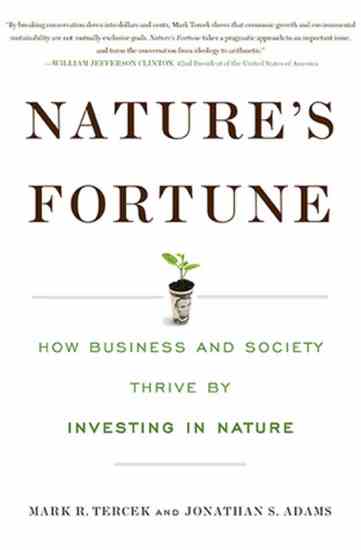

In Nature’s Fortune (Basic Books, 2013), Mark Tercek, along with conservation biologist Jonathan Adams, argues that economic growth and environmental stewardship are not mutually exclusive, and that in fact, saving nature is the smartest commercial investment any business or government can make. In the following excerpt, the pair explains how money and saving nature combine to change our concept of conserving water.
You can purchase this book from the MOTHER EARTH NEWS store:Nature’s Fortune.
Rebalancing water consumption to sustain the competing needs of agriculture, cities, rivers, and lakes requires changing ingrained
patterns of behavior. That includes changing who uses water,
for what, and how much they pay for the privilege.
A popular view among economists places the last part, price, above
all other considerations. Indeed, some who study the problem believe
that getting the price right would magically solve our water problems
and all sorts of other natural resources problems as well. If only investing in nature were that easy.
People around the world have been buying and selling oil for
150 years but have yet to figure out an economically and environmentally
sensible way to do the same with water. When the price of
oil goes up, people drive less and turn down the heat in their homes,
and businesses seek efficiencies or alternative energy sources. Get
the price of water wrong, on the other hand, and the consequences
are dramatic. Raise the price of water and yes, some people will use
less—but rising prices might also force farmers out of business and
cause food shortages.
The controversy over sharing water between farms and cities in
Southern California has a simple cause: not enough water to go
around. The contentious issues are allocation and value. Should
farmers use water in the Imperial Valley to grow vegetables or should
the residents of San Diego use it for drinking, cooking, and household
needs? Elsewhere, the issue is not scarcity but access, moving small
amounts of water at high cost by building new pipes and treatment
plants, to get water to poor urban areas. In either case, the underlying
principle is clear: water, like all earth’s goods and services, should not—
or at least not always—be free.
What Parts of Nature Can People Own?
That principle is far easier to state than to enforce. Basic necessities
such as water, fish, timber, or land safe from floods have to be affordable,
even to the poorest people who may be unable to pay anything
at all, but at the same time not so inexpensive overall that no one has
any incentive to conserve the resource. Markets offer one obvious way
to approach the problem.
To have a market, you first need to have property; after all, you
cannot rightly sell what you do not own. But what parts of nature can
people own?
People own coal deposits and oil fields, forests of valuable timber,
and pastures for grazing. Can they also own all the water underneath
that pasture, or in the river that runs by it? Can anyone—a government,
a business, or an individual—own the diversity of a forest, or the
flood protection that a coral reef provides?
Unease over private ownership of an important part of nature can be
seen in a global context. In June 2010, the United Nations General Assembly
declared, without one dissenting vote, that water was a human
right. The vote was not unanimous: forty-one countries, including the
United States, Canada, the United Kingdom, and Australia, abstained
over concerns about sovereignty. That not one country voted against
the resolution suggests that not even the worst despots would take the
public stand that they have a right to deny someone water. Ownership
of water, unlike oil, has an unmistakable moral component.
The widespread assumption that water and some of nature’s other gifts are and should always be free has deep roots and is thus difficult to upend. In the developed world at least, just about everyone knows two things for certain: when they turn the tap for their morning shower, the water will be clean; and when they get the bill, it will be small. Even in Santa Fe, which in 2011 was the US city with the most expensive water, an eight-ounce glass of tap water costs about a dime. Even that may overstate the case, as Santa Fe is an outlier. The
city faced water shortages, so in 2008 it began building a huge, costly
project to divert water from the Rio Grande—a project that residents
pay for on their water bills. Most everywhere else, even bone-dry
Phoenix, a glass of water costs a fraction of a penny. The scarcity of
water thus bears almost no relation to its price. Water in the desert is
inexpensive, while rainy Seattle has among the highest water prices in
the United States. That’s due partially to Seattle’s need to pay off debt
on water treatment plants, as well a conscious decision by Seattle lawmakers
to keep rates high to encourage conservation.
In fact, most of us hardly even pay for water at all. The water bills
we receive are not for the water itself, but instead for the pipes that
bring water to the house and the people who keep the system working.
The price of water does not reflect its importance—a lapse that
has hidden the risks of water shortages for decades.
Reprinted with permission from Nature’s Fortune: How Business and Society Thrive by Investing in Nature by Mark Tercek, with Jonathan Adams and published by Basic Books, 2013. Buy this book from our store:Nature’s Fortune.






