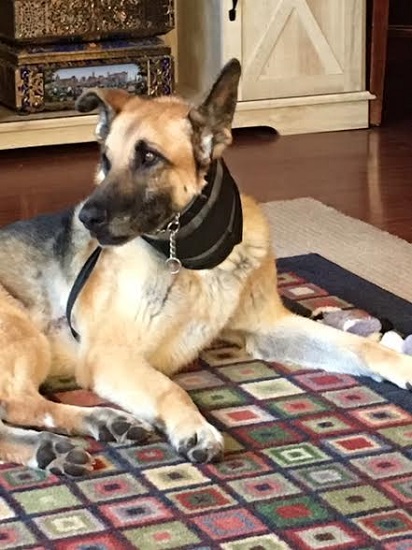
In my last blog about adopting senior dogs I failed to share some of the problems that can be encountered when doing so. While senior dogs without health issues are slow to be adopted, ones with health issues are even slower. We adopted Ruby (see photo) one month ago, problems and all. The sebaceous cysts were clearly visible and we promptly had her seen by a veterinarian to have them removed so she would be more comfortable.
Deafness Confirmed:
With those out of the way our veterinarian routinely checks their ears while they are under anesthesia. We had already discovered she was deaf but wanted to see if any of her hearing could be restored. Regretfully we learned nothing could be done and she would continue to remain totally deaf. She came with no history and hence no name as she was deaf and couldn’t respond to voice recognition commands or any name. Initially I tried hundreds of dog names and when she did not respond to any we suspected she may be deaf.
Communicating With Deaf Dogs:
We had never had a totally deaf dog before so we had to find a way to communicate with her. We started with hand signals and she picked up on them quickly. Until we started her training she would stand in place not knowing what to do or what we wanted of her. If she is uncertain what we want from her she still stands or lays in place until we communicate our wishes. We had to have some method of consistent communication between us and the most important lesson was the “come” command. She also learned to take her prompts from our other senior dog who has been with us for many years. She watches us closely when we are outside/inside for signals as to what we want from her.
Prioritize Commands:
Like most senior dogs she has a strong desire to please and not having the ability to hear verbal commands she looks for direction and guidance. Perhaps younger dogs would not have that strong of a desire to please or to fit into our routine but older dogs seem to always want to please. The “come” command is so important because we live remotely and have occasional predators roaming about (see photo). Our back yard is 1,600 sf consisting of a 6’ high fence for our dog’s protection. Our canine family are always on a leash when outside and not in the fenced area.
Canine Disabilities No Reason To Not Adopt:
As she masters the “come” command we will then move on to other hand signal commands that she will need to know. We don’t think it is wise to attempt too many at one time as it would only serve to confuse her. Her being deaf, her incontinence which is controlled by Rx, or any other senior issue is not a good reason not to adopt her or others like her. Her desire to please us and fit in plus all the love she has is reason enough to make her part of our family. Her medical problems are minor in comparison to the love, desire to please and devotion we receive from her in return.
Safety Precautions:
Ruby’s deafness only presents minor problems that are easily adjusted to by us. We have given her a tag for her collar that indicates she is deaf and also that she requires daily medication and contact numbers should she get loose. We do not expect she will need the tag but should a guest or visitor hold the gate open and if she would slip out she can’t hear us call her so we exercise additional precautions should any unfortunate occurrence happen.
Design Hand Signals That Suit The Canine:
Our hand signals may be different from others with deaf dogs but we are now able to communicate and she is now understanding the new signals better. I’m not sure if there is a uniform set of hand signals so we developed our own. Of course we have to have her attention and be within her sight for the communication to work properly but she seems to know instinctively to look in our direction frequently.
Deaf Dogs Startle Easily:
Living remotely as we do with the sounds of nature all around we regret that she can’t enjoy the sounds but her sense of smell and her vision are acute and very little escapes her attention. We have found that it is important not to abruptly wake her while sleeping as she startles easily. We turn on a light or step heavily creating a floor vibration which lets her know we are near and she awakens normally. Because she does not have any noise distractions she tends to sleep soundly and more often. We have not heard her bark yet but no occasion has occurred that would prompt barking.
No Reason To Not Adopt Dogs Due To Handicaps:
Adopting senior handicapped dogs should not be a deterrent for anyone as the dog can function normally but just has to be treated a little differently. The rewards are exceedingly great inasmuch as they have more love and devotion than we actually deserve. Neither we or the shelter that adopted her to us were aware she was deaf but that would not have made a difference to us anyway. What we want for Ruby is that she has a safe, loving home to live out her days and for her to be happy and content. Just watching her around the house lets us know she is very happy and she certainly doesn’t allow her disabilities to impede her zest for life in any way. Because a dog is deaf or has other handicaps is no reason not to adopt them in my opinion.
For more on Bruce and Carol McElmurray and their mountain lifestyle with their two senior dogs go to their blog site at: www.brucecarolcabin.blogspot.com
All MOTHER EARTH NEWS community bloggers have agreed to follow our Blogging Guidelines, and they are responsible for the accuracy of their posts. To learn more about the author of this post, click on their byline link at the top of the page.