


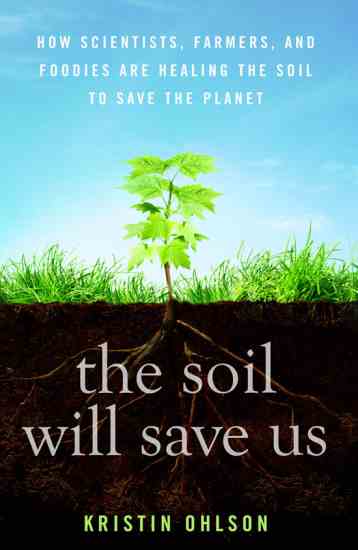
Through vivid storytelling Kristin Ohlson lays out discoveries that will change how humans interact with the land.The Soil Will Save Us(Rodale, 2013) sheds light on the importance of the world’s dirt. After millennia of poor farming practices, especially conventional agriculture, soil health has been depleted. Ohlson argues passionately for building healthy soil as a potential means for reversing global warming, improving food quality, as well as lessening air and water pollution. The following excerpt from Chapter Four discusses the risks involved with using chemical fertilizers and what happens to the soil when they are implemented.
Building Healthy Soil on the Plains
A fleet of dusty pickups and SUVs bumped across the North Dakota prairie, the summer grasses and wildflowers and wiry forbs susurrant against their undersides. From my seat in Jay Fuhrer’s SUV, it sounded as if we were in a boat cresting a river of chop. We finally pulled up next to one of Mike and Becky Small’s cornfields, jumped out into the lemony air — the vehicles had crushed a lot of wildflowers called lemon scurfpea — and formed a ragged circle of plaid shirts. At the center stood Fuhrer, the USDA
Natural Resources Conservation Service conservationist for Burleigh County, the county seat of which is Bismarck. The sun was blinding, and I was the only foolishly hatless person in the group. I hunkered in a tall guy’s shadow, mindful of the tobacco juice he kept spitting to the side.
Fuhrer is a compact man with some silver in his hair and a wryly self-deprecating habit of referring to himself as “the old German.” On that July morning, he could have doubled as the genial host of a cooking show. He bent down and carved up a brownie-size chunk of soil from the Smalls’s cornfield, broke it apart and waved it in front of his nose as if savoring the complexity of its ingredients. He passed dark chunks around for everyone else to sniff and appreciate. Then he wrenched up a cornstalk and shook it until most of the soil fell away from its roots. Even with all his shaking, the tangled strands were still coated in a thick, dark layer of sticky soil. They looked like dreadlocks.
“Why doesn’t the soil fall all the way off?” Fuhrer asked the crowd, touching the roots. “The glues in the soil hold it there. There are aggregates being formed right now.”
He broke off one of the larger roots and asked someone to pour their bottled water over it. When it finally washed clean, he sliced it into pieces and passed them around the crowd, like hors d’oeuvres. I popped a piece in my mouth, and it was — perhaps unsurprisingly — cornlike, sweet and crisp and cool. “Can you taste those sugars?” Fuhrer asked. “Those are the soil exudates! That’s what the plants use to attract the biology.”
People from around the United States and beyond visit Burleigh County to see how soil health can be built in land that is actively cropped. A renegade band of 40 farmers and ranchers there — I’m not sure what they should be called, as most of them both plant crops and raise meat animals — with enthusiastic backup from Fuhrer and USDA scientist Kristine Nichols have done what nearly everyone believes is impossible: They are building healthy, carbon-rich soil and healing their landscapes while increasing yields and making greater profits. And, as Mike Small told me and the crowd of farmers and Natural Resources Conservation Service employees from Missouri who toured that week, they also enjoy more time with their families.
The Trouble with Conventional Agriculture
By its very nature, conventional cropping is a far greater assault on the environment than herding animals. Plowing rips apart the crucial underground networks of mycorrhizal fungi and shatters the soil aggregates that hold water and gases in the soil. After these aggregates break down, the soil particles pack tightly against one another — this is called soil compaction — and the land can’t capture and hold the water from either irrigation or rain. In fact, a recent study showed that nearly half of the rise in sea level comes from water that runs off agricultural lands. Want to know where the quickly draining Ogallala Aquifer is going? Lots of it winds up in the ocean. About 70 percent of America’s freshwater usage goes to agriculture, but compacted soil means that much of it can’t penetrate. Tillage equipment is redesigned periodically to strike deeper and deeper to break up this compacted soil, but this only creates a new and still deeper layer of compaction.
In the process of preparing a field for sowing, conventional farmers also remove all the vegetation so that they can offer a blank slate to the one crop they want to grow and sell, whether it be corn (planted on 24 percent of America’s 406 million acres of cropland) or wheat (14 percent) or soybeans (19 percent). Weeds, other plants, and even residue from a previous year’s crop are removed, often in the fall so that the farmer can plant more quickly the following spring. This leaves the soil bare and exposed for up to 7 months. The process wasn’t designed to starve the soil microorganisms, of course, but that’s what it does, since there are no live roots in the soil to feed them exudates and no dead plant materials lying around for them to gnaw on. When I drove from Cleveland to Portland in the fall of 2012, I sped past what seemed like thousands of these naked brown acres. Sometimes I passed the culprit: a tractor pulling a huge disc, pluming off so much dust that it was hard to see the highway. It was almost as if I was downwind from a fire.
Even most organic farmers conduct this annual ruination of the soil, especially the huge industrial concerns that produce most of the organic products in our grocery stores. They can’t call themselves organic if they use chemical herbicides to get rid of weeds, so they till them away.
Clearing and tilling farmland has been going on for millennia — some of the world’s poorest soils and communities of people have been created this way — but today’s machinery allows it to happen at a far more massive and accelerated scale. Farmers drop seeds into this degraded soil come spring, but have little hope of growing a crop in ground where all the natural processes have been devastated. And not just by tilling and clearing. Without a healthy community of soil microorganisms to provide nutrients, something has to be added. Organic farmers rely on manure, compost, or natural fertilizers to restore some of the lost nutrients, but most conventional farmers — and about 99 percent of our food comes from them — have been subjecting the land to a harsh chemical bath for years. That’s what nearly every expert they’ve ever encountered has told them they must do to survive.
As entrenched as chemical farming seems, it’s only been around for about 50 years. As with so many innovations, the “process of taking atoms from the atmosphere and combining them into molecules useful to living beings,” as Michael Pollan writes in The Omnivore’s Dilemma, is connected with the exigencies of war. Nitrates are needed to make bombs, and a German-Jewish scientist named Fritz Haber figured out how to make synthetic nitrates for the bombs and poison gases that were used during World War I. (He also developed the poison gases later used in concentration camps during World War II, although the Nazis had forced him to leave the country by then.) Weirdly, Haber’s work to pull nitrogen from the air was originally undertaken to create chemical fertilizers and boost agricultural productivity. His invention “liberated” agriculture from biological processes and allowing farmers to raise crops without needing much knowledge of natural systems. “Once chemical agriculture came along, you didn’t need any skill, you didn’t even have to know how to be a farmer,” says Abe Collins, a farmer and soil visionary from Vermont. “You could just throw that stuff out there, even on really degraded land, and get a crop.”
Picky consumers like me look for the organic label in a grocery store or, better yet, a farmers’ market, because we have an intuitive feeling that foul-smelling chemical fertilizers couldn’t possibly make healthy food — we feel that nature’s way has to be better, although we don’t really know why. But the new scientific understanding of what’s happening in the soil validates this intuition. Most chemical fertilizers are a mixture of the three minerals that agricultural scientists long ago determined are essential for plant growth: nitrogen, potassium, and phosphorus. But as microbiologist Elaine Ingham points out, as the tools of science get better, scientists pinpoint more and more nutrients in foods that are important for our health. Those nutrients aren’t going to reach the plants through the application of these chemical fertilizers, because they’re not in the mix. In fact, the full panoply of necessary nutrients might never be in the mix, because the interactions between the plants and the soil microorganisms — nature’s way of providing plants with the minerals they need — are so very complicated and hard to replicate.
Even after tilling, soil microorganisms will still be in the soil, but they aren’t likely to provide these varied nutrients to the plants once the chemical fertilizers are applied. Simply put, these applications interfere with one of nature’s great partnerships. By the terms of this partnership, plants are supposed to distribute carbon sugars through their roots to the microorganisms in exchange for nutrients. Fertilizer disrupts this pay-as-you go system. Plants get lazy.
This excerpt has been reprinted with permission fromThe Soil Will Save Us: How Scientists, Farmers, and Foodies Are Building Healthy Soil to Heal the Planet by Kristin Ohlson and published by Rodale, 2013.






