


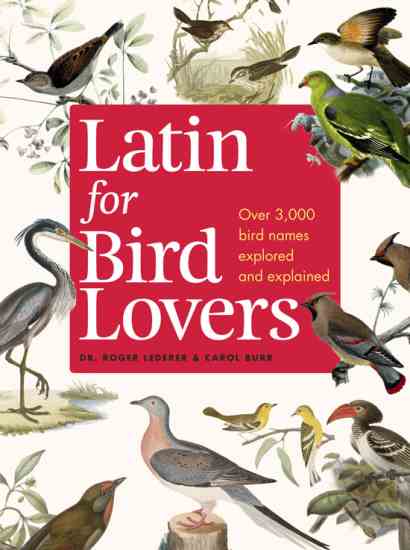
Latin for Bird Lovers(Timber Press, 2014), by Roger Lederer and Carol Burr, uncovers the rationale behind more than 3,000 scientific bird names. It also delves into bird behavior and reveals the fascinating discoveries of ornithologists, such as the one who debunked the myth that robins sing because they’re happy. The following excerpt from “A Short History of Binomials” and “Latin for Bird Lovers” briefly introduces us to the formal system of taxonomy for naming all living things and discusses how scientific names can help bird enthusiasts more accurately identify birds.
A Short History of Binomials
A “binomial” is a double name. It is part of a formal system of taxonomy for naming all living things. Carl Linnaeus, a Swedish physician, botanist, and zoologist of the eighteenth century, is considered the father of taxonomy and the system of binomial nomenclature, in which his name is rendered Carolus linnaeus.
All living organisms are classified according to their evolutionary relationships and through the classification scheme they are given an individual binomial or scientific name that consists of a genus and species. Human beings, for example, are Homo sapiens, meaning they belong to the genus Homo, along with other now extinct species such as Homo habilis and Homo erectus, but are their own specific group, sapiens. In usage, the genus, in this case Homo, is always capitalized and either underlined or italicized. The species name or specific epithet, sapiens, is either underlined or italicized, but never capitalized. And the word “species,” as used in biology, is both singular and plural. (“Specie” is incorrect as it means “coin.”) Species is often used interchangeably with the scientific name. Classifications change over time as new information develops, but it is a slow and thorough process so the classification scheme is quite stable.
A species is generally defined as a group of organisms that can interbreed and produce viable offspring. Anas platyrhynchos, the Mallard, cannot interbreed with Melanerpes cactorum, the Whitefronted Woodpecker, or even with the more closely related Anas strepera, the Gadwall. The species concept continues to evolve with new genetic tools, and there are minor exceptions where different species do hybridize, but the system continues to be useful.
When Linnaeus created the binomial system, “New” Latin was used in Western Europe as the common language of science, and scientific names were in Latin or Greek. Scientific naming is governed by international codes, such as the International Code of Zoological Nomenclature (ICZN) for animals, and the International Code of Nomenclature (ICN) for algae, fungi, and plants.
You might see three names, a trinomial, as in the Red-shouldered Hawk, Buteo lineatus, which has five subspecies, B. l. lineatus, B. l. elegans, B. l. alleni, B. l. extimis, and B. l. texanus. In the hierarchy of taxonomy, only one name below the binomial, a “subspecies,” is allowed to denote different color forms or geographic races of a particular species. Hypothetically, all these subspecies can interbreed, but it may not happen if their ranges do not overlap. So whilst subspecies is a somewhat slippery concept, it is useful in delineating populations with distinguishing characteristics. Thus, binomial nomenclature provides a global identification of particular bird species and defines their relationships to other birds. DNA studies over the past couple of decades are refining those relationships and name changes will continue to occur.
Where do the names come from?
• Latin and Greek and occasionally other languages, as in Anas platyrhynchos, which comes from the Latin Anas, duck, and from the Greek platy, flat, and rhynchos, bill. Gavia immer is the Great Northern Loon or Diver, Gavia deriving from Latin, meaning ravenous sea bird, and immer, Swedish for embergoose, referring to the dark color of the bird.
• Names of people, often ornithologists or naturalists, and, in practice, names of people other than the person doing the naming. The White-eared Bronze Cuckoo, Chrysococcyx meyerii, was named after Adolf Meyer, a German anthropologist and ornithologist of the late nineteenth and early twentieth century.
• Names of places, as in Tangara florida, the Emerald Tanager.
• Local names, like Hoopoe, an onomatopoetic name based on the bird’s call. These common names become part of the scientific name, in this case, the Greek epops, in Upupa epops.
• Descriptions of the bird’s color, shape, or behavior such as Bicinctus, twice encircled, or banded, as in Treron bicinctus, the Orange-breasted Green Pigeon. The Red-headed Myzomela or Honeyeater, Myzomela erythrocephala, is from the Greek, muzao, suck in; meli, honey, Latin, erythro, red, and cephala, head.
• Odd appellations, such as Aerodramus fuciphagus, from fuci, seaweed, and phagus, eater of, as in the Edible-nest Swiftlet. The species name derives from a Chinese story of the birds swooping down into the ocean to collect material for their nests, which are made almost exclusively of saliva, not seaweed.
On the whole, the scientific—binomial—names of birds are descriptive in one way or another. More importantly, they can definitively designate each particular species of bird in one language that is officially recognized around the world.
One can only imagine the confusion if birds were identified only by their common names. Instead of Anas platyrhynchos all over the northern hemisphere, we’d have Mallard, Canard Colvert, Anade Real, Stokente, Wilde End, Germano Reale, Stokkand, Ma-gamo, Pato-real, and others. Clearly unworkable. So scientific names are valuable, although common names are used most often by birdwatchers.
But since common bird names have caused confusion in the past, the American Ornithologists’ Union and British Ornithologists’ Union have made some common English names for American and British birds official.
As in all science, continually gathered new information changes taxonomic relationships, and the scientific and common names along with them. So, although we tried to include the most current and accurate scientific names, based on the International Ornithologists’ Union’s IOC World Bird List, there is no guarantee that they will be accurate tomorrow.
Latin for Bird Lovers
As in every scientific discipline and related endeavors, words derived from the Latin form the core language of the discipline, although derivations from Greek and shared Indo-European roots figure strongly as well. Ornithology and bird-watching are perfect examples. The scientific names of birds define the relationships among some 10,000 species and are typically descriptive. The genus and species name may describe the birds’ color, pattern, size, or parts of the body; the name of an ornithologist or other person; where it is found; its behavior; or some characteristic that may not make sense now but did in the eye of the person who named it. In any case, it is often interesting. For example, Falco mexicanus, the scientific name of the Prairie Falcon, obviously means a falcon from Mexico. Less obvious, perhaps, is Anas acuta, the Northern Pintail, whose scientific name means “sharp duck,” referring to the male bird’s tail.
Bird enthusiasts don’t often pay much attention to scientific names, but bird feather anatomy such as “superciliary” and “auricular” are crucial to identification, as is “furcula” to those banding (or ringing) birds and estimating fat stores on the birds. “Pelagic” is a term not known to most people but often used by ocean-going birders.
We hope this book will open your mind to some scientific and everyday terms that have derived from the Latin and make your bird-watching activities all the more fascinating.
Biological classification is based on the work of Carl Linnaeus, who grouped species on the basis of shared physical characteristics. Darwin’s classifications based on evolutionary descent increased the consistency of classification. Now, phylogenetic groupings created by taxonomy and DNA data in addition to morphology are used. Interestingly, these new methods have corroborated much of the anatomical and morphological classifications.
The major taxonomical classifications are class, order, family, genus, and species. Birds belong to the Class Aves and are grouped into 27 orders, all of which end in -iformes, such as Passeriformes (songbirds) and Gaviiformes (loons or divers). Each order contains one or more family, ending in -idae, such as Paridae (titmice). The focus of this book is on the genus and species, the most specific groupings. The genus is always capitalized and italicized; the species is always lower case and italicized; e.g. Passer domesticus, the House Sparrow. While taxonomists in all biological fields disagree to some degree about classifications schemes, those in ornithology generally agree.
Pronunciation of the names in this book is based on New Latin, the form that developed after the Renaissance (around 1500) for scientific nomenclature, particularly Greco-Latin taxonomic nomenclature of biology.
Unlike classical Latin, New Latin varies from region to region, country to country, and there is no international agreement about how scientific names should be pronounced. Since this book is in English, we are using that language to shape our pronunciations. Our main goal is to give you a workable pronunciation that is true to the etymology of the term—both Greek and Latin. In addition, we are using English pronunciations of places to determine the best management of vowels, consonants, and accents.
Beyond the regional differences in the pronunciation of scientific names, New Latin differs from classical Latin in its handling of vowels, consonants, and accents. For example, there is no th- sound in classical Latin; it is, however, generally used in New Latin but only in its unvoiced form, as in theater. The only exception to this rule is in proper names, such as a person’s name (Thomas) or a place name (River Thames). Many birds are named after people, usually not the person doing the naming. These names are “Latinized” to create the binomial. For example, Audubon named a wren after English ornithologist Thomas Bewick. This bird’s common English name is Bewick’s Wren, but
the Latin name is Thryomanes bewickii (Greek, thruon, reed, and manes, very fond of ) to describe the preferred habitat of the bird. Bewick’s name becomes Bewickii, -ii to show possession, giving us a pronunciation of be-WIK-ee-eye. While the accent is generally put where it exists in the language of the name, the Latin possessive form sometimes shifts that accent and accounts for some of the variations in pronunciation between regions and countries.
Taken from Latin for Bird Lovers: Over 3,000 Bird Names Explored and Explained© Copyright 2014 by Roger Lederer and Carol Burr. Published by Timber Press, Portland, OR. Used by permission of the publisher. All rights reserved.






