

Next to air, without which we could survive for only a few
minutes, water is the compound most necessary to human
life. Not only do we drink it — to help our bodies
perform a number of vital functions — but we cleanse
ourselves with it, grow food with it and harvest the
bounty of its lakes and streams. In fact, the single most important reason for a human’s
picking a spot to live has usually been the presence of an
adequate supply of clean water.
Of course, Western civilization’s attitude toward the
precious liquid has changed somewhat in the last 100 years.
Water is now delivered to most people in developed
countries through mazes of pipes and faucets, rather than
directly from wells or streams. It’s entirely possible
that the attitudes engendered by take-it-for-granted tap
water have helped cause the pollution and shortage problems
we face today. In little more than a decade, the threat to
our drinking supplies has become a top-priority concern.
In fact, 10 years ago few people even recognized the
danger in what was then a puzzling new phenomenon … acid
precipitation. Acid rain, as it’s often called, is a direct
result of the burning of fossil fuels, and it’s the
first water-quality problem that’s managing to
cross state and national boundaries on a daily basis.
Where Does Acid Rain Come From?
Acidified precipitates (which can include rain, snow, other
forms of atmospheric moisture, and dry acidic particles)
are produced when sulfur oxides (SO 2 and SO 3 ) or
nitrogen oxides (NOx) — or, to a minor extent, hydrogen
chloride (HCI) — react with air and water in the
presence of sunlight. Though the actual mechanisms that
produce acid precipitation are not thoroughly understood,
there’s little question that they result in sulfuric,
nitric, and/or hydrochloric acid build-up that can render
rainwater as sour as vinegar!
The primary sources of sulfur emissions (which are
estimated to cause about two-thirds of all acid
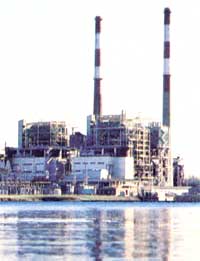
precipitation today) are coal-fired power plants (Ohio’s
electric utilities are the largest producers in the U.S.)
and smelters (International Nickel in Sudbury, Ontario
pumps out 1 percent — roughly 2,500 tons — of the world’s daily
total). Nitrogen emissions, on the other hand, come largely
from transportation sources (about 40 percent), with effluents
from power plants and industry making up the rest.
Though such pollutants usually remain in the atmosphere for
no more than five days (NO hangs on longer than does SO 2), they’ve been known to show up as far as 700 miles
downwind of their sources, in the form of sulfates and
nitrates. These two substances are the major producers of
acid rain.
Ironically enough, if it weren’t for the
Clean Air Act of 1970, they probably wouldn’t have gotten a
chance to travel so far and do so much harm: In order to comply with the act’s standards, many utilities
and industries in the early 1970s built tall
smokestacks to disperse emissions (which, for the purpose
of law enforcement, are measured at ground, or nose,
level). Though no one anticipated the problem at the time,
the superstacks (International Nickel’s is 1,250 feet high)
help sulfur and nitrogen stay airborne long enough to cause
full-fledged acid precipitation.
Of course, coal-fired plants that have been built since the
passage of the Clean Air Act are equipped with sulfur
scrubbers and are relatively clean. The older
(uncontrolled) plants now spew out most of the sulfur oxide
emissions that enter the atmosphere. Consequently, it’s of
vital concern that the oil-fired power plants currently
being converted to coal not be considered “old” — and
thus uncontrollable — for regulatory purposes.
Nitrogen oxide, the other major cause of acid
precipitation, is much more difficult to deal with than is
sulfur oxide. Because there is no suitable control
technology yet, nitrogen oxide production is likely to remain
essentially unchecked for as much as a decade. Rollbacks
and/or delays in clean air standards (both of which are
advocated by the Reagan administration) could further
postpone effective control of nitrogen oxide emissions.
How Acidic is Acid Rain?
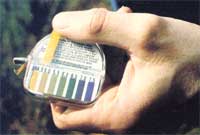
The acidity or alkalinity of a solution — as many of
you already know — is measured numerically (the levels
range from 0 to 14) on what’s called a pH scale. A pH of 7
is neutral, while smaller numbers are acid and larger ones
are basic (alkaline). The rating is actually a measure of
the concentration of hydrogen ions and it builds
logarithmically (that is, pH 6 is 10 times more acidic than
pH 7; pH 5 100 times more than pH 7; pH 4 is 1,000 times more
than pH 7).
The pH of pure rainfall happens to be slightly lower than
neutral (about pH 5.6), because the moisture reacts with
naturally occurring carbon dioxide in the atmosphere to
produce dilute carbonic acid. Hence, precipitation that has
a pH of less than 5.6 is generally considered to have been
made acid by some human activity. Historic records,
obtained from core samples of polar ice, indicate that
world precipitation has been slowly growing more acid over
the last 100 years. (Episodes of acid rain have occurred
naturally for eons — caused by sulfur released from
volcanic eruptions, for example — but these sources
contribute a very small part of this century’s growing
total.)
Though Swedish scientists were the first to pinpoint the
harmful effects of acid precipitation, U.S. researchers
have been keeping track of rainfall pH since the 1950s. As
far back as the middle of that decade, precipitation with a
pH of 4.5 was occasionally recorded in a few areas of the
Northeast. But, by 1979, the average pH of rainfall
in the entire eastern U.S. had fallen to below 4.5 —
and many areas now regularly report pH readings as low as
3.4 (close to the acidity of vinegar). Nor is acid
precipitation limited to the eastern U.S. In the Los
Angeles basin, for example, typical pH levels have fallen
from around 7 in the 1950s to between 4.5 and 5 at
present.
What Does Acid Rain Do?
The overall effect that acid precipitation has on a
particular ecosystem depends largely upon the soil and
water’s ability to tolerate the incoming low pH liquid.
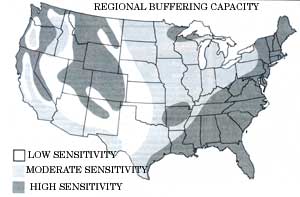
Areas rich in calcium or magnesium carbonates (limestone
and dolomite, respectively) and/or organic matter are, as
yet, able to buffer the acidity of the rain, in much the
same fashion that an antacid tablet relieves a sour
stomach. Ironically, the Midwest (where a large portion of
the sulfur oxide emissions are produced) has good buffering
capability overall. But, downwind — in New York,
Pennsylvania, and West Virginia — the soils are formed
mostly from igneous rock that’s low in buffering compounds.
In the Adirondack Mountain region of New York (which has
been the hardest-hit area of the U.S.), more than 200 lakes are
now considered acidified, with an average pH of less than
4.5. (Remember, that’s 500 times more acid than a normal
lake.) To the north in Ontario,
Canada, 400 lakes have been lost to acid
precipitation and 48,000 more are threatened. (Despite
the prodigious emissions of the nickel plant in Sudbury,
it’s estimated that two-thirds of Canada’s acid
precipitation results from airborne contaminants produced
in the U.S.A.)
In order to appreciate the potential damage we’re talking
about, it’s important to understand what happens when a
body of water goes acid. More than 50 percent of the lakes with pH
readings of less than 5 have no fish at all. Even at pH 6.5
the reproductive capacity of most trout species begins to
drop — and the fry that do survive are increasingly prone
to genetic defects. Often, the first hint that a lake is
going acid comes from people who fish there, when they
report a limited catch of large fish (which grow rapidly as
a result of not having to compete with new generations for
food) and few, if any, smaller ones.
However, scientists believe that the eventual death of the
fish population in an acid lake isn’t caused directly by
the low pH. Rather, it’s thought that toxic metals which
are mobilized by the acid precipitation — aluminum and
mercury are the two most prominent offenders — do most
of the damage.
Other forms of aquatic life are also severely affected by
low pH. The bacteria that are normally present in
freshwater lakes tend to die back as pH drops, while fungi
are more likely to thrive. Consequently, organic matter
(such as falling leaves) accumulates on the lake’s bottom
instead of being consumed. In fact, so many bacterial
organisms, which are normally suspended in the water, die
off that acid lakes are often very clear. (A sure sign of a
lake with low pH is the growth of sphagnum moss on the
bottom. That plant can adapt to an aquatic life
only in acid water.)
Because it’s been less than 10 years since scientists
began to study the effects of acid rain, our understanding
of the problems it causes is by no means complete. Although we
are beginning to catalog the effects of low pH on
freshwater lakes, research into the actions of acid
precipitation upon complex land-based ecosystems has barely
started.
Still, even the fragmentary available evidence points to a
number of dangerous terrestrial effects — including
threats to human health. The presence of sulfate and
nitrate compounds in the air over the Northeast has been
shown to correlate with a pollution-related death rate
(resulting from lung disorders and cancer) that is roughly
twice that of areas with cleaner air.
Acid rain is also damaging the quality of domestic water
supplies, both private and public. Folks who depend on
cisterns for their potable water may have dangerous levels
of lead, zinc, and/or aluminum in their drinking supplies resulting from deterioration of the catchments and from
suspended material. Throughout much of the East, collecting
rainwater for drinking is unsafe. Furthermore, some
reservoirs have become so acidic that they must be treated
(largely with lime) at tremendous expense. Low-pH water
also increases the corrosion rate of many types of plumbing by contaminating drinking supplies with copper, zinc or
lead from pipes.
In many regions it’s no longer healthful to eat fish caught
from local lakes, since the creatures are likely to contain
dangerous concentrations of aluminum and/or mercury that
have been liberated by acid precipitation. Officials in New
York advise that children and pregnant women not eat any
fish caught in the state’s lakes.
Acid precipitation also degrades soil quality and can
result in stunted plant growth. Calcium and magnesium are
leached from the soil by low-pH rain, and such elementary
processes as reproduction, nitrogen fixation and
photosynthesis may be slowed or interrupted. The protective
waxy coating on leaves is sometimes stripped away by acid
rain, and the presence of low-pH precipitation makes it
especially likely that greenery will draw toxins, such as
lead and cadmium, from the soil. Some crops are more
affected by these problems than others — but we do know,
for example, that soybean yields in some areas are already
being reduced by acid precipitation.
Valuable inanimate materials are also feeling the bite of
contaminated rain, snow, etc. Buildings made from limestone
and marble — substances that are especially
susceptible — are showing prominent pitting (the U.S.
Capitol is a case in point). Even relatively acid-resistant
granite structures are being damaged because calcium-based
mortar is used to bond the blocks in such buildings.
Furthermore, metals are more prone to corrosion in an acid
environment. It’s frightening to contemplate the dollar
value of damage to automobiles that are rapidly rusting
away because of acid rain.
If we continue to pour sulfur and nitrogen oxides into our
atmosphere at the present rate, we face an ecological
crisis, a significant risk to human health and an economic
loss that could be staggering. Unfortunately, such
emissions are likely to increase through the year 2000.
According to the Environmental Protection Agency, sulfur
emissions can be expected to rise by 10 to 20 percent during the next
20 years, and those of nitrogen oxides by at least 50 percent. The
steps taken by Congress to modify the Clean Air Act in late
1981 or early 1982 will be the single most important
influence on such developments.
Though there are no regulations today that deal directly
with acid precipitation, there are methods of control
available. By using stack scrubbers, low-sulfur coal,
washed coal, and new technologies such as fluidized bed
furnaces, sulfur emissions
could be cut by as much as 80 percent. The cost of doing so would
be substantial, but might not be as high as utilities and
our current government would have us think, and the expense
involved in ignoring acid rain could prove to be
much larger in the long run. However, the burning question
is: Can we put a price tag on protecting our
planet’s ability to support life?






