

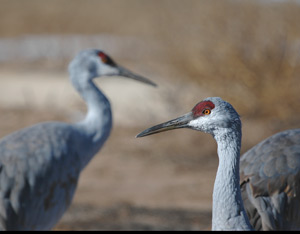

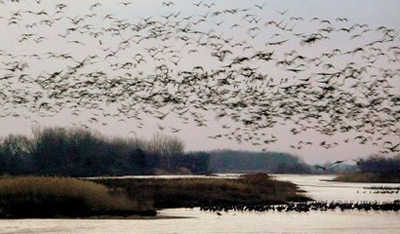
It’s spring or promises to be, and so, again, I need to be among the Cranes. There’s an actual ache in my breastbone which pulls me to get my feet wet in the meadows, to watch the Sandhill Cranes eat and dance in the farm fields, to hear them wake and call to one another at dawn, and to see them ride thermals on the brighter, south wind days, kettle, then fly to the river to roost together on the sandbars in the river at dusk.
This year I didn’t get out to see the Spring Crane migration on the 80-mile Big Bend of the braided river Platte until the first weekend in April. I had planned on going the last weekend in March, but the bluster of ice and snow kept me home reading by the fireplace. One year, I saw them on an 80-degree last day in February.
Though the Platte River has only been flowing for maybe 10,000 years or so, fossil evidence says that the Cranes have been migrating through this area for 9 million years or more. The adult Sandhill Crane is gray with a red crown and stands between three and four feet tall. They weigh in at between 6 and 12 pounds, have a 6- or 7-foot wingspan, and live from 20 to 40 years.
Given that they are migratory, Cranes eat whatever they find wherever they are. They spend their days in the North American Central Flyway and what is now Nebraska gleaning leftover grain from last season’s crops, though every once in awhile a little rodent becomes a meal, as do small reptiles and amphibians, earthworms, plant tubers, and grubs. Sandhill Cranes find their way over the globe through the collective memory of the flock, teaching their young and keeping them close for their first three years.
I have photographs, journal entries, audio, and poems of and about the Sandhill Cranes, but the pull to be among them lives in my forward body. Every year that I am within a five or six hour drive to the Big Bend of the Platte River, I join them for a dusk, a dawn, a day.
One might think that a bird who has a nine million year history of taking off, flying, and landing, might have gotten pretty good at all skills involved in that. And they are prodigious, effective fliers, Cranes are, flying an amazing 25-35 miles per hour, and typically traveling some 200-300 miles a day. With a good tail wind, they have been noted flying five hundred miles in a single day. However, their landing skills still need a bit of polish, though it is perhaps my favorite thing to watch them do. Wings out some, they float into a landing, looking as if they were each assisted by perhaps a tiny, invisible parachute. Then they tumble into a landing, as often as not, as if they have not quite decided whether their feet or their tummies should come to ground first. So, even with nine million years of practice, they wouldn’t be invited to any sort of Carneige Hall landing competition or concert.
Sandhill Cranes migrate from wintering in South America to flying their 200 to 500 miles per day up to northern Canada, Alaska and Siberia. They stop off on the Platte to eat and to gain weight and strength from copious amounts of grain and grubs, to dance for, at, and with their mates, and to sleep safe on bare sandbars in the river, protected from predators.
This year there were no friends who migrated to my house from Maine or Pennsylvania, California, or from down the block to travel with me to see the Sandhill Cranes munching in the fields near the Platte. Nor were there any little children of mine dressed in railroad striped overalls, t-shirts, and jean jackets, their faces full of sleep from our pre-dawn drive. Nothing and no one much traveled to see Cranes way back when when I first did. Every third or so pickup stopped to ask if we needed help; had our old half-dead Chevy broken the rest of the way down, or what.
Instead, this year, it was my partner of 23 years and I packed into the car with the ritual tick and bug spray, binoculars, camera, blankets, gloves, hats, sketch pad, water, protein snack bars, journal, and stamps for all the postcards I inevitably buy, write, and send.
This wasn’t the year I saw a pair of American Bald Eagles in their nest, their fledglings’ fluffy heads just visible above the nest. This wasn’t the year I saw as if an x-ray of a Crane wing, the sun above the low-flying bird, me six feet or less below the bird. This also wasn’t the year I saw Cranes riding the thermals, those columns of warm air born of south winds, which start up in March and April along this River. Cranes ride the thermals so high, one does not know there are Cranes in the sky. Even with binoculars, they are distant. Famously, Cranes have been seen riding thermals over the 28,000-foot-tall Mt. Everest.
However, if I’d been present on that inch-deep, mile-wide 10,000-year-old river earlier this year, I would have seen a blizzard of Snow Geese migrate through. So many Snow Geese, I hear, that they darkened the sky! Now that’s a sight I’d like to see, a tumult of wings I’d like to hear, a group I would like to be among even for the briefest time. This year, too, people chattered gleefully about seeing many more than usual American White Pelicans. One smiling bird-person mentioned seeing the single Whooping Crane who travels with the Sandhill Cranes. The white Whooper is still in Kansas right now at the beginning of April, but she’ll be flying through Nebraska in the next week or two, they say.
At the straw bale Audubon center there on the Platte they keep count of the birds who live or migrate through the area spring and fall, winter and summer. They’ve recorded sightings of Loons and Grebes, Gulls and Terns, Vireos and Warblers, Cormorants, Doves, Cuckoos, and Owls, Catbirds, Mockingbirds, and Brown Thrashers, the Black-crowned Night-Heron, the Great Blue Heron, Snowy Egret, Green Heron, White-Faced Ibis, Pigeons and Wigeons.
Ducks and Raptors, Warblers including the Yellow-Rumped Warbler, Hummingbirds, and Kingfishers, Owls, Owls, and more Owls, Eagles, and Terns and the Double-crested Cormorant, Flycatcatchers, Larks, and Swallows, Sparrows, Cardinals, Buntings, and Grosbeaks are there, too.
Blackbirds, Finches, Pheasant, Prairie-Chickens, Turkeys, and Bobwhite, Pipits, Waxwings, and Shrikes. Jays, Crows, Magpies, and the Baltimore Oriole. Wrens and Kinglets, Plovers and other shorebirds like the Killdeer, American Avocet , the Greater and LesserYellowlegs, Willet, the Spotted and Upland Sandpiper, Whimbrel, Hudsonian and Marbled Godwit, Ruddy Turnstone, the American Woodcock, and Wilson’s Phalarope gather and fly, nest and raise young.
And in winter, the Trumpeter Swan migrates through what is largely farmland populated with photographers, coyotes, and other mammals, reptiles, amphibians, summer butterflies, wildflowers and grasses, the roads, just graveled dirt strips of unplowed fields.
Granted, most of these birds are dwindling, remnant species, flocks but a murmur of the roar they have been in the past, but there in my favorite stopping place on Elm Island Road, a foot from the flat Platte, this is what and who we have left, and it is wonderful.
Top Photo: Fotolia; Illustration: Linnea Johnson; Bottom Photo: Cheryl Long





