

Not long ago the ruggedest, most versatile
farm utility vehicle made anywhere was the pickup truck
manufactured by the American automotive industry. Like most
Detroit brain children, it was a mother-bear to work on . .
. but the body was solid enough to withstand the most
abusive treatment and the springs–designed for
shouldering brawny loads down back roads–could put
kinks in your backbone.
Recently, though, the American
pickup truck has been transformed into a glorified town
car, making it more difficult to know how to maintain a truck. Its body is now tinnier, chromier, more sculptured . .
. and the springs have been softened so much in an effort
to make the vehicle suitable for Miss America to drive to
the boat dock that, today, a new “stock” pickup is hardly
qualified to haul a load of feathers to a comfort factory.
But, to be fair, the machine’s engine has been improved and
somebody up there has actually begun to think about us poor
devils who have to work on the monster.
Now, if you’ve never owned a real working vehicle of any kind, you might
not realize just how important that last point–which
I call “maintenance potential”–can be. In truth,
though, the maintenance potential (how easily and
economically a machine can be repaired by its owner) is of
supreme importance to anyone buying a new or used pickup .
. . especially if the buyer will be operating the vehicle
in a remote area and/ or on a limited budget.
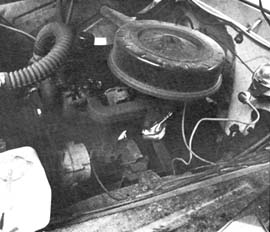
To determine the MP of a pickup, first compare the size of the truck’s
engine with the size of the vehicle’s engine compartment.
Look at the clearance between the firewalls and the engine
(bearing in mind that clear space equals easier working
conditions every time you’re forced to make an adjustment
or replace something).
Next, concentrate on the manner in
which the engine and its accessories are arranged within
that space. Is everything packed tightly into a confusing
maze? That sort of efficiency can cause you to move half
the engine to get at the generator or adjust the carb . . .
and will cost you time and barked knuckles (if you do your
own repairs) or money (if you hire it done). Either way, it
certainly takes the joy out of even minor maintenance.
Is the engine a six cylinder or a V-8? An eight has its uses
on a drag strip but there are several arguments against it
in a utility vehicle. For one, it’s a hard dude to work on.
An eight also has more moving parts to replace than a six
and the arrangement of those parts generally makes for a
lot more grunting and straining when repair time rolls
around. And then there’s the eight’s greater appetite for
fuel.
On the other hand, the six has its problems also, the
greatest of which is lack of power when it comes to
muscling into the tougher jobs.
The best compromise is often what is known as the “truck-six”. This is the engine
designed especially for 3/4 ton and larger trucks. As built
by most major companies, the power plant ranges in the
neighborhood of 300-cubic inches, has enough guts to walk
right through the toughest jobs and is built to last. These
durable mills almost always have five main bearings instead
of the three considered sufficient on most automobile
engines . . . which reduces wear on the crankshaft, rod
bearings and main bearings themselves.
Obviously, a truck-six engine will probably be your first choice
but–V-8, six or truck-six–every power plant must
be judged on its own merits. No need to jump in any
direction yet. Might as well check out a few of the finer
points while you have your head under that hood.
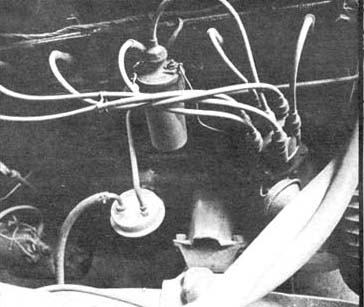
Look at the position of the distributor and the nut underneath
which must be loosened to adjust the engine’s timing. Is
the nut easily accessible or will it take an extension
elbow to reach it? Is the distributor itself in such a
position that you can time the ignition alone . . . or will
you need another person to move the blamed thing while you
operate a timing light?
If you can see the fuel pump, can you get a wrench on it?
Open, box-end or socket? Using an open or box on a long
bolt can be a royal pain, especially when you’re running
short of daylight or a storm is approaching.
What about the water pump? Will you have to remove the radiator to change
it? And the bolts that hold it in place . . . ask yourself
the same questions about them that you asked about the
bolts on the fuel pump.
By now you’re getting the general idea. If you buy this truck, you’re the one who’s going to
have to work on it, love it and take care of it. That
knowledge kind of gives you a more critical eye as you look
the vehicle over, doesn’t it?
OK. Now check the maintenance
potential of the seldom-considered bottom side of
the truck. Crawl underneath and take a look at the bolts
which hold the crankcase on. Can you get to all of them
with a tool of some kind? A careful look will tell you a
lot about whether or not you want to own this pickup. The
crucial question is: can you drop the oil pan without
pulling the engine? On a number of models you can’t
and, in that case, you probably won’t want the truck.
In the same manner, if the drive shaft from the engine to the
real wheels is enclosed above the frame, you’ll have
trouble dropping it to pull the transmission or to replace
the universal joints. The situation is roughly equivalent
to that of a dentist telling you that your teeth are all
right . . . but your gums have got to come out.
So much for a quick check of the maintenance potential of the vehicle
you’re considering. Another area that’s extremely important
in a farm pickup is is hauling capacity . . . a subject
which covers a very wide range of non-standard
characteristics. If you’re buying your first utility
vehicle, chances are you’re not familiar with these
characteristics and you’ll only notice them when you don’t
want to. That is, when they get in the way or when you need
them and they’re not there.
First off, pickups come under
two tonnage designations: 1/2 ton and 3/4 ton. These
quick-and-easy tag names used by Detroit tell you only that
the second is larger than the smaller. That’s all the names
mean. Trucks in both categories–properly
outfitted–are capable of hauling immeasurably more
than three-quarters of a ton. Other pickups–again, in
both categories–are often unsafe carrying a load half
that size. The difference depends, in large part, on the
tires and springs with which the truck is equipped.
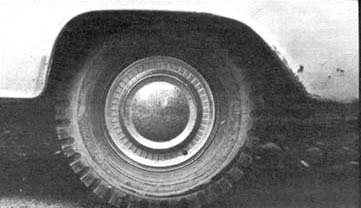
But tires are tires, right? Wrong! In fact, there is such an
incredibly diffuse selection of tires–made from
different materials, in different sizes, different plys and
different ply “equivalents”–now on the market that
this piece could easily turn into a book about tires. Let
me over-simplify, then, and say only that you’ll be wise to
make certain your pickup is mounted on truck–not
automobile–tires that are rated for the largest total
gross weight at which you ever expect your vehicle to tip
the scales . . . plus a generous margin for error,
wear, etc. In general, too, the bigger in diameter the
wheels and tires are, the better they’ll be for lugging
around heavy loads . . . assuming, of course, the truck’s
springs will take those loads.
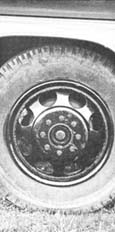
I favor 16″ wheels because
they offer more ground clearance than fifteen inchers. And,
since the 16″ tires range from six to sixteen ply, the body
of one of the heavier tires will have a longer life than
the tread and can be safely recapped almost forever. As a
second choice, there are some very good truck type
fifteen inch wheels and tires. They don’t come as standard
equipment on 1/2 ton trucks but they are available and
they’re worth every extra penny you pay for them. You might
also consider buying only mud-grip or snow tires for the
back country. They don’t hold up as well at highway speeds
but they can’t be beat for getting away from it all.
Today’s
“standard” half-ton pickup is a second cousin to the family
car but a 3/4 ton is half-brother to real, no-nonsense,
hauling trucks. From the outside, it’s hard for some
first-time-buyers to tell one from the other. The
difference, however, is worthy of note . . . even
if–as is generally the case–that difference
happens to lie in out-of-sight places.
Not so out-of-sight
are the noticeably larger and heavier-duty engine,
transmission and rear end on the 3/4-ton machine. Also
obvious are the standard 16″ truck tires (the half-ton
comes equipped with automobile-type fifteen-inchers). The
springs are hardier and heavier on the 3/4 ton, too. Miss
America wouldn’t like the rougher ride that results but
you’ll appreciate the greater hauling capability those
springs give you.
Spring capacity is one of those
not-so-obvious things that represents an important
consideration no matter what size pickup you buy. Much of a
truck’s utility depends on this capacity, so always try to
get the heaviest springs available (without necessarily
going to “overloads” unless you know you’ll be doing a lot
of extremely heavy hauling). The bigger and heavier the
springs, the longer it’ll be before they sag . . . and, in
the meantime, they’ll give you a great deal of protection
on heavy jobs.
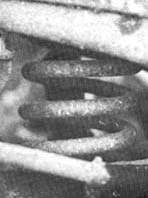
By the way, coil springs are another one of
Detroit’s inventions that are better left off a truck. They
sure enough give you a soft automobile-like ride . . . but
they aren’t as strong or as durable as good leaf springs.
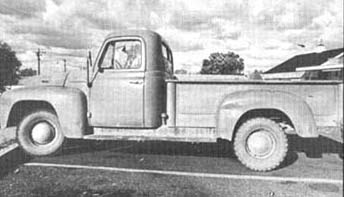
Another point to consider when you’re figuring the hauling
capacity of a truck is the machine’s wheel base: the
distance between the front and rear wheels. There are
strong arguments in favor of both the long and short wheel
base. Forget those arguments and let the specific use you
have in mind for your truck make the decision for you.
Trucks with a long wheel base generally ride more smoothly
on the road and–having a longer bed–have a
larger load capacity than those trucks with a short wheel
base. The long-legged vehicles are less maneuverable,
however . . . the longer distance between the sets of
wheels gives the machine a larger turning radius and tends
to make it more susceptible to “high centering”, or
dragging its belly, in rough country.
Short wheel base
trucks are easy to park and generally get around better in
both traffic and the boondocks than do their spaced-out
counterparts. The shorties are also better for jobs like
pulling stumps because they generally have more weight over
the rear wheels. But the bed on these sawed-off pickups
is–understandably–a couple of feet shorter too
and, if you put a tool box behind the cab, you’ll find the
space left over hardly bigger than a car trunk.
A small bed
on a pickup can be the largest single factor in determining
the truck’s hauling capacity since a well-sprung and
well mounted vehicle can haul a lot more of most things than
anyone could ever cram into even a long bed.
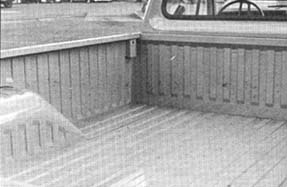
Pickup beds
come in two basic sizes: wide and narrow. Each has a
specific purpose and each is available in 1/2 or 3/4 ton,
short or long wheel base.
The walls of a narrow bed go
inside the truck’s wheel wells, making the bed a
straight-sided, rectangular box. Grain, sand, feed and
other scoop-it-out-with-a-shovel materials are much easier
to unload from one of these beds since there’s no
wheel wells sticking into the box to work around.
For hauling anything other than loose loads, though, you’ll
usually come out ahead with the wide bed. It has
considerably more room and is almost wide enough to let you
lie down in it crosswise. The wide bed also offers a lot
more storage space “back in” if you ever mount a camper on
such a pickup.
Another seemingly unimportant (at least at
first glance) element of truck design is the position of
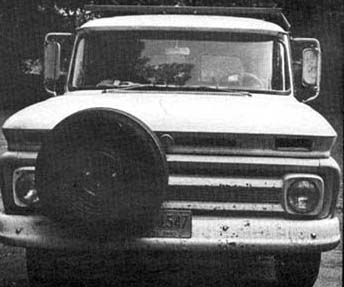
the spare tire. If the tire is mounted on the inside of
your pickup’s box it can take up a lot of valuable hauling
space. If located on the outside of a narrow bed, the tire
may encourage a ripoff artist to lean against the vehicle’s
side, work off the lugs and steal the wheel in broad
daylight.
Many of the newer trucks mount the spare under the bed.
This is a good place for it . . . unless you’ll be working
your pickup in really rough country. Many times I’ve had to
use my spare tire as a base for the jack in order to get
the truck out of mud. If the extra wheel had been up under
the bed, I’d have been in a bad fix.
The ideal place for the spare, if you have a choice, is
over the front bumper. There, it will offer some protection
in case of collision and it’ll be completely out of the way
when you aren’t using it, completely accessible when you are.
One caution, however: on some trucks it’s necessary to mount
the extra wheel off center so it won’t cause the vehicle to
overheat by unnecessarily blocking air flow to the machine’s
radiator.
A very important factor that buyers often overlook
while shopping for a truck is fuel capacity. This can be of
prime importance in the back country. Fuel tanks capable of
holding upward of 60 gallons are available as options on many
newer trucks and they’re a good buy. They’ll get you into
town in an emergency and–in the city–they can
carry you from gas war to gas war.
Matter of fact, the whole
subject of fuel itself cannot be overlooked by anyone
shopping for a pickup. In some back areas of this country
(and certainly in rural Mexico) the best petroleum available
is little more than high-grade kerosene. Needless to say,
high compression engines don’t function well on such a brew
so steer clear of high compression equipment on your
homestead vehicle. Even with severely retarded timing, many
of today’s Detroit mills will ping and perform poorly on less
than the highest-octane gasoline.
If you’ll be operating your
truck in a milder climate, you might even consider converting
it to butane. I’ve heard that, this fuel doesn’t perform well
in colder regions but it’s a beautiful way to power all your
machinery in more temperate areas. . . clean, safe,
economical, efficient and easy to store.
And how about the
transmission for that pickup? Automatic or standard? Four-speed
or three? Which is best? Most durable? Well, I don’t know
exactly . . . but here are some of the pros and
cons.
Three-speed, standard shift transmissions are tough,
simple, and easy to work on . . . but they don’t have that
compound bottom gear which gives SO much torque and which is
so handy out back of beyond. Then again, there’s no
synchromesh on the four-speed’s bottom gear, which means that
yon have to be standing still to shift into compound low . .
. and frequently you aren’t when you want to shift the most.
T` four-speed is more complicated to work on, too. Still,
that bottom gear is nice to have.
Folks who like them,
consider modern automatic transmissions to be probably the
most misunderstood pieces of machinery in history. Contrary
to popular belief, they say. today’s automatic
transmission–although probably not quite a rugged as a
standard–is certainly rugged. Furthermore, an automatic
delivers power to the rear wheels more smoothly thaws
standard, giving an automatic-equipped truck better traction
in mud and snow. Most of today’s drivers find an automatic
transmission easier to handle, too, and–given
reasonable care–it should last at least 100,000 miles.
Unfortunately, there’s just one catch: you’re never going
to be able to fix an automatic transmission yourself unless
you know exactly what you’re doing and you have the special
tools necessary for the job. Chances are, you don’t . . .
and hiring the work done is expensive. If you’re lucky,
you’ll never face the problem. Then again . . .
Happily,
selecting a rear end for your truck is easier . . . partly
because you have fewer choices. If you buy a 3/4 ton,
you’ll automatically get a significantly larger and
heavier-duty rear end than is available for 1/2 ton
pickups. A two-speed rear end is offered on both sizes by
some manufacturers and–if you find one–consider
yourself fortunate. They’re usually pretty good. I consider
positraction (limited slip) rear ends almost a must in
rugged terrain.
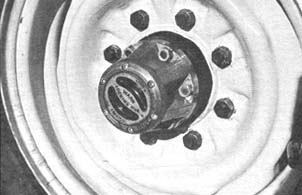
If you get a chance to pick up a four-wheel
drive vehicle and it’s in good condition, I’d say do it!
It’ll have almost unlimited use on your farm, especially if
you make sure the machine has quick disengage hubs (such as
Warn) up front which will allow those wheels to roll freely
when you want. Driving on the road with all four wheels
powered can give you a superior form of headache and
additional mechanical problems later.
Most truck
manufacturers offer a power take off option front, rear and
sometimes even amid ship on at least their 3/4 ton pickups.
PTO is not at all necessary when you’re using a pickup only
for hauling but it’s a handy thing to have for running
winches, loaders, snow blowers and other accessories that
folks sometimes put on personal trucks.
Now that we have an
idea of what to look for and avoid on pickup trucks in
general, let’s give a little more thought to buying a used
vehicle.
First off, it’s good to remember that the fellow
selling a particular second or third-hand machine probably
used the vehicle for the same purpose you have in mind:
hard work. Even if the truck has really been put through
its paces, however, that doesn’t mean it’s worthless. A
severely used pickup can be a good buy if it’s been well
taken care of. If you’re interested in a used pickup, it’s
up to you to check it out carefully and try to second guess
the man who owns the vehicle. He has a reason for selling .
. . if you can find out what it is, you may have some idea
of the worth of the truck.
When trying to determine the
condition of a particular pickup, you
should–again–look at the engine. Pay attention
to the finer details. Is everything clean? Do you see oil
splattered or dripping anywhere? Is there oil splashed up
on the underside of the hood?
If the pickup isn’t clean,
drive it to a 25¢ car wash and get as much of the
grease and oil off the vehicle as you can. Then run it for
a while, inspect at the engine and engine compartment again
. . . and you should be able to tell whether the power plant
has any serious oil or water leaks. Look at the oil while
the engine is hot. It’s probably new (changed just for the
occasion by the man trying to sell the truck) but you’re
not going to be fooled that easily.
Pull the dipstick and
inspect the oil very carefully. Are there spots of sludge
in it? If there are, it suggests that the previous owner
didn’t change the oil often enough and that there are
probably sludge deposits in both the lubrication lines and
the crankcase. When you find evidence like this, it’s a
good idea to pull the rocker arm cover–if you
can–and have a look underneath. I’ve seen engines
with sludge buildups so bad that the rocker arms and
lifters weren’t getting any oil at all. (Excessive tappet
noise is also sometimes an indication of this problem).
If there are any strange noises coming from the engine
compartment while the truck is running, try to find out
exactly what those noises are. Rev the engine, lug it . . .
and listen carefully. If you have a vacuum gauge, use it.
It can tell you a lot.
Now shut the engine off and look at
the oil again. Do you see evidence of water bubbles? If you
do, it could mean several things . . . probably a cracked
block.
Never buy a truck until you’ve run a compression
check on it. If you don’t have a compression gauge, buy one
for two or three dollars before you go shopping. It could
save you hundreds.
Does the engine you’re looking at give
the impression of having been steadily maintained over a
long period of time . . or has it been “slicked”? Check the
installation dates on rebuilt parts. If they’re all recent,
it could mean that the owner has been trying to cure a
problem, can’t do it and is trying to dump the headache on
you.
Check out the interior of the truck. You’re going to have
to spend a lot of time there, and you’ll want to be
comfortable. Are things inside in good shape? Too good? If
everything looks new, it may be another sign that the truck
has been slicked. Feel the springs under the driver’s seat.
Are they sagging? That’s one sure sign of hard use, no
matter what the upholstery looks like.
While you’re inside,
check out the mileage. Are the figures all in a straight
row or are some out of line? The latter often indicates
that the mileage has been set back, probably for your
benefit. Can the car pass safety inspection? Honk the horn,
test the head lights, tail lights, turn signals and brake
lights.
Outside, you’ll want to check the body over
carefully. Does the hood open and close easily? Try it
several times. Also, try the tailgate. Some are so badly
battered that they won’t latch unless you hammer them shut.
Has the truck been wrecked? Sure signs are uneven distances
between doors and body or hood and body . . . and distorted
reflections of light off the paint. If the light reveals
ripples, creases or cracks, you’ll probably want to check
more closely. Unless you’re particularly worried about
looks, though, the only thing you really want to make
certain of is that the body isn’t stuck together with bondo
or fiber glass, both of which tend to crack badly when the
truck is driven over dirt roads or plowed fields for long
periods of time. Also, trucks patched with these materials
may leak water, which is a nuisance.
Another thing you want
to look for is body rot. Tap around a little with a
screwdriver handle on the fenders, behind the wheels, under
the running boards and in the bed (particularly toward the
front). That area doesn’t drain well and water tends to
stand there if the bed is metal.
If the box isn’t metal,
you’ll want to check the wood for splintering, breaks or
rot. All three will probably be present to some degree, so
take the degree into consideration when you’re deciding
about whether and how much.
Now, check out the tires. Are
they good, solid truck tires or are they thin automobile
donuts? Is there plenty of tread left on all of them?
Examine each carefully–inside and out–for
blisters, bruises, cuts or peeling.
Is the transmission a
standard shift? If it is, work the gears. Does it shift
easily? Does it grind when you shift? Does it stay in gear?
Try it on the street in each gear for a distance. Remember,
though, that trucks are often harder to shift than cars, so
don’t make a snap judgment. The problem may be in your
shifting, not in the truck.
If the transmission is an
automatic, notice whether it takes a while for the truck to
start moving after you begin to accelerate. If so, the
transmission may be slipping, so check it out thoroughly
before buying the pickup. Another way to test an automatic
is to listen to it carefully while you’re driving. Does it
wait until the engine is highly revved before it shifts?
Does it shift roughly? These can be signs of trouble.
Listen, too, for a howling rear end, and avoid the truck
that has one.
Try the brakes. If they seem good, pull a
front brake drum (it’s simple if you leave the tire on, and
it’s well worth your time). Are the drums scored? Badly?
Have they been turned down as much as they can be? How are
the shoes? Are they worn evenly, or have they been eaten
away by the drums?
If the truck has four wheel drive, can
the front wheels be disengaged? Do they make suspicious
sounds when they are engaged?
Crawl under the vehicle and
look at the springs. Are they leaf or coil? Are they
beginning to sag? Spring-loaded shock absorbers are usually
a sign that the springs were breaking down and the owner
was trying to compensate.
It’s a good idea to check coil
springs closely on a used truck. When they begin to sag,
it’s possible–and useless–to brace them up by
inserting a support between the coils. The problem is that
under rough treatment, springs with these things in them
often snap. Spring supporters are good for selling a truck
to someone who doesn’t know about them . . . and little
else.
To determine if the truck you’re considering has
front end troubles, first look at the tires. If they’re
worn on the sides, or on one side or the other, you might
have an alignment problem.
Squat down facing a tire and
grip the top with both hands. Push, then pull. Do you feel
any play? If you do, the truck may have a bad king-pin.
Now, grip one side of the tire with each hand. Pull with
your right, and push with your left . . . then push with
your right, and pull with your left. Play? Remember it when
you are making up your mind about the truck. A front-end
job might run you a fair sum, even if you did it yourself.
If you’ve been a careful shopper, the pickup that you
finally drive home ought to be a pretty sound one. To keep
it that way, you’ll want to be as particular about
maintaining it as you were about buying.
Change the oil
faithfully every 4,000 miles. Proper engine lubrication is
an absolute must, and clean oil will help keep down sludge
deposits. If you’ve bought an older truck, your engine
already has a certain amount of wear on it and one way to
minimize any additional wear and tear is to keep the engine
well lubricated. Use a heavier weight oil during hot
weather and a high-grade, high detergent oil at all times.
When you change the oil in your truck you should also do a
grease job on the front end. This will add to the life of
the vehicle’s king-pins and ball-joints and make the pickup
easier to handle. In the long run, it will also save wear
on your tires by maintaining the whole front end in good
shape.
It’s important to keep up to date with minor repairs
on your vehicle. If you need new spark plugs or distributor
points, replace them before they put too big a load on some
other part and cause major problems. If you’re
conscientious about repairs, the per-item expense will be
minimal and you’ll save money in the long run.
In order to
keep your pickup in shape, you’re going to need certain
tools. The number and type will depend on the extent of the
work you plan to do, but a good basic set for around $50.00
should let you keep up with standard maintenance.
Don’t go
out and buy fifty dollars worth of just any old thing,
though. You’ll need most, if not all, of the following
specific tools:
- 1 good grease gun with flexible hose and a
nozzle small enough to reach the universal joints
- 1 hack saw
- 1 cold chisel
- 1 ball-peen hammer
- 1 complete set of screw drivers
- 1 rachet
- 1 good breaker bar
- 1 set of combination wrenches
- 1 set of open-end wrenches
- 1 set of lug wrenches
- 1 bumper jack
- 1 hydraulic jack
Economize on most any of these tools–any good brand
will do–except the socket set. You’ll probably need
sockets ranging from 3/8″ to 1″ in a 3/8″ drive set and
it’s OK to purchase these in the lower cost, uncoated
variety . . . but don’t buy a cheap brand.
On most other
tools there’s little difference between brands unless
you’re a pro mechanic. Not so with sockets.
The sockets
made by the Snap-on Tool Company cost a couple of dollars
more, but they do things that no other socket can. A
special shank drive allows each socket to grip the sides of
a nut or bolt head rather than the corners and many worn
bolts and nuts with rounded edges can only be removed with
Snap-on sockets. Don’t worry about replacing them . . .
Snap-on offers a life time guarantee.
If you’re planning on
being along way from civilization or if you simply like to
be prepared, there’s a number of spare parts you may want
to carry with you. The following equipment should see you
through most any small job you’ll have to do.
- 1 complete set of water hoses
- 1 complete set of fuel lines
- 2 fan belts
- 1 water pump
- 1 fuel pump
- 1 overhaul gasket set
- 1 thermostat
-
1 ignition set (Points, plugs, plug-wires, rotor
distributor cap, fuses and electrician tape)
- 1 coil
- 1 oil filter
- 1 air filter
- 1 tubeless tire repair kit
-
1 tire pump (One is available which screws into a spark
plug hole. It’s a good buy)
Obviously, if you’re going to carry these tools and this
spare equipment, you’re going to need a good tool box or
topper shell . . . I prefer the tool box because it tends
to keep the volume down and doesn’t restrict hauling
capacity.
In spite of all you may have heard to the
contrary, the Motor’s Truck & Diesel Repair Manual is
available to us non-pro mechanics, too. You can get yours
most easily from the J.C. Whitney Go. in Chicago, from
Sears and–now–from MOTHER EARTH NEWS.
One last suggestion. If
you’re going to be operating your truck in cold climates,
forget about the standard automotive 12-volt battery. Buy
two 6-volt, 180 amp golf cart batteries and rig them up in
series. They’ll carry your truck all the way to the equator
on the starter motor, if need be.






