

Replacing an aging engine with an electric engine to convert to an electric vehicle will save time, money, energy, and headaches.
While there are several types of vehicle conversions
possible — such as Dave Arthur’s hybrid electric car
(see MOTHER’S June/July ’93 issue); or using propane or
even wood-produced steam to replace your existing
combustion engine with a clean-burning, reliable powerplant
— converting to an entirely electric vehicle has
become a very reliable and cost-effective means of
transportation for the commuter. In fact, many city
governments have electric vehicles in their fleets and
electric forklifts have been in the workforce for well over
a decade.
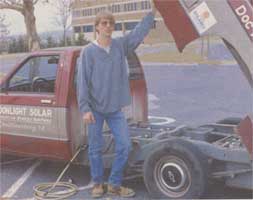
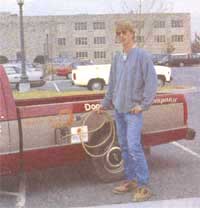
Brian Walsh is an alternative energy expert and has
recently converted a Chevy S-10 pick-up as a pilot vehicle
for his company Moonlight Solar, Inc. This truck has been
on the road now for a year, running without a problem and,
according to Walsh, that’s the point . . . while electric
vehicle conversions have certain components that are
costly, once converted, the vehicle is not only quiet and
non-polluting but has no real maintenance except for normal
brake replacement, occasional battery water level checks,
and brush changes in the electric motor every 80,000 miles
(which costs a whopping $80). That’s right, there’s no
longer an engine, carburetor, catalytic converter, exhaust
system, radiator, starter, hose, or belt. This means that
there’s no oil to change and no anti-freeze needed, also
reducing the need for fluids toxic to the environment.
The conversion process explained in detail here is based on
the Moonlight Solar truck conversion. Notice that none of
the cargo space in the truck has been compromised, unlike
Dave Arthur’s truck where batteries, a generator, and an
engine all are piled in the bed. Walsh’s truck has
batteries tucked away nicely in boxes under the bed and
hood and there are no extra internal combustion engines or
generators to install as with hybrid vehicles.
Converting a vehicle completely to electric in this manner
means removing the internal combustion engine altogether
and installing an electric motor, the components necessary
to operate the motor, and batteries. An EV (electric
vehicle) of this type must be charged for several hours and
then enjoys a traveling radius from 50 to 150 miles
(depending on factors such as weight, number of batteries,
and type of batteries), making it only suitable for
commuter travel. In the near future, however, a new type of
battery called a zinc-air battery should be available which
is reputed to double the range of an electric vehicle for
the same weight. These batteries are already in use in
vehicles in Germany (see “Bits & Pieces” in MOTHER EARTH NEWS
February/March 1996 issue).
While the range threshold makes an EV most suitable for
commuter travel, this should not be confused with lack of
power. Riding in the Moonlight Solar truck, one is struck
by how much power it has; it can literally leap from a
stop. Walsh explains, “We converted a truck to show people
that electric vehicles aren’t just one-Beaters with bicycle
tires.” And seeing him buzz through town loaded down with
building materials or electrical supplies is testimony to
the success of this venture.
The costs for running an EV converted in this way is
amazingly low. For instance, with gas prices now running
about $1.20/gallon, the average vehicle would require about
$4.80 in fuel cost to go 100 miles. The average EV charged
at the current average grid power rate would cost 75 cents
for that same 100 mile trip. But Walsh maintains that the
true savings come from the lack of maintenance; after all,
virtually every part particular to internal combustion
motors are no longer part of the vehicle and there is very
little to go wrong with the conversion components.
Finding the Components
The reasonably seasoned, generally skilled do-it-yourselfer
can tackle an EV conversion, but there are certain
components that must be purchased and these should not be
skimped on. Some of these may be available in surplus
catalogs or used from some industrial suppliers but finding
them will take a bit of scrounging and they all are
available new from EV, forklift, or industrial supply
companies.
First is the propulsion motor. You will need either a DC
motor or an AC motor coupled with an inverter. Most motors
are rated at 120 volts and come either as an eight- or
nine-inch motor — the eight-inch for vehicles up to
2,500 lbs. before conversion and the nine-inch for vehicles
up to 3,000 lbs. Best for the home builder (also the type
used in the truck and stressed in this article) is the DC
series wound motor — it is more efficient than a
brushless type DC, with more power for the weight and it’s
infinitely simpler to configure than an AC motor/inverter
system. There are used motors out there, many powering
large industrial equipment, but if you buy a new one expect
to pay $1,200 to $1,400.
Next you must find a controller. This piece controls the
activity of the propulsion motor and must match the
characteristics of the motor and be properly sized for the
vehicle you are propelling. When looking for a controller,
make sure the one you get is matched for the voltage of the
battery bank in the vehicle (or larger) and it must have
enough amperage to propel the vehicle from a stop. The
amperage rating must be three to five times normal cruising
amperage to be road worthy — 400 amp for light cars
is acceptable (the Moonlight truck is rated at 500 amps).
The best brand controllers to purchase are Curtis and GE as
they have been around for a long time and are continually
updating the equipment. Expect to pay $800 to $1,300 for a
good controller, remembering always that skimping in this
area will produce a vehicle that is not
roadworthy.
Another very specific part is the adapter plate which goes
between the electric motor and the bell
housing/transmission of the vehicle being converted. A
local machinist may be able to build one of these for you,
but it is definitely a job for a professional.
Prefabricated adapter plates are on the market for hundreds
of different vehicles. Moonlight Solar handles these items
as do several other EV conversion companies around the
country.
The final specialty component may surprise you — the
battery charger. Realize that the large battery banks of an
EV produce voltages around 120 and chargers that operate at
that high voltage only are found from forklift or EV
dealers. The Moonlight Solar truck is equipped with an
inboard charger allowing Walsh to charge anywhere a regular
electrical socket is handy — he opens the fuel tank
cap and pulls out a cord. At home, however, he “tanks-up”
the truck with a larger charger reducing the time necessary
for a full electrical load, and you may wish to install
this same set-up.
The rest of the components are more readily available and
can be found locally or through surplus catalogs and
stores.
Batteries come basically in two types, lead acid and nickel
cadmium. Lead acid are the most common, are compact, and
are one-tenth the cost of ni/cads. The only real advantage
to the ni/cads is that they do not lose range in cold
temperatures as lead acid batteries do. Note also that the
batteries here are not normal automotive batteries which
are rated in cranking amps but rather they are deep cycle,
EV, or golf cart batteries and have a “minute” rating. Most
fall between 110 and 145 minutes which is how long their
charge will last at a 70 amp discharge.
Battery requirements for an EV are typically figured as
such:
Twelve 6-volt batteries (72 volt)
…strictly city use, no high speeds, or…
Sixteen
6-volt batteries (96 volt) …more standard
operation, or…
Twenty-plus 6-volt
batteries (120 volt) …hilly operation or larger
vehicles.
Power — Acceleration and ability to climb hills is
related to voltage which corresponds directly to the number
of batteries in the vehicle.
Range — This is determined by the overall storage
capacity of the battery bank, not necessarily the number of
batteries.
Wiring for an Electric Car
Good wiring techniques are essential to proper performance
and low maintenance in an EV. Always check wires, screws,
bolts, buss, etc. at each junction at the time of
connection for problems. Wires should be kept short between
components and should have proper ends crimped, soldered,
and then taped or (best of all) shrink wrapped. When
bolting connections together it is always best to shine up
the connections with sandpaper first. Connections can
become corroded causing loss of power or malfunction, so
take the greatest care to prevent this.
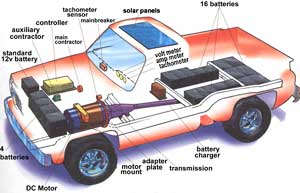
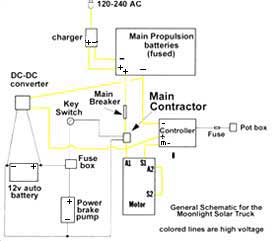
The schematic shows how the components of the Moonlight
Solar truck are wired, which is similar to any EV,
especially other conversions using the DC series wound
motor. Low and high voltage wire types are given in the
diagram and each corresponding connection must be wired
with the appropriate cable as inadequate wires will heat up
causing current loss or more serious problems. Stick with
copper wire; aluminum is much less preferable and requires
larger sizes for the same load as copper. When running
wires around the vehicle always tie or clamp them neatly
out of the way to conpartment walls or frame. It adds to
the showpiece of your handiwork, helps avoid wire damage,
and makes future maintenance and changes much simpler.
Connecting batteries to one another is a very important
part of the overall system. Use 2/0 welding cable with
professionally crimped lugs and “L” type battery terminals
for bolting the cables down rather than the round post
automotive type terminal connectors. This allows for a
tighter connection with a larger surface area. Also
adequate, and probably less expensive than the cable would
be a copper buss (1/8 inch by 1 inch strip) or a thick copper tubing
with flattened ends with drilled bolt holes to go between
batteries.
Between the batteries and the main contact there must be
either a 250 amp DC rated breaker made by Heiman (which is
the cat’s meow of breakers — very easy to click on
and off) or a 300 amp DC rated GE breaker. This breaker
must be accessible to the driver in case it trips while the
vehicle is in operation. Also for safety, 400 amp rectifier
fuses should be placed between batteries — one in
each compartment set. These will never blow unless there is
a major problem, but if there is such a problem
you will be ecstatic to have had that fuse inline. The
truck has three such fuses, one in each battery
compartment.
The main contactor is an electromagnetic contactor, a
remote switch, which allows main battery power to go to the
breaker and then the controller. This switch completely
disconnects all power from reaching the motor when the key
is off and for a couple other safety reasons described in
the wiring section later. The main contactor in the truck
is made by Albright.
You will also need to scrape up an electric heater. These
are generally pretty efficient and shouldn’t be hard to
come by.
Battery enclosures must be installed in the vehicle and
must be stout. 1 1/4 inch angle iron welded with 1/8″ plate
bottoms welded to frame or within the body with plywood
sides are good. Angle top strap or some other significantly
structural top to avoid battery tipping or movement over
large bumps is critical. For lead acid operation in colder
climates adding insulation and small heaters which come on
during charging will help range considerably.
Beefing up shocks and springs may be necessary, especially
in the end of the vehicle where the weight ratio is not
offset by the removal of the internal combustion engine.
Adding leaves to leaf springs, going from shocks to
spring-over shocks or adding air shocks are all simple
alternatives to this need. Note, however, that if you choose
the air shock route, the vehicle must have enough clearance
to travel even when the air shocks are not pumped up due to
shock damage or malfunction.
If your vehicle is equipped with manual brakes, simply keep
them as they are. For power breaks you can either convert
to manual breaks or install a vacuum pump and air chamber
(built from three-inch PVC pipe with capped ends) which
will operate the power breaks.
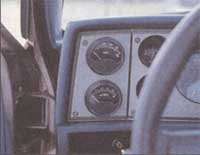
The instrumentation will change. At the very minimum the
vehicle needs an amp and a volt meter which allows the
driver to monitor battery charge and the amount of load on
the motor. Additionally you may install a temperature
gauge, a tachometer, and/or an amp/hour meter.
Relays (remote switches) may serve several roles in a
conversion vehicle. Turning on circuits for the controller
or vacuum pump or disconnecting an onboard charger are good
uses for these switches.
Also helpful is the inclusion of a standard 12-volt car
battery to run auxiliary equipment like radio, windshield
wipers, and headlights. To charge this battery the
Moonlight Solar truck has two solar panels mounted on the
hood (or roof as indicated by the diagram on WIRING ), but
a DC to DC converter running off the main charger may also
be used.
That is a basic walk through the various components. Many
of them can be scrounged, but always keep quality and
condition in the front of your mind when acquiring the
various parts. It can make the difference between happy
motoring and a nightmarish breakdown or poor performance.
Finding a Vehicle to Convert
Any vehicle can be converted to electric and be outfitted
with just about any extra equipment imaginable, but there
are definite pros and cons to take into consideration if
you want good range and a simple, minimally expensive
conversion.
Manual, rack and pinion steering is a big pro. It works
well and puts no extra strain on the battery banks. Power
steering is not a complicated addition (requiring only an
extra vacuum pump and air chamber), but costs considerably
more and reduces the range of the vehicle by 10-15 miles
per charge.
Manual transmissions are preferable. They simply remain in
the vehicle as originally installed with no fuss. Automatic
transmissions must have a pump installed to pressurize the
transmission fluid, again reducing range, or the torque
converter must be removed detracting from the smoothness of
the ride. Also note, as explained later, that with an EV,
manual transmissions function like automatics when stopping
and starting anyway.
Air conditioning is also possible, but again you’re going
to need big bucks and have to endure a significant
reduction in range per charge.
Pick-up trucks, like the Moonlight Solar S-10, as it turns
out, make a super easy home conversion. There is adequate
space for components and room enough to work on everything.
Also quite easy are VW Rabbits (probably the all-time
favorite EV conversion), VW bugs for a short range EV (as
battery space is limited), and small cars like the Geo
Metro, which have superb range due to their lightness.
Some automobile companies are also offering what are called
“gliders.” This is a brand-new regular automobile right off
the assembly without any internal combustion components,
making an EV conversion more practical and affordable than
buying the whole completed thing and dismantling it —
but they are bound to be more expensive than a sound used
vehicle with a blown motor.
Converting the Vehicle
This is a list of the steps in converting a mainstream gas
guzzler to a quiet, peppy EV They are straightforward, but
much of the job will be the result of how you use your
common sense and finesse to adapt these principles to the
particular vehicle before you.
-
Weigh front, rear, and total vehicle weight. It sounds
strange but will allow you to asses the weight ratio of the
conversion, allowing it to perform optimally. The local
quarry or dump should have scales and a quick phone call
will let you know a good time to drop by for such a visit.
-
Mark all wires. If you do this as you disconnect all
parts of the existing vehicle order it can save many
headaches when reassembling the new EV order.
-
Find out which direction the internal combustion engine
rotates by bumping the starter. You will need this so that
the electric motor can be wired to turn the proper direction.
-
Measure the position of the transmission in relation to the
frame and firewall so that you have a way to judge that it
returns to the same spot when outfitted with the new motor
and adapter plate.
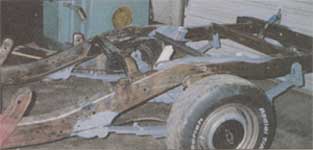
- Pull motor.
- Do away with: exhaust system; gas tank and lines; radiator, hoses, and all cooling system; all air pumps and emission system and all extraneous hangers,
brackets, and unnecessary weight.
- Clean and paint engine
compartment.
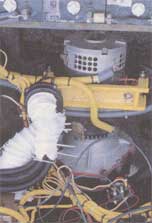
- Think about battery placement. In the truck
there are three compartments, one under the hood and two
attached to the frame in the rear under the bed. Using
cardboard mock-ups of correctly sized battery compartments
helps to visualize their placement. Also keep in mind the
size and placement of the electric motor when trying to
figure battery placement under the hood.
- Weld in any battery
boxes which do not inhibit installation of electric motor. Do
not compromise the integrity of the frame in any way when
undertaking this step.
- Design bolt-in-place battery boxes for
those in the way of motor installation which can be removed
when installing motor.
- Install hub to motor.
- Attach flywheel
to hub.
- Secure motor (still outside of vehicle) and test to
5,000 RPM for balance. If out of balance take flywheel to
machine shop for balancing.
- Attach transmission to motor with
adapter which goes between bell housing and the electric
motor and install in a temporary fashion, getting the
transmission back to where it was originally using the
measurements taken earlier.
- Fabricate motor mounts which will
hold the electric motor in place and attach to existing motor
mounts.
- Install a torsion bar from the motor adapter plate to
frame. Also called a “dog bone,” these come in various sizes
and may be purchased at most auto parts stores.
- Beef up
suspension (discussed earlier).
- Mount the controller in a
good spot which has some airflow to help cool the component.
-
Find good spots for and mount main contactor, main breaker,
gauges, relays, etc.
- Connect accelerator to controller. There
are two basic ways to go about this. Either use the old cable
and connect it so that it pulls on the “pot box,” which
should be included with the controller, and configure a
spring to pull the cable back so that it functions like a
normal accelerator pedal; or you can purchase an accelerator
pot box that mounts to the floor, taking the place of the
existing pedal, and then only needs to be wired to the
controller.
- Connect low-voltage circuits to light, windshield
wipers, radio, power brake vacuum pump, and any other 12-volt
apparatus you may have.
- Wire in any extras you may have.
- Run
all main wires.
- Install batteries, wiring them tightly and
carefully together, installing one 400 amp rectifier fuse
between the middle two batteries, one per compartment, and
bolting compartment tops properly in place.
- Make the final
wire connection a positive battery connection with the
main breaker off.
And that is the basic blueprint for electric vehicle
conversion. You should now be able to flip the main breaker
on, turn the key, put it in gear, gently depress the
accelerator, and ease the newly converted EV into motion.
You will quickly realize that even vehicles equipped with
manual transmissions accelerate from a stop like
automatics, as it is not necessary to depress the clutch
when stopping or starting; unlike the internal combustion
engine, which must always spin when running, the electric
motor only turns when propelling the vehicle. Also, there
is no noise at all from the vehicle when it rests at a
stop, so do not become confused, press the gas, and leap
forward into traffic or a garage door. Walsh found the
Moonlight Solar S-10’s operation in foul weather greatly
improved after the conversion, since the battery weight was
distributed throughout the vehicle and not concentrated in
the nose as the internal combustion configuration had it.
While an EV conversion requires an investment of time and
money, the result is a fantastic commuter vehicle that
greatly reduces maintenance, fuel cost, and impact on the
environment. Also, the EV is less disposable — expect
to get hundreds of thousands of miles from your components
rather than the normal hundred and fifty thousand of the
internal combustion vehicle. Long distance travel in EVs
also may be closer than you realize, as talk of electric
quick-charging stations along major routes has begun. This
awareness of EVs will certainly continue, and people who
convert vehicles today assert their belief in a more
sustainable mode of travel and pave the way for larger
changes to follow.






