

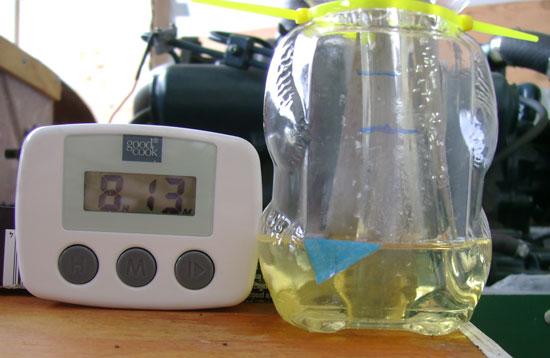
What a miserable month, as is typical of the end of a Western Oregon winter. Rain rain rain snow rain, definitely not road test weather. But thanks to the HBFCI I’ve been able to learn a thing or two in the relative comfort (it’s not raining indoors and that’s good enough for me) of my well ventilated shop.
Two updates ago (MAX Update No. 68: Idle Speculation) I reintroduced the Honey Bear Fuel Consumption Indicator, and did some engine efficiency comparisons between MAX and my store-bought minivan. I was curious what we’d save if we shut our engines down at idle, plus I was curious what MAX’s minimum fuel consumption might be. Well, I learned that it takes a fair bit of fuel just to make an engine run, and to nobody’s surprise, as engine size and horsepower increase, so does the fuel required, even if the engine is just sitting there idling.
But we’re interested in fuel economy here — the fuel it takes to get someplace — so fuel burn at idle isn’t the main issue. A more important question is, how much fuel does it take to run the engine at cruise?
So with the van idling in park, I gradually increased throttle until my ScanGauge showed I was burning 1 gallon an hour, and noted the rpm. I did it a few times and 2150 looked about right; I double checked by holding 2150 rpm and sure enough, the gallons per hour nibbled around between 0.98 and 1.02 so I’m calling it 1 gph.
The sobering thing about this is, this van goes 54 miles an hour at 2150 RPM, so even if the van had no aerodynamic drag and no rolling resistance and no transmission losses at all, the best mileage it could ever hope to get would be 54 miles per gallon. There is no car available — not even in theory — that is so light and streamlined and friction free that it could get 55 mpg with that engine and gearing.
Interestingly, it takes less fuel for each turn of that engine at 2150 than at idle. Idling at 760 rpm on 0.43 gallons per hour, it takes about 1.21 ounces of fuel to turn the engine over 1000 times (you can trust me or do the math: gph divided by 60 gives gallons per minute, divide that by rpm for gallons per revolution, times 128 converts gallons to fluid ounces, times 1000 gives ounces per thousand revs, so 0.43 / 60 / 760 x 128 x 1000 = 1.2070… and since my measurements aren’t likely to be perfect, I’ve rounded to the nearest 1/100 of an ounce). At 2150 RPM and 1 gallon per hour, it’s 0.99 ounce of fuel per thousand revolutions (1 / 60 / 2150 x 128 x 1000 = 0.9922…) so for a very simplistic estimate, that engine is about 20% more efficient at cruise than at idle. That’s what we want, of course, we want best efficiency while driving, not while idling, and presumably the folks at Kubota also aim for best efficiency in the engine’s normal operating range.
So back at the Honey Bear, I found it took MAX an average of 8 minutes and 12 seconds to burn 4 ounces of fuel at 2150 rpm, which is less than ¼ ounce of fuel (0.23) per 1000 revolutions. At idle (3.425 minutes per ounce at 940 RPM) each thousand revolutions sucks up 0.275 ounces, which is still pretty good (an ounce ever 3.425 minutes? In college, I knew guys who consumed Jose Cuervo at that rate, though we hid their car keys first), but (what a surprise) like my minivan motor, MAX’s burn per rev was also about 20% better at 2150 RPM than at idle.
Well I know you’re curious: if the engine were MAX’s only fuel economy limitation, if MAX-the-car had no drag at all and all the engine had to do was turn itself over, what mileage would it get? Since it’s geared a little lower than that minivan of mine (MAX goes 52 mph at 2150 rpm) MAX would go 228 miles on a gallon if the engine had no load but its own.
From these tests, a couple of interesting hypotheses spring. For one, presuming these are typical internal combustion powerplants, it doesn’t look like driving an ordinary car real real slow is going to improve mileage–and in this case, I’ll have to list MAX as an ordinary car–because going very slowly decreases engine efficiency, and as long as the engine is running, it is consuming fuel. So for in-town driving, hybrids have a clear advantage over straight ICE…presuming the hybrid system is light enough and inexpensive enough.
A couple of blog posts ago, I’d concluded that hybridization would do MAX more harm than good, since it looked like the electrical bits (motor, controller, starter/generator, batteries) would increase MAX’s weight by about 20%, but a commenter pointed me toward a system he thinks would only bump my weight up by 100 pounds. Unfortunately it’s not for sale, and if it was it would cost about five grand, but it’s an interesting concept and worth brooding over.
But first, let’s see if we can hit 100 mpg the old-fashioned way; it’s time to get back to road testing.
Let me conclude with this brain teaser: the first time I tried to time 4 ounces of fuel at 2150 RPM, I barely broke 7 minutes (7:09). I had to take the shirt off my back to get the fuel to last more than 8 minutes, and if you think you know why, click Comments below and send in your best guess.
Photo by Jack McCornack






