

If you have a bajillion dollars or a well-equipped university, you can determine a car’s aerodynamic drag in a wind tunnel. But you don’t, and neither do I, so we’ll have to do it on the cheap. Champagne science on a beer budget, that’s my motto.
Automotive wind tunnels work by blowing air at a measured speed over a stationary vehicle (or model) and measuring the forces (drag, lift and stability … doubtless the source of those tailfins that started appearing on American sedans in the ’50s) acting on the car via a number of scales under the tunnel floor.
It’s a fine way to do things, and is quite comfortable for the technicians, who sit in a room outside the tunnel, who can wander off for coffee, and who don’t have to worry about their notes blowing out of their pockets during the test.
For the MAX project, however, we’re using a moving car traveling through stationary air, which presents two obvious problems: How do we measure the speed and how do we measure the force?
PHOTO BY KATHERINE LOECK |
A car speedometer isn’t sufficient for speed measuring — too vague and too inaccurate — but modern technology has brought extremely precise speed-measuring equipment to the masses: the handheld hiker’s GPS. Not only do they measure speed, they measure position and date and time of day, and best of all, they record it for you. This is important because one disadvantage of doing aerodynamic testing in cars (and trust me, this is also critical when testing aircraft) is that the technician has to pay attention to not crashing, along with attending to the test.
I quit trying to multitask during test flights (and drives) nearly 30 years ago, when I started using an Apple II for data acquisition. I mounted it on a plank (a literal “on-board” computer) along with a motorcycle battery to run it, and a 5¼-inch floppy drive. It was big and cumbersome and costly and fragile and only accurate within 3 percent to 5 percent, depending on what I was measuring.
Who would have guessed that future sporting goods stores would have speed-time-and-distance recording devices for under a hundred bucks, accurate to 1/10 mph, and small and handy enough to take in the shower with you?
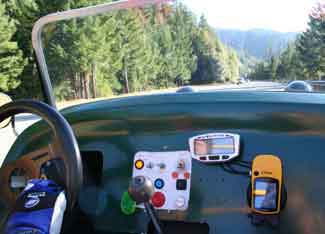
That yellow thing on the dash in the photo is a Garmin eTrex GPS, and I leave it running any time MAX is running. It records my last 600 miles or so of driving, and every now and then I download it to my laptop and examine the data at my leisure.
So that covers speed, but how do we measure the force? I’ll tell you the answer to that riddle next week. But in the meantime, I’ll give you a hint: See that yellow light on the driver’s side of the dashboard? That’s the oil pressure light.






