

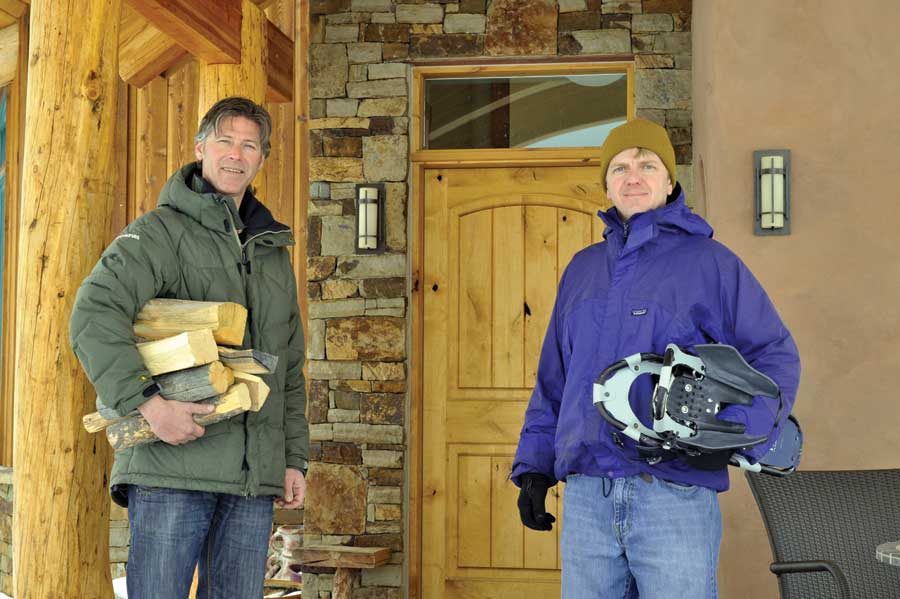
Thedo Remmelink has seen the world. A Dutch native, he competed in World Cup snowboarding championships from 1988 through 1998 and in the 1998 Nagano, Japan, Winter Olympics, then coached on several continents. It was a great life, but by 2003, as he approached his 40s, Thedo was ready for change. He wanted permanence and a home of his own. He had a standing fantasy about building a “sport ranch”–although he wasn’t really sure what that meant. “It was a metaphor for something,” he says. “I had no idea what a ranch was!”
Thedo saw lots of ranches when the Steamboat Springs Winter Sports Club invited him to coach in 2002. Situated on the upper Yampa River Valley just west of the Continental Divide, Steamboat Springs, Colorado, is a friendly resort town of about 10,000 surrounded by sprawling ranches. Thedo spent a year there and found that he missed it when he returned to Holland. “I came back, spent a summer here, and said, ‘I’m going for it,'” he says. He took a permanent job as the club’s pro-am coach and bought 42 acres just west of town–close enough for comfort but far enough away for good outdoor living. And he started to think seriously about his sport ranch.
Defining the sport ranch
Thedo’s land was everything he’d wanted, with plenty of great terrain for hiking, snowshoeing and snowboarding. But 42 acres was a lot of ground to cover when exploring where to build his home. He spent a year camping out on different parts of it, living in a tipi for several months at a time. “Positioning on the land was really important to me,” Thedo says. “I wanted to look over the land, my big playground.”
As he camped, Thedo also considered how to build. Yampa River Valley snow is legendary, and the winds can be strong, so the house had to be sturdy. A friend suggested he look into straw bale construction. “I really liked it,” he says. “It’s a natural material, and it has really good insulation.”
Thedo became a convert when he visited a straw bale home in the area. The European feel of the fat bale walls and plaster were familiar and comforting. “It reminds me of the old hotels in the Alps, high up in the mountains, with huge, thick walls,” he says. “I’ve always really liked that.”
He commissioned Todd Young, an architect who was working with Steamboat Engineering and Architectural Design at the time, and started talking seriously about building his sport ranch. “I gave Todd relatively little information to make sense of my sport ranch idea,” Thedo says. “I told him I wanted to live here with the space around me so I could do my sports but also have a balanced lifestyle.”
Young, who had already designed several straw bale houses, fell in love with the land right away. “I just had to interpret what he meant by ranch,” he says.
To start, Young asked a lot of questions, gave Thedo some design books to read and suggested he keep a scrapbook of house features he liked. Thedo did his homework and realized that a big sitting porch was crucial to his ranch vision. He wanted clean materials, passive solar orientation and enough room to accommodate a family in the future.
“I’d never built a house before,” Thedo says. “I just wanted a house that feels good and balanced–where I could feel balanced with nature, work and private time off.”
Solid ground, found
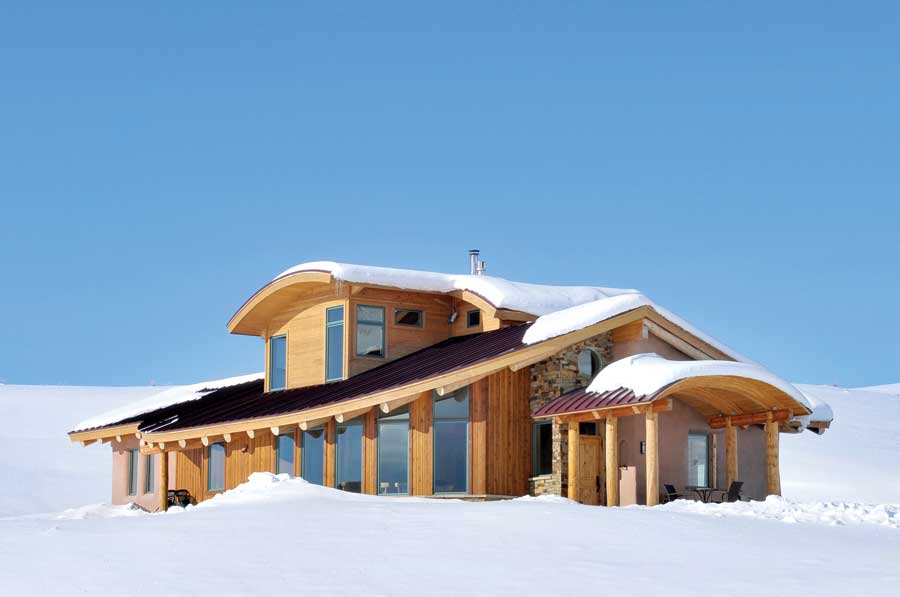
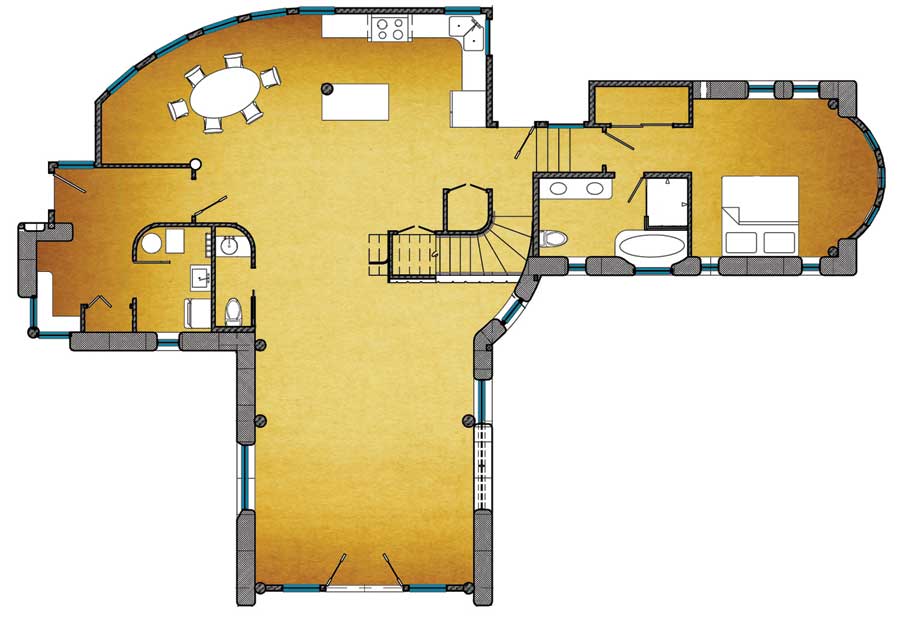
Young designed–and builder John Randolph carried out–a 2,400-square-foot home tucked into the valley, with most of Thedo’s rugged terrain behind it. The house has easy access to the road, which minimized the cost of the driveway and cuts down on snowplowing. “I like being down in the valley,” Thedo says. “I work on top of a mountain every day.”
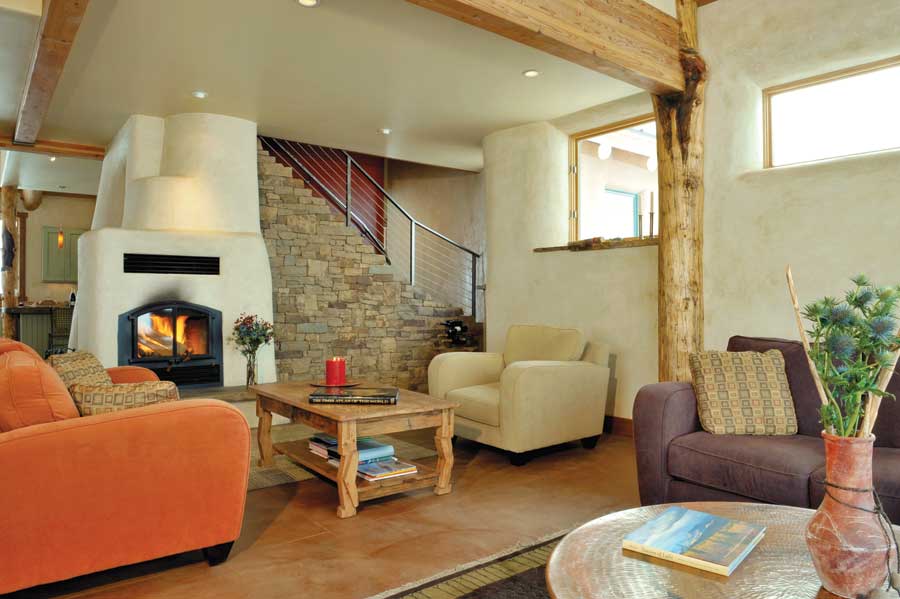
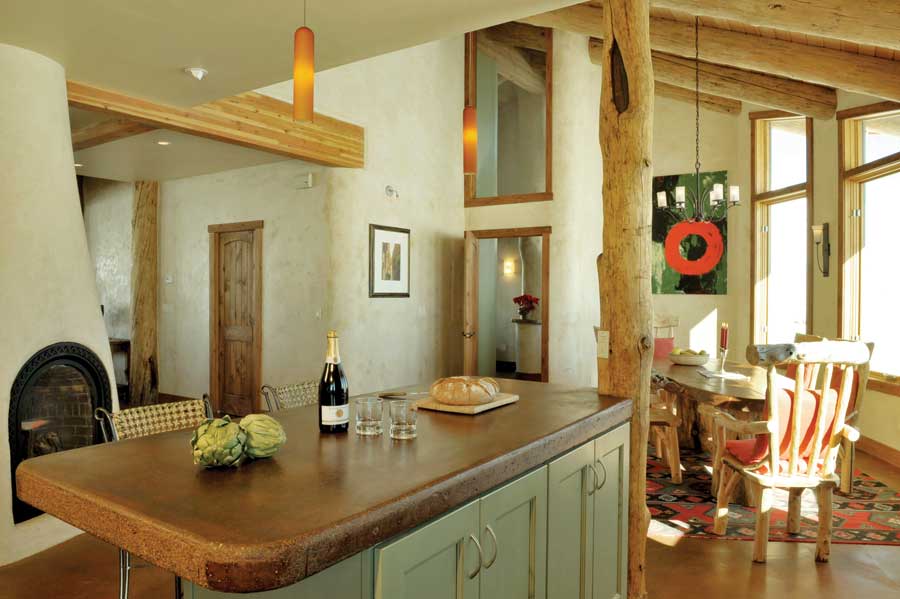
On the north side, a small hill protects the solid straw bale wall from the cold and wind. South-facing bay windows in the dining area let sun pour in, providing passive heat gain. A central heating mass built around both a wood and a gas fireplace divides and warms all of the living space.
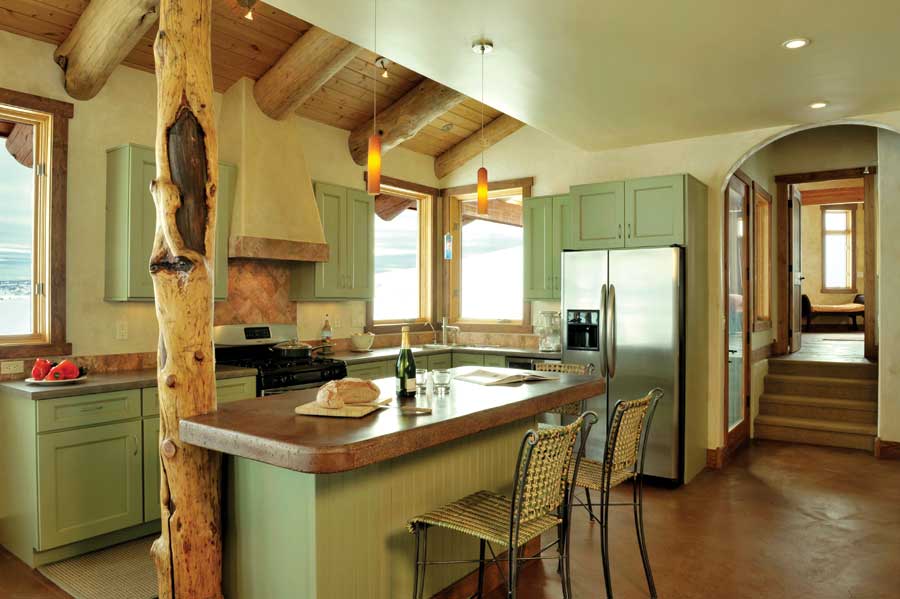
The ranch-esque house is open and airy, with spaces defined by ceiling heights rather than walls. In the living room, 20-foot ceilings and massive windows provide a spacious, sunny lounging area; a drop-in ceiling height near the fireplace creates a cozy, warm spot. The rooms have a sense of privacy but also feel connected. “I love the openness, that not every space is labeled,” Thedo says. “You get the feeling of space but you can still retreat into spaces like the dining room or kitchen, and you don’t feel trapped in.”
The living room opens onto a covered patio, a space protected from the snow that blankets Thedo’s back acres–and the completion of his ranch vision. The patio is where Thedo often just sits, watching as deer and elk come by, and it’s where he begins and ends adventures on his big playground. He can snowboard down the hill behind his house almost to the front door (he makes it in slushy spring snow).
It’s exactly what Thedo wanted. “You can live out of a backpack for a long time, but it’s nice to put your feet on the ground–to feel solid,” he says. “This was a big step for me to my future–to that balanced space. Now I have property and a house to take care of. I enjoy it, but I really work it, too. And that’s my choice.”
A chat with the homeowner
What books are on your nightstand?
Thedo Remmelink: The Art of Happiness (Riverhead Hardcover, 1998) by Howard C. Cutler and His Holiness the Dalai Lama, because this conversation between the Dalai Lama and Cutler, a psychiatrist, reminds me that happiness is an internal state that has more to do with my interpretation of a situation than with external conditions. Being mindful about difficult things is better than avoiding thinking about them. Compassion and loving kindness can be developed. Also, Mutant Message Down Under (Harper Paperbacks, 2004) by Marlo Morgan, because of the wisdom passed on by the “Real People,” an aboriginal tribe in Australia. They celebrate each person’s unique talent and inner spirit, natural healing and the meaning of life by understanding oneness. They don’t need to sugarcoat things like we do in the West to avoid seeing what’s really going on.
If you could invite anyone to dinner, who would it be?
Thedo: Linda, my girlfriend, because I love to spend time with her with good food and a nice conversation. Friends and family would be next.
What would you serve?
Thedo: Ratatouille made with organic ingredients
What’s in your fridge?
Thedo: Organic milk for cappuccino and Chocolove chocolate bars.
Where are you when you’re not in the house?
Thedo: Somewhere in the hills behind the house or in the nearby mountains hiking, riding or snowboarding. Traveling would be next.
What’s your favorite antique?
Thedo: Silverware with my grandfather’s name, which is the same as mine, engraved on it.
The good stuff
Architect: Todd Young, (970) 846-6019; toddeyoung@hotmail.com
Structural Engineer: Steve Moore, Steamboat Engineering and Architectural Design, (970) 871-9101; steve@seadinc.com
Builder: John Randolph, (970) 819-0599; dmr58@hotmail.com
Landscaping: Thedo Remmelink
House Size (square feet): 2,400
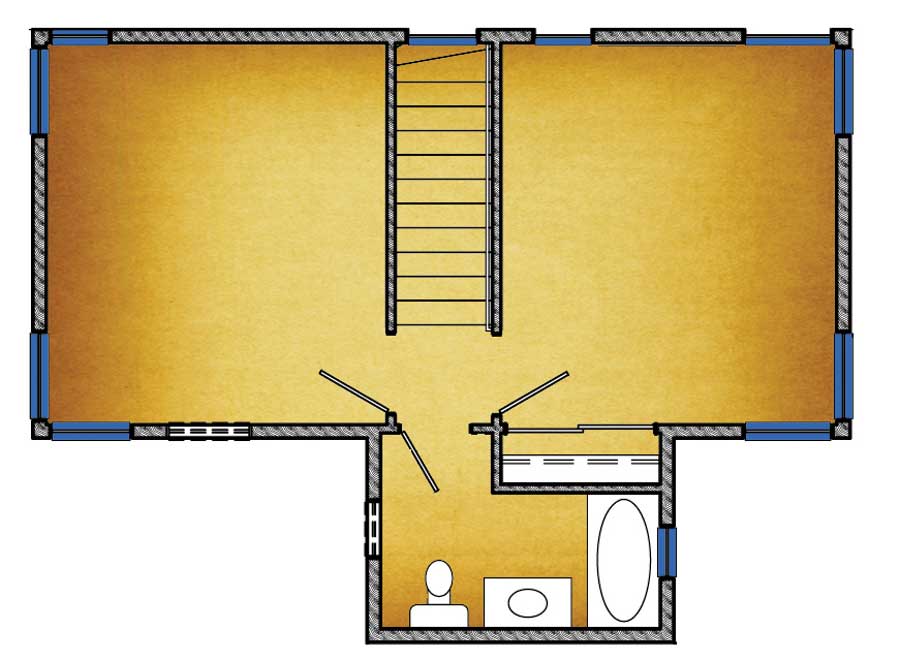
Bedrooms: 3 plus sleeping loft
Bathroom: 2 1?2
Cost per Square Foot: $250
Energy
Heating/Cooling System: Passive solar, radiant heat in 5-inch concrete slab, passive cooling through cross ventilation
Electricity Source: Grid-tied utility
Lighting: Low-voltage
Appliances: Energy Star
Insulation: Straw bale walls (R-40 to 45) and blown cellulose (R-22) in conventional framed walls.
Roof: 12-inch Structural Insulated Panels (R-49)
Building Materials
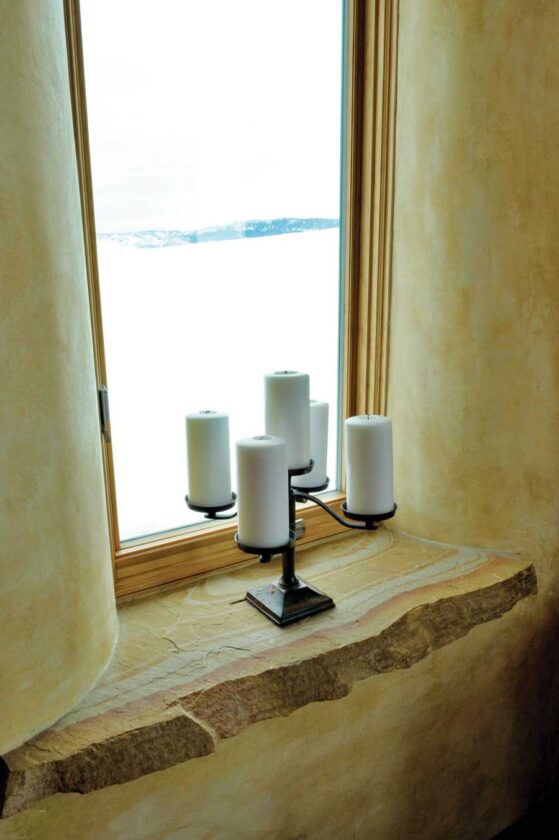
Exterior Materials: Straw bale walls with sprayed and hand-finished stucco, framed walls with cedar siding and local stone
Interior Materials: Plaster, local stone, wood, stained concrete floors
Water
Water Conservation Systems: Spring on property, pipe to underground water-treatment bunker (no need to heat) with filter, UV, softener and pressure tank. Reverse osmosis under kitchen sink for drinking water
Fixtures: Dual-flush toilets, low-flow fixtures
Construction
Waste Reduction: Structural Insulated Panels manufactured to house specification, leaving minimal on-site waste
Recycling: Construction waste separated and recycled
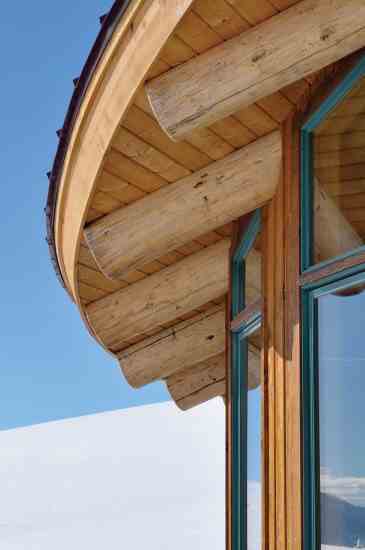
Construction Methods: Hybrid construction: log post and timber beam, straw bale (primarily to the north and west), and conventional framing (primarily to the south and east)
Landscaping
Site and Land Use: Hard-surface landscaping, flagstone and boulders 5 to 20 feet from the house; remaining 42 acres remain indigenous
Water Conservation: Xeriscape
Natural Home editor-in-chief Robyn Griggs Lawrence likes that Thedo Remmelink’s birthday is on Earth Day.





