

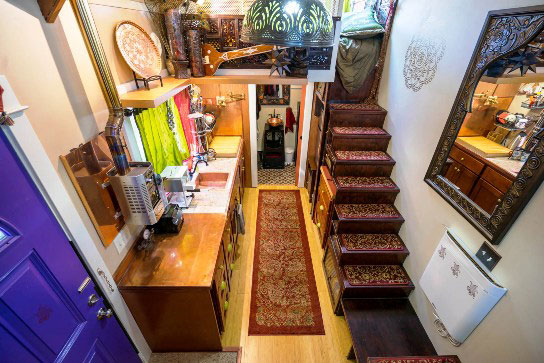
Homes are getting larger in the USA, but some alternative thinkers are actually downsizing their dream homes and opting for itty bitty dwellings. These “tiny homes” are becoming more attractive due to their small footprints, affordable prices, off-grid capabilities and green appliances.
Why are Tiny Homes Inherently Green?
Tiny homes use fewer materials to construct and cost less to build than the average-sized home. Savings on overall price can be used for higher quality materials, green building alternatives and sustainable resources. A few examples commonly used in tiny homes are: bamboo flooring, solar panels, LED lightbulbs, manufactured composting toilets, high efficiency insulation, etc.
A small interior space requires less energy to heat and cool. Limited storage promotes a minimalistic lifestyle and conscious purchasing. Small refrigerators supports a healthier diet with fresher ingredients.
In the spotlight today, we’d like to feature Anita’s Tiny Home. At only 248 square feet, Anita wanted her house to be as green as possible. She worked with designer Lina Menard and builder Small Home Oregon to incorporate green appliances and systems in her Lilypad Tiny Home.

Lilypad Tiny Home’s Green Features
• Rainwater Catchment System
• Soy-based Spray Foam Insulation
• Bamboo Flooring
• Solar Power System
• French Drain for Greywater Disposal
• LED Lighting
• Wood Burning Stove and High-Efficiency Electric Heater
• Denatured Alcohol Cook Stove
• Gravity-Fed Fresh Water Tank*
• Nature’s Head Composting Toilet*
• Vertical Aeroponic Garden*
*More details below
Gravity-Fed Water Tank
By placing a freshwater tank in the loft of her tiny home, Anita is able to use gravity power for her sink water instead of a electric water pump.
Nature’s Head Composting Toilet
The Nature’s Head compositing toilet is a good choice for small bathrooms, off-grid homes, mobile homes and green homes because of its zero-water use, self-contained compact frame and simple urine diverting system.
By design, the Nature’s Head separates liquid and solid waste, reducing odor and affectively speeding up the composting process. A 12-volt fan aerates the solid waste chamber and a human-powered crank is used for stirring. For more information on this green product, click here.
Aquaponic Indoor / Outdoor Garden
The Tower Garden is a vertical aeroponic growing system. It is great garden option for tiny and eco-friendly homes because of its petite body and efficient reuse of water (the Tower Garden uses only 10% of water involved in traditional gardening). Plants grow faster in the Tower Garden than with traditional gardening, so it’s not only cleaner, more compact and greener, it’s also a very efficient alternative. For more information on this green product, click here.
Take a tour of Anita’s Lilypad Tiny Home here and for more information, visit her website.
Photos byGuillaume Dutilhand Small Home Oregon
In an effort to pursue an alternative nomadic lifestyle, Jenna and her partner, Guillaume, began building a tiny house on wheels. Within the first year of travel, they towed their tiny abode over 20,000 miles around North America and Canada. Read about their travels and follow at Tiny House Giant Journeyand followTiny House Giant Journey on Instagram.
All MOTHER EARTH NEWS community bloggers have agreed to follow our Blogging Best Practices, and they are responsible for the accuracy of their posts. To learn more about the author of this post, click on the byline link at the top of the page.





)