

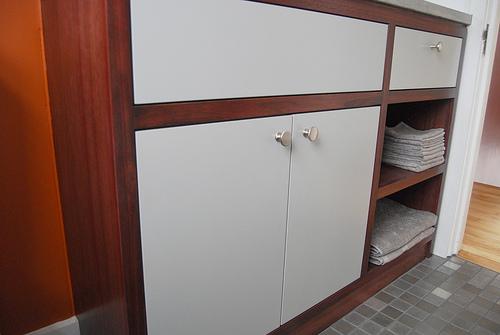
How much do I love my new bathroom? So much that I clean it all the
time. Not just quick run-throughs to make sure all the germs and hairs
disappear, but near-obsessive deep cleanings that reflect my continued
investment in the loo I helped build.
I started to detail this journey last week, explaining that my
priorities were to create more space and use fewer resources. Renovating the
bathroom has also given me an opportunity to use products that incorporate the
core tenets of environmentalism: reducing pollutants and waste, reusing inputs
and recycling materials.
Selecting eco-friendly paints and varnishes is one way to minimize indoor air pollution. Ensuring
you have proper ventilation is another. Spot ventilation can reduce the indoor
air pollutants ranging from formaldehyde offgassing from furniture to, well,
the smells one finds in a bathroom. I’d never paid any attention to ventilation
fans until this project, but now I understand they are an important way to control
moisture and prevent mold. An EPA Energy Star rating is a good starting point for seeking
out the appropriate ventilation. My choice was a Panasonic WhisperGreen
fan. The company has a great online application to help you determine the most
appropriate fan for your needs and sells units that are more than 300 percent
more energy efficient than Energy Star requirements.
Ian works with an enormously talented man named Ryan
Comment. Ryan was responsible for the most important–and priciest–part of my
bathroom: the cabinet and countertop. He has been using environmentally friendly
materials for a long time. When I started to describe what I wanted, Ryan
mentioned he had some leftover Lyptus
from an earlier project and thought it would be just enough to build my skinny
little counter. Lyptus is made from eucalyptus trees that have been sustainably
harvested in Brazil. Had I used new wood, I would have opted for a tree native to Kansas. Because it
was leftover from another project, eucalyptus was a low-impact, sustainable
option.
When my contractor, Ian Hurst,
first suggested a concrete countertop, I was intrigued, then excited. Concrete
is extremely durable and can be sourced locally before being poured into a
Plexiglas mold and transformed into a countertop. However, it requires a lot of
energy to make and transport. Although I love the surprisingly warm look of the
material, I would not use it again.

The water-based sealant MexeSeal was generously passed on to me by Asa Collier,
the owner of the eco-friendly building store Blue Sky, whom I
had called in a panic when I learned the finish Ian was planning to use was not
green enough. MexeSeal–from AFM Safecoat, a company that has become my primary source
for all finishes–was designed to repel oil and water. However, it can’t really
do the job because concrete is just too porous. Even though I love cleaning my
bathroom, the care I have to take to keep makeup, soap, toothpaste and more off
this counter is not fun. Next time I’ll explore recycled glass or a more
stain-resistant cement/recycled paper composite.
My bathroom is tucked into the southwest corner of my house,
nestled against two exterior walls. I hadn’t really considered the significance
of exterior walls until I became a homeowner and had to ponder the placement of
plumbing to avoid frozen pipes. Exterior walls increase exposure to the
elements. In a sweet old home facing a nearly record cold winter, that equals a
very cold bathroom. Well, it would have, were it not for the radiant heat
underneath my aluminum tiles.
According to the Department of Energy, radiant floor heating is “more
efficient than baseboard heating and usually more efficient than forced-air
heating because no energy is lost through ducts.” Radiant heat usually
involves the use of electric mats or a series of pipes that circulate heated
water. My house wouldn’t easily allow for a liquid system, but it’s great for
new construction. Ian’s incredible builder, Dustin, installed a Suntouch mat just under my
aluminum tile flooring.
Electricity isn’t cheap, so I have the mat programmed (using the programmable
thermostat seen here) to warm up just before I wake. The floor is charged
during off-peak hours and then stays warm for most of the day. Because I am not
heating my floor during the times when electricity rates are at their peak, I
save on energy costs while enjoying an indulgently warm bathroom.

Over the Suntouch mat are beautiful aluminum tiles from
Alumillenium. (These tiles cover the sink’s backsplash, too.) These tiles are
like little gems on my floor. They feel industrial but still manage to work
with the warmer wood in the rest of the house. Although they scratch pretty
easily and the coating drove my contractor nuts (he said he would never work
with them again), I absolutely love them. The Mexico-based company Alumillenium is
dedicated to reclaiming scrap aluminum and brass and transforming them into
tiles and sinks that feel handmade and heartfelt.
Another suggestion from Ian was tube lighting. Knowing that
lighting accounts for about a quarter of the electricity used in a home, I had
planned on going with energy-efficient lighting. But florescent tubes conjured
thoughts of my very unflattering high school cafeteria. I was hesitant about
the tube light right until the very end of the renovation–but it’s actually
perfect.
My final choice was to use Oxygen Lighting. When making your own decision, check out YLighting, an outlet that
lets you filter your search for really beautiful lighting for energy efficiency
and LED lighting. LED lighting offers better hues of light and far surpasses
compact florescent bulbs in terms of energy efficiency, but their price is
still out of my reach.
Back to scrubbing…
Simran
Simran Sethi is an associate professor of Journalism at the University of Kansas. Follow her on Twitter @simransethi.






