

Choosing quicker and more efficient methods of cooking are
some of the easiest ways to save on your energy bill. The
average family cooks 1.5 meals a day and each of those
meals takes an average of 30 minutes of energy to prepare;
because traditional ovens have a considerable appetite for
energy, the yearly costs of serving hot food to the family
can be anywhere from $150 and up. But you can save
considerably on costs and still keep the oven fires burning
with a little advice.
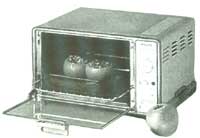
As you might imagine, using as small an oven as possible
will be the most efficient way of preparing any meal, but
you might not realize just how disparate in their energy
consumption ovens are.
Several ways of cooking the same casserole are shown in the
following chart.
• Use as small a pan, as little water, as little
preheat time, and as little peeking in the oven as
possible.
• For stove-top cooking, consider using a pressure
cooker. By building steam pressure, they cook at a higher
temperature, reducing cooking time and energy.
• Keep burner pans (the metal pans under the burners
that catch grease) clean so they’ll be more effective at
reflecting heat to the cookware. Blackened burner pans
absorb a lot of heat, reducing burner efficiency.
• If you use electric burners, solid disk elements,
and radiant elements under ceramic glass, use flat-bottomed
cookware that rests evenly on the burner surface. The ideal
pan has a slightly concave bottom because when it heats,
the metal expands and the bottom flattens out. Electric
elements are considerably less efficient if the pan does
not have good contact.
• Always cook with the lid on your pans. Cooking
without lids can take three times as much energy.
• If you have a gas range, make sure that the gas
burns blue. If the flame is yellow, the fuel is burning
inefficiently and the range should be checked by the gas
company.
• To reduce cooking time, defrost foods in the
refrigerator prior to cooking.
• Food cooks more efficiently in ovens where air can
circulate freely. Don’t lay foil on the racks. If possible,
stagger pans on upper and lower racks to improve air flow.
• Cook double portions when possible, and freeze the
remainder. Less energy is required to reheat than to cook
the dish over again.
• Using glass or ceramic pans in ovens allows you to
reduce cooking temperature by 25°F with no extra time
required.
• Microwaves operate better when the interior is
clean. Spills will absorb energy waves just as readily as
the cooking food.
From Consumer Guide to Home Energy Savings
(1991), published by the American Council for an
Energy-Efficient Economy (ACEEE).