

Our conversation should begin by struggling to define what mainstream American workers and homeowners want in the way of housing and energy. Feel free to chime in anytime with your thoughts.
Foremost, many of us want this whole increasing energy cost thing to just disappear. Find some more oil and gas fields. Dispel the peak oil argument. Make my stuff more energy efficient. And just leave me alone so I can continue to do what I’m doing like I’ve always done it. That would be nice. But I’m afraid it’s not going to happen.
Second on the wish list is a magic bullet that will instantly (almost) make existing homes super energy efficient at an affordable price. While I am rooting for us on this one, I don’t see it on the horizon. It is an understandable wish considering the amount of existing homes in the US. That is why so much effort has been going into retrofitting homes instead of building new super energy efficient homes. The business of retrofitting is huge compared to building new homes. That statement would have been true enough before the homebuilding market collapsed. It’s absolutely true now.
Worse, I have seen estimates that the maximum savings you can expect to achieve if you retrofit everything correctly is in the 20% – 40% range. Let’s say 50%, so we don’t have to quibble. In the 21st century, that’s not good enough. I have said elsewhere, “Existing 20th century homes are obsolete energy sieves that will take Herculean measures to bring up to speed in the 21st century.” “Herculean measures” means tons of work and money and “up to speed” means a home that at least produces as much energy as it consumes, if not more.
LEED homes, PassiveHouse homes (of German origin) and Solar Decathlon homes pop up in the press all the time. I just read about a net zero energy 4800 sq. ft. home built in the Hamptons that received a LEED Platinum certification. After I made a call it turns out the home came in at roughly $300 a sq. ft., or under 1.5 million.
This past fall I heard Wolfgang Feist, the founder of The PassiveHouse Institute, give a talk in the Great Hall of Cooper Union in NYC. Afterward, I was told of a new construction PassiveHouse that was having an open house in upstate NY. It turned out to be a near net zero energy 1650 sq. ft. home that came in at (you guessed it) about $300 a sq. ft. or a tad under $500,000.
The Solar Decathlon, held bi-annually in both the US and Europe, also bears mentioning. University inspired collegiate teams create 600 sq. ft. homes (small single wides come to mind) to compete for energy efficiency and design awards. They are shipped (in the US competition) and displayed on Great Mall in Washington, D.C., to be viewed and judged.
These homes are wonderful for what they are: media eye candy that brings well-deserved attention to energy conservation and laboratories for new concepts and technologies. They cannot, however, be given credit for what they’re not: 21st century affordable homebuilding templates. If created, these templates can inspire mainstream Americans to rekindle the homebuilding market and successfully position themselves in our post peak oil increasing energy cost environment.
For that task, we need something akin to a 21st century version of what Levittown was to the 20th century. The Levittown Historical Society states “Levittown is the model on which scores of post World War II suburban communities were based — a place that started out as an experiment in low-cost, mass-produced housing and became, perhaps, the most famous suburban development in the world.” Putting aside the notion of a subdivision, which has undergone much change and controversy, this is the type of home we need to see for the increasingly difficult times in our country.
The homes I mentioned also fail to live up to the mainstream American mind’s eye image of a home. 1.5 million — way too much. 1650 sq. ft. for $500,000 — too much for too little. 600 sq. ft. Decathlon homes — you must be kidding. I love all sorts of alternative residential architecture. But much of what I love leaves mainstream Americans scratching their heads. Cob, hay bale, earth bermed (think Bilbo Baggins’ hobbit house,) earthships and used shipping containers are some of my favorites.
LEED and PassiveHouse also have a retrofit version. But to reach near net zero energy efficiency, they have to be complete gut jobs. The price of the existing house plus the gut job almost always costs substantially more than selling the existing home (which you used to be able to do easily) and building a new net zero energy home. So if you are not anchored to the location of the existing home, it makes no financial sense. The cost/benefit ratio is just not there.
My next project house is slated to be a 2000 sq. ft. traditional style home that annually produces more energy than it consumes for under $150 a sq. ft built in the cold North East snow-belt region. $150 a sq. ft. is directly price competitive with regular efficiency homes built today (not that many are being built or sold today.) It is a direct outgrowth of my original Kosmer Solar House Project.
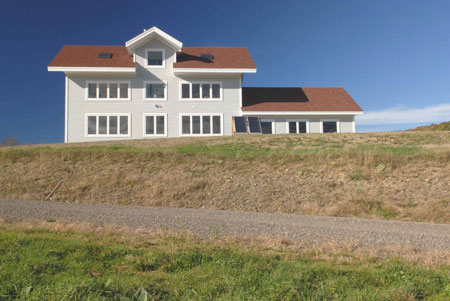
The original solar house project, which I now live in, came in at under $115 a sq. ft. including the Solar Engineer and General Contractor fees. It is a traditional style 4000 sq. ft. heated home (3000 sq. ft. for living and 1000 sq. ft. heated unfinished attic.) My passive solar house was built three years ago. It was finished just before the initial energy price shock followed by the financial and homebuilding collapse. Also located in the cold North East snow belt region, it annually costs about $1000 to heat and another $1000 for electric (the house has no electric solar panels.) My long-term hope is that my original solar house project becomes one of the most inefficient homes in America.
Initially, this blog will discuss cost effective technologies, strategies and products that may wind up in my next project house before the project begins. When the project can begin, this blog will also track the construction. After the project is completed, monitoring the house will be added to this blog. I hope you will join me in those discussions.
Photo: The Kosmer Solar House Project. Courtesy of Simonton Windows.





