


The “Prescott Solar House”, as it’s come to be known, wasn’t originally planned to be a solar-heated structure at all. The residence was initially designed as more or less a “conventional” dwelling by local architect George Allan for Mr. and Mrs. Robert Grieve.
The Prescott Solar Heated House
The idea of heating the building with solar energy was raised only after the structure’s design was “set”. At that time, the Grieves asked ‘us — a group of solar energy enthusiasts — to conduct a feasibility study on their house. That study convinced us that although it was located on steep mountain terrain — the home’s orientation and structure did seem to favor retrofitting a solar space — heating system to the residence. In addition, Prescott’s climate seemed almost ideal for the operation of a sun-powered furnace. We decided to give the idea a try.
The Grieve’s house is sited on steep terrain that slopes southeasterly. The residence is oriented 40 degrees east of south and the largest area of the roof — which has an 11-degree pitch — faces southeast. Due to the constraints of the site and our construction budget, we decided to locate the building’s collector on its roof.
This was not an ideal choice for at least two reasons: Solar collectors make best use of the sun when they’re:
- Faced full south or southwest.
- Set up at an angle of approximately 60 degrees.
The roof on which we proposed to locate our flat-plate collectors was a long way from either of those optimum conditions but installation simplicity and low cost won out over operating economics. In short, the cost of orienting the collector for maximum efficiency would have been prohibitive, so we settled for a “second best” that was guaranteed-in advance-to cut the effectiveness of our collection panels by approximately 40%.
The rooftop collector is made up of four bays, each eight feet wide and thirty-two feet long (with a one-foot-wide walkway between bays for maintenance). The area covered with glass totals out to 1,024 square feet and the panes are placed on a typical greenhouse frame module of wooden 2 X 4’s set on 16-inch centers which run to the roof’s ridge. The pieces of glass are overlapped like shingles and closed at each joint with tube caulking. Greenhouse bar cap. caulking (which comes in rolls) and aluminum bar caps are used to seal the glass to the 2 X 4’s.
The heat-absorbing surface in the bottom of the collector is actually laid directly on the roof of the Grieve house. The roof itself is made up of typical wood frame construction covered with a one-half-inch-thick plywood deck. Two 40-pound base sheets of roofing with a 120-pound black cap sheet form the roof’s “real” surface and two layers of metal (plastering) lath, painted black, act as the absorber.
At the time this article was written, we had operated the Prescott solar home’s collector for four full months with no glass breakage and no apparent weathering of any of the flat-plate furnace’s components.
We designed the collector to heat air — rather than water — because we figured that such a system would:
- Be simpler.
- Neatly bypass the problems with freezing that seem to plague some other solar installations.
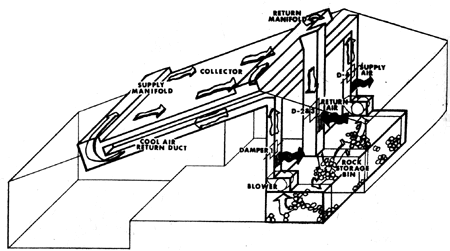
A sheet metal supply manifold at the lower end of the glassed bays distributes air into the heating chambers, and the warmed air is then drawn off at the top by an intake manifold. Manual dampers in the sheet metal ducts can be adjusted to direct and “even out” the circulation through the collector. Last January, the average temperature of air introduced into the bottom of the roof mounted furnace was 80 degrees Fahrenheit and the temperature of air drawn off at the top averaged 120 degrees Fahrenheit.
Once we had settled on air as our heat transfer medium, it seemed simplest and most natural to store the warmth collected in the Grieve’s solar system by blowing the heat-laden air through a bin filled with rocks.
This heat storage unit is actually two shoebox-shaped bins (each three feet high, seven feet wide, and eighteen feet long) set end to end under the house in an area previously designated for the stowage of odds and ends. We particularly liked the idea of using unbreakable, rust-free, tarnish-proof, no moving-parts rocks (32 tons of river rock in pieces three to five inches in diameter) as our heat sink, because we knew the storage bins would be inaccessible to maintenance once the construction of the house was completed.
The floor of the storage chambers is a concrete slab which is insulated around its perimeter to prevent heat loss. Walls and roof of the bins are wood stud construction with six inches of insulation throughout.
Hot air, as you know, tends to rise when left to go its own way. As might be expected, then, we found we had to use fans to force the warmth collected on the roof of the Grieve house down to the heat storage bins under the building.
This proved to be somewhat more difficult than we had anticipated. Due to the length of the duct runs from the roof to the basement and the static pressures within the storage bins themselves, we’ve found that our fans move only 1,500 cubic feet of air per minute instead of the 2,000 cfm we originally planned.
This means we’re circulating just 75% of the volume of air we’d like to move which, in turn, means we’re transporting less heat down to the basement than our bins are designed to hold. Besides that, the hot air we do force into the storage chambers stratifies as it moves through the bins although this doesn’t seem to be a significant problem. As the air’s pushed through the storage boxes, the rocks within have a natural tendency to diffuse and break up the stratification layers. On the average, last January, the temperature difference between air coming into the bins and air emerging eighteen feet later for return to the collector was 40 degrees Fahrenheit.
Despite all the compromises we’ve built into the solar collector and heat storage bin, they’ve worked quite satisfactorily. Last December, for example, we were capturing and storing nearly 440 Btu per square foot of collector. That’s just over 50% of what an optimum system should be able to do which, under the circumstances, isn’t bad. As a matter of fact — again, this was last December — we found we could shut down one whole bay of the collector without noting any temperature drop on the air going into the bins. This indicates to us that, once we’re able to move more heated air to the basement (as we originally planned), our system should catch and store at least 60% of the heat energy that an optimum system can capture.
The Winter heating load requirements of the Grieve house are considerable over a six-month period (Degree Days in December, January, and February this year were, respectively, 818, 865, and 686). Heat loss for the, 2,100-square-foot residence in January was 650,000 Btu per day.
This “problem”, however, is offset by the fact that more than 80% of the days are sunny (which, of course, is good for solar heating systems) during the coldest weeks of the year out here. Large south-facing windows — that allow the sun to warm a thick, heat-storing concrete floor in the building — have, alone, contributed 250,000 Btu to the residence on a January day.
A total of 1,750 square feet is directly heated by the collector storage system (which is backed up by auxiliary electric radiant ceiling panels) in the Prescott solar house. The sun-powered system has two modes: [1] rock bin heating and [2] house heating.
When we have a sunny day (and the south-facing windows — mentioned above — are providing all the house heat we need during daylight hours), we’re on rock bin heating. This mode is controlled by thermostat which is wired to a remote sensor in the rooftop collector. The sensor turns on two one-half horsepower motors when the collector’s temperature reaches 105 degrees Fahrenheit, and shuts them off when it falls to 100 degrees.
The motors (located on both ends of the storage bins in the basement) turn fans which draw warmed air off the top of the collector, through the return manifold, down a duct, and in and around the rocks which fill the insulated basement boxes. Once the air has been forced through the bins, it’s returned through another duct to the supply manifold on the lower end of the, rooftop collector. It then picks up a new load of heat as it flows upward through the collector toward the return manifold from which it repeats the circuit all over again.
To change the solar system to its house heating mode — which is done every evening and on overcast days — we manually switch to thermostat T2 and throw four dampers.
Thermostat T2 monitors the building’s temperature and cycles the two fan motors mentioned above to maintain a preselected comfort level throughout the 1,750 square feet that are heated by the solar system. To do this, house air is heated by drawing it down through the storage bins. The air is then diverted by the dampers into ducts that carry it back to various areas of the building.
Last January, during the most severe test that the system has yet had to face, air was supplied to the house from the bins at an average temperature of 78 degrees Fahrenheit and at a volume of 1,500 cubic feet per minute.
Given the above inputs from the storage units to the living space, we found that-by running the fans continuously throughout the night we could maintain a house temperature of 68 degrees. And what happens when — due to long spells of overcast weather — we pull so much from our stored heat reserve that there’s no longer enough left to warm the building? The radiant-heat ceiling panels-which are set to kick on whenever living space temperatures drop to 60 degrees simply take over automatically until the insulated bin of rocks is recharged.
And the primary system plus backup does work! From December 1 to April 1 this past winter (minus several weeks when the Grieves were gone), the solar heating system provided over 70% of the house’s heating needs. The cost of operating the two one half horsepower motors 22 hours a day averaged $16.20 a month versus the $70.00 to $100.00 a month bill that the radiant heating system alone runs up.
Interestingly enough, by the way, we’ve found that we experience a “heat lag” phenomenon with our solar system. That is: We can charge the storage bins for six hours straight and raise the temperature of the air passing from the insulated boxes to the house only a few degrees. Then, for the first several hours after switching to the house heating mode, we find that the air passing from the bins to the living space will actually continue to rise in temperature! Still later — by morning, on an all-night run — the temperature of the supply air will have dropped off only a few degrees from its level at the beginning of the heating cycle.
With summer approaching, we’re now looking forward to reversing the operation of the solar system so that we can use it to cool the Grieve house. By running the collector/bin circuit at night instead of during the day warmth should be extracted from the stored rocks, drawn through the rooftop collector, and radiated to the sky. The resulting “cool” left. in the insulated boxes can then be circulated throughout the residence on the following day.
The coming hot season should give us a chance to try another idea: One major drawback of our )ow-angle (11 degrees instead of the nearly ideal 60 degrees) roof mounted collector is that-as the sun climbs higher and higher in the sky-the unit provides more and more heat just when our house requires less and less. We’re going to have a very hot roof in the summer, in other words, just when we don’t want it.
To counteract this, we plan to use ventilators and a greenhouse type shading compound to cool our collector and reflect away a portion of the sun that strikes the unit. The shading compound is sprayed on in the spring and floated off in the fall with a mixture of water and laundry detergents.
In short, then, we do have more tests to run on the Grieve installation: If I were to sum up our experiment to date, however, I’d say that the Prescott house solar system has performed beyond our expectations. Its cost — based on going market prices for labor, material, and profit — was about $8,300 almost equally divided into thirds for collection, storage, and air handling.
On the whole, of course, retrofitted systems — such as this one — which must be tailored to an existing structure, are more costly to install than systems which are integrated into a building right from the first rough architectural rendering. I believe, for instance, that significant savings could have been made in our expenses for air handling if we’d originally designed the floor and roof joists in the Grieve house to act as ducts and distribution manifolds.
It’s also more expensive — when using an air/rock system as we did — to position the collector above the heat storage bins. If we’d had the option of planning this residence to fit the solar heater (instead of the other way around), I’m sure we’d have placed the collector below so that a very natural, simple, and low-cost convection current (heat rises, you know) from the heat-gathering unit could warm the insulated storage boxes. Another improvement (which should solve our static pressure problem) might be the redesign of the air-moving system so that collected heat is pulled across — rather than along the length of — the rock-filled boxes.
Still, we can’t complain too much. Warts and all, our first solar heating installation is working a lot better than we had hoped.
What is a Degree Day?
To estimate average heating requirements, we use the “Degree Day”. Degree
Days (DD) are figured from a base of 65 degrees Fahrenheit outside ambient temperature.
It is assumed with the Degree Day method that if the outside temperature
is 65 degrees Fahrenheit or higher, no heating requirements exist to keep the inside
temperature of the home at 70 degrees Fahrenheit. Each degree below a 65 degrees Fahrenheit outside
temperature is a Degree Day. For example, if in a given month the
average mean outside temperature is 55 degrees Fahrenheit, then each day has 10 Degree
Days.
The above explanation of Degree
Days is taken from Harnessing The Sun, an excellent small handbook which
is subtitled, A Practical No-Nonsense Approach to Home Solar Heating.
It is that and, at only $1.25 a copy, the book is a rare bargain. The
publisher is Conestoga Graphics Publication, Denver,
Colorado, and the book is available for $1.25 plus $ .75 handling and
shipping from International Solarthermics, Nederland,
Colorado.






