

MOTHER EARTH NEWS staff experts answer questions from MOTHER readers on building an in-ground passive solar home and the dangers of formaldehyde pollution.
An In-Ground Passive Solar Home and Formaldehyde Pollution
Underground Oaks
I’m planning to build an in-ground, passive solar home in southwestern Wisconsin. My question: Can I successfully use oak logs for the main structure? Could they be properly water-proofed before backfilling? I know that the usual material is concrete block, but I have 60 acres of white oaks in desperate need of thinning. Right now they’re just being cut for firewood.
It’s no doubt possible to use white oak logs in an earth-sheltered house. My question: Do you really want to? Will the effort and cost be acceptable? Assuming you want a house that will still be around half a century from now, here are a few of the things you should worry about.
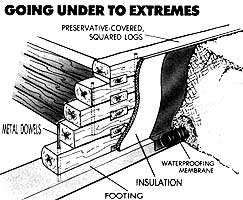
1. Structure. You must find a way to secure the logs to the footings to resist sliding forces. This could be done by setting threaded rod in the footings, slipping the bottom course over the rods and snugging the log to the footing with nuts. Each subsequent course should be secured to at least the previous two with pins at the joints, and staggered at several locations between joints. Traditional log corners may not offer enough resistance to over-tipping forces unless they are heavily reinforced (by steel rod passing from top to bottom and into the footing, and possibly by a bond beam) and buttressed (by right-angle walls that are secured to the footing and pinned). The sizes and spacing of reinforcing elements will depend on the height of the walls, the soil type and the length of unbuttressed walls. This is a job for an engineer.
2. Waterproofing. An irregular surface with gaps–the typical outside profile of a log building–would place undue demands on a waterproofing membrane. It’s unlikely that any manufacturer would recommend use of its product unless the logs are square on three sides to present a smooth, uninterrupted exterior surface. As an alternative, it might be possible to fill the gaps between the logs with chinking, affix insulating panels over this more or less even surface and then apply the waterproofing membrane.
3. Rot resistance. Even if the waterproofing system keeps outside moisture out, there’s likely to be some condensation inside. It would be a good idea to apply a preservative to the logs before installing them.
Personally, if someone dropped a couple of semi-truck-loads of white oak logs in my yard, I’d build an aboveground house or heat my concrete earth-sheltered house for several generations.
–David Schoonmaker, a senior research editor for MOTHER EARTH NEWS.
Inside Air
I read recently that formaldehyde is a leading indoor pollutant, particularly in manufactured housing. As a mobile home resident, I’m concerned–and confused. Formaldehyde? Outside a biology classroom?
It’s not just for embalming anymore. Pure formaldehyde is a colorless gas with a pungent, suffocating odor. Most of us have encountered it in two forms: dissolved in water (a formaldehyde solution) for preserving specimens for high-school biology; and as a small part of the air we breathe in office buildings and homes–especially mobile homes. Even though the Consumer Products Safety Commission banned the use of urea-formaldehyde foam insulation in 1982, we’re still exposed to formaldehyde off-gassing from building materials, notably the glues and mastics used to make plywood and laminated paneling, to hold carpets and tiles in place and to make furniture.
Formaldehyde in the air has two kinds of health effects. First, it irritates the eyes, nose, throat and lungs. (Some people are more sensitive than others.) More ominously, in April 1987 the EPA classified inhaled formaldehyde as a probable human carcinogen. Because concentrations are higher in mobile homes, in 1984 the Department of Housing and Urban Development limited the amount of the gas that can be emitted from plywood and from particle board floor decking and cabinetry installed in mobile homes, with an eye toward keeping ambient levels below 0.4 parts per million. Federal agencies have not yet issued new standards in response to the reclassification of formaldehyde as a carcinogen, but new rules may well be on the horizon.
There are tests available to measure the amount of formaldehyde in your home, but they’re not inexpensive. You can contact your state’s environmental agency or public health department for leads. Meanwhile, weather and energy conservation permitting, you may want to keep a window open or consider an air-to-air exchanger.
–David Burmaster, Ph.D.; a consultant on indoor air pollution.






