

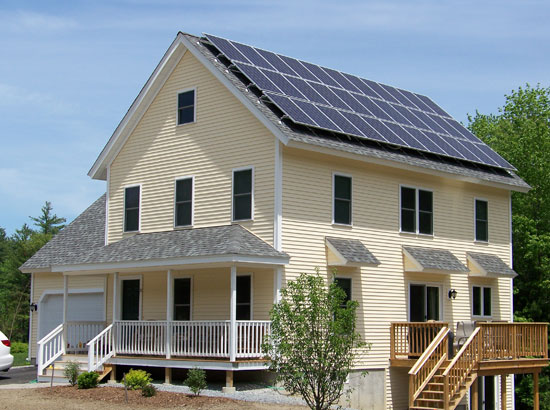

The following is an excerpt from Home Sweet Zero Energy Home by Barry Rehfeld (New Society Publishers, 2011). This practical guidebook clearly identifies all the pieces of the zero energy puzzle and how they fall into place, and explains how homeowners and buyers can also take smaller steps towards sharply reducing the energy use of existing buildings. Keep reading to learn why net zero energy homes may be the future of building. This excerpt is from Chapter 1, “Free and Clear.”
If you were driving through the small town of Townsend, Mass., along Highland Street in the spring of 2011, you would have passed the future of building just off the side of the road. You would have passed it, too, because at thirty miles an hour the small new development looks the same as any other small middle-class neighborhood you’d see in New England.
The nearly two dozen houses already built and occupied are a typical collection of robin egg blue, canary yellow, warbler gray and cardinal red single- and two-story clapboard homes with steep gabled roofs. Had you taken a right, though, on to Coppersmith Way, the development’s single road, you’d have seen almost immediately one of the rarest of sights in any single community.
All but one of the homes have solar panels — visibly darker and shinier than the gabled roofs they cover on one side. Towards the end of the lane, you would have seen a nearly completed house that on close inspection had some other uncommon features: unusually deep walls and windows that are noticeably wider than most windows.
You might have wondered whether what you’d see inside the house or any of the existing homes would be different too, then shrug and think maybe not any more than the little you’d seen so far. You’d be right, and that’s just the point.
The Future of Building: Natural Renewable Energy Sources and More
The future of building is not about any radical change in the way houses and other buildings look. It goes deeper, to the way they work, and here the change is nothing short of revolutionary. Put simply, these are houses that will produce as much energy as they use. This balance is summed up in the name they are known by: zero energy or net zero energy homes.
It doesn’t stop there, though. The spirit, if not the letter, of zero energy homes requires that the energy produced must be from completely natural renewable energy sources — typically solar, but possibly wind too — converted into electricity on the property. What isn’t used at the time it’s produced is fed into the local utility grid. Any energy consumed when the sun isn’t shining or the wind blowing is also electricity, supplied to the home by traditional fossil fuel-burning power plants. Eventually, however, those plants will be replaced by solar, wind, geothermal and ocean wave power facilities — as they have been in a few communities to some degree today — when coal, oil, propane and natural gas supplies start running out or become more expensive than the renewable sources. (And nuclear facilities become untenable.)
Also, a zero energy home consumes very little energy. The amount should be at least two-thirds, and hopefully as much as ninety percent, less than consumed by a standard house the same size. Smaller houses trump larger too — the better to reduce the amount of energy used.
Inside the house, it’s mostly a story about the many ways — small, unseen, out of the way or uncommon — that make up the structure and components of the house that will separate the future from the present and the past. It’s a revolution about doing nothing less than changing the way we live — without, as contradictory as it may seem, reinventing the way homes are built. That’s because everything it takes to build the house of tomorrow is for sale today, bought off the shelf or from the Internet.
Some of the features and ways of doing things will be new to most homes, though much of what makes up a zero energy house will just be more efficient versions of what’s already in them. In the package of features that make up a zero energy home there can be heat or energy recovery ventilator systems, tankless hot water heaters, heat pumps, fiberglass doors, low-flow showerheads, Energy Star top-freezer refrigerators, front-loading clothes washers, LED lighting and cellulose and foam insulation, as well as triple-pane gas-filled windows and solar electric panels.
Finally, a zero energy home must be priced within the means of the average homebuyer.
All the houses on Coppersmith Way were built with the goal of reaching zero energy, coming close or at least being far more energy efficient than any standard home. They use many of the features noted above and depend on electricity for nearly all their energy. A few use nothing else and a number of the houses are well below the average house size. (The one house without solar was too close to protected wetlands and the trees there would block the sun from reaching a photovoltaic system.)
Ideally, zero energy homeowners would wind up paying nothing for the electricity they consumed over the course of the year. For the owners of a typical American house, eliminating the entire bill in an all-electric zero energy home could be a savings of about $2,200 annually (2009 figures). It can also mean more money in the pocket later, when the house is sold. In a study appearing in The Appraisal Journal, a home’s value was said to increase an average of $20 for each $1 decrease in the annual utility bill.
Higher Quality of Life
A higher quality of life — by a number of different measures — is another advantage of living in a zero energy home. The homes are quieter, maintain temperature settings better, allow more natural light, have better air quality and may stand up to storms better than traditional homes. But as welcome as these advantages are, they don’t speak to the reason why zero energy homes are — many people would say must be — the housing of the future.
In the United States, buildings, both residential and commercial, account for roughly 40 percent of energy use and carbon emissions, more than either of the other two main sectors of the economy, industry and transportation. Throw in construction and demolition, and it increases to 50 percent.
Governments have seized upon the idea of developing zero energy buildings as a key strategy for cutting down on both energy consumption and pollution as part of worldwide efforts to end global warming. If they are not successful in the next decade or two, it will be fair to question whether there will be a future as we have always thought of it — a time better than what preceded it — for housing or anything else.
New single-family homes have been their prime focus. Existing homes, multifamily residences and industrial and commercial buildings are also targets for efficiency makeovers and on-site solar production, but new single-family homes make a great lead-in. Their impact is relatively small, but they’re the easiest to develop and can provide a field lab and a set of standards for all buildings.
This strategy began to take shape in the ’90s based on what was already well known. In theory, anyone could build a zero energy building. All it took was enough money to lay out solar panels and/or wind turbines on a property to offset any amount of electricity use. Yet, to do so would likely be beyond the financial reach of most families because of the high cost of solar equipment. Big solar layouts tended to come with big, well-stocked houses that require a lot of energy to run. A family of four in a two-bedroom cottage with a single bathroom and a leaky oil furnace might use less energy than a zero energy home that was larger and didn’t maximize energy efficiency.
This excerpt has been reprinted with permission from Home Sweet Zero Energy Home, published by New Society Publishers, 2011.





