

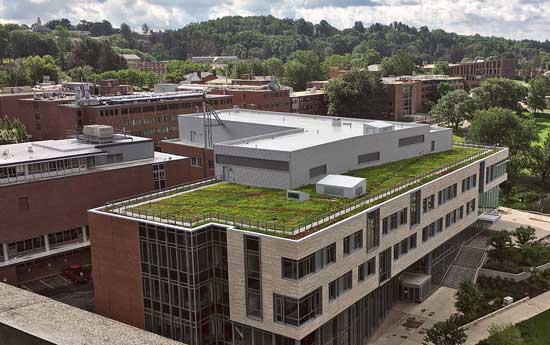

Cool roofs are designed to absorb less heat than conventional roofs. This mainly involves making them more reflective, through the use of lighter colors. However, new technologies also aim to produce surfacing materials with thermal emittance, or the ability to give off absorbed heat more quickly. The ultimate goal is to reduce surface temperatures and hold onto less heat during the day, which means less heat radiated from the surface at night.
Conventional shingle, asphalt, and tile roofs can be 55-85 degrees Fahrenheit hotter than the air, while cool roofs tend to be only 10-20 degrees Fahrenheit hotter. And while traditional roof surfaces may absorb 85-95% of the energy that reaches them, the coolest cool roof materials can reduce that rate to 35%, substantially lowering the amount of heat that is transmitted into a building.
Both low-sloped and steep-sloped roofs can benefit from cool roofing techniques, but each type needs a different approach.
Low-sloped roofs may be flat or have a maximum pitch of 2 inches of vertical rise in 12 inches of run (2:12). These roofs are most commonly found on commercial and industrial buildings and sometimes on apartment buildings, but rarely on homes. In the past, this type of roof would often be waterproofed with thick liquid asphalt that was either painted or sprayed on.
Two types of cool roof materials can be used to replace this asphalt: elastomeric coatings that are sprayed on, or flexible sheeting that is laid on the roof with seams that are glued, taped, or heat-sealed. Both are manufactured to have both high reflectivity and high thermal emittance. Most cool roof programs tend to focus on the low-sloped sector of the roofing world.
Steep-sloped roofing alternatives, however, are becoming more available every year. Instead of the traditional dark-colored clay or concrete tiles, with a reflectance of 10-30%, manufacturers are working to raise the shingles’ reflectivity to as much as 65%, mainly by using lighter colors and infrared-reflecting pigments. And the popularity of light-colored metal roofs is also growing steadily, for the same reason.
The ultimate in cool rooting is the emerging field of photovoltaic (or solar) shingles. Beyond being highly reflective and generating electricity for the building, they can now actually take the place of conventional shingles, tiles, or shakes. And, unlike standard roof-mounted solar PV arrays, which require rack-mounting that penetrates the roofing material, solar shingles are attached directly to the roof sheathing. As of this writing, solar PV shingles are an emerging technology with a lot of potential, but they are not yet widely available.
Last Thoughts
Cool roofs can save on utility costs in several ways: through reduced energy demand, smaller AC equipment, longer roof lifetime, and rebates and incentives. When building a new roof, the installation costs can be the same as a regular roof, but converting a standard roof might cost more than the expected savings. “Cool roof calculators” found on the internet can help with figuring this out.
Keep in mind that cool roofs tend to have the greatest benefit in hot climates. In cool climates, by comparison, they have the potential to increase energy costs by reducing wintertime heat gains. AS with many of the guidelines in this book, the right decision will require some homework. And local expertise will also help.
More from Climate-Wise Landscaping
Excerpted from Climate-Wise Landscaping by Sue Reed and Ginny Stibolt, copyright © Sue Reed and Ginny Stibolt, 2018. Used with permission from New Society Publishers.





