

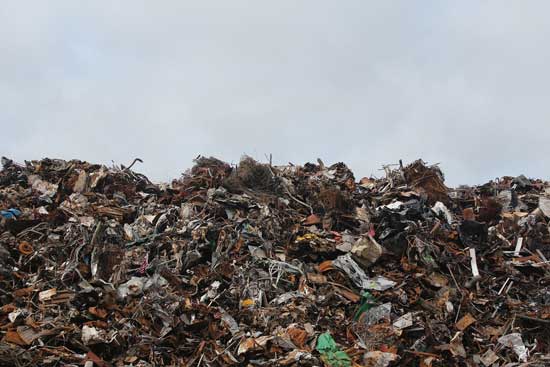

InThe Zero Waste Solution (Chelsea Green, 2013), Paul Connett shows consumers across America that their community’s waste handling can be re-imagined to be more effective and kinder to the environment. Connett gives suggestions that the average consumer can use to lessen the amount of waste coming from their home. The following excerpt is his list of four methods to reduce waste in the community.
It may appear that zero waste is an idealistic goal, but we can approach this target with simple, practical, cost-effective, and politically acceptable steps in mind. In fact, many cities and towns around the world are taking these steps to get closer to—and hopefully eventually achieve—zero waste.
You’ll note that many of these steps stress community—another reminder that getting closer and closer to zero waste involves building both local and global communities in order to move toward the greater goal of sustainability.
Step 1: Source Separation
Waste is made by mixing discarded items. Waste is unmade (or rather not made in the first place) by keeping discarded materials separated into a few simple categories. While many communities in the United States recycle, the types of items collected at curbs are usually limited to three or four categories (see Step 2 below). However, in places where citizens deliver their discards (materials they no longer need) directly to drop-off recycling centers, the number of categories can be much higher. In one town in Japan, citizens separate into thirty-four different categories. Daniel Knapp of Urban Ore, a leading recycling venture in Berkeley, California, believes all discarded materials can be divided into twelve master categories, and he designs resource recovery parks in ways to receive and handle these categories. It all boils down to the simple fact that the more categories a community offers, the more waste its residents can recycle and the less material is wasted in processing.
Step 2: Door-to-Door Collection Systems
Door-to-door collection systems in towns that are serious about zero waste typically involve three or four color-coded containers or bags. Collection rates vary, as does the degree of curbside waste separation. San Francisco, for instance, does a once-a-week collection of three containers. Several cities in Italy and Spain use four or more containers, and some communities collect specific materials (using the same collection vehicles) on different days of the week to allow for greater source separation. Communities at the leading edge of door-to-door collection have been able to allow citizens to recycle over 80 percent of their discards, and some smaller communities over 90 percent.
Basically, in the more comprehensive door-to-door systems one container is used for kitchen waste, one or more for recyclables (an extra division can be made here between paper products and bottles and cans), and a third for the residual fraction. Being produced seasonally, garden debris is usually picked up less frequently. Some communities collect the kitchen and garden debris together, but this leads to the use of much larger containers—which in turn can influence the size and expense of the vehicles used for pickup. Most communities in North America, though, still lack door-to-door pickup of organics and kitchen waste.
Step 3: Composting
In my view composting is more important than recycling. Kitchen waste and other organic matter not only causes foul odors when mixed waste is left around in cities, it also generates methane and leachate in landfills. But perhaps the most important reason that we need to collect clean organic waste is because it is needed by farmers to replenish their soils of depleted nutrients and, especially in warmer climates, help fight erosion by holding onto moisture. Not only does the conversion of organic matter to compost avoid the global warming gases involved in the production of synthetic fertilizers and topsoils, but it also delays the release of global warming gases from the waste materials themselves by sequestering the carbon in wood and other cellulosic fibers in the final product. With incineration, the conversion of cellulose and other organic material to carbon dioxide is instantaneous; the cellulose left in compost can last in the soil for many months to many years. Moreover, by stimulating plant growth, this in turn leads to more absorption of carbon dioxide from the air.
In San Francisco the kitchen and other organic waste is sent to a large composting plant located approximately one hundred kilometers from the city. The site is surrounded by farmland, and local farmers use the compost to produce fruit, vegetables, and wine—which is sent back to San Francisco.
According to Robert Reed, a spokesperson for Recology, the company that runs the composting plant for San Francisco, the city has composted 1.2 million tons through its green bin program since it began in 1996. By so doing, Reed says, “San Franciscans have achieved a total CO2 equivalent benefit (methane avoided and carbon sequestered) of at least 640,000 metric tons. That is equal to offsetting all emissions from all vehicles crossing the Bay Bridge for three and a half years.”
Instead of exporting their mixed waste to landfills and incinerators located in rural areas, which causes so much intense opposition from citizens and farmers, municipal decision makers should work with farmers to coproduce a compost product from which everyone can benefit. Even so, municipal composting facilities need to be located carefully because of the odor problem—not necessarily a huge problem in rural settings but highly problematic in or near cities.
Farmers do not want low-grade material, and so the key to a municipal composting program’s success lies in the ability of cities to organize their citizens to separate their organic discards from plastic, glass, and other contaminating materials. In this respect, the city workers who pick up this material can be very important players in the education process as well as the kitchen staff in hotels and restaurants.
Many towns where householders have more space have taken a simple preliminary step before building a centralized composting facility. They encourage as many of their citizens as possible to compost their own kitchen and yard waste in backyard compost bins or vermiculture boxes (worm bins). Some provide the composting or vermiculture kits either for free or at reduced cost. Communities are sometimes aided by nongovernmental organizations that train volunteers to become “master composters.” These show people how to get started and troubleshoot problems as they arise.
Zurich, Switzerland, which has a very dense housing situation, has encouraged “community composting.” In this program a number of households (ranging from three to two hundred) share the responsibility of running a simple compost system. These do not occupy a large area and can be located in city parks or in the space between high-rise buildings. Currently the city boasts over one thousand community-composting plots, which in total are taking care of about half of the city’s household organic waste. According to Thomas Waldmeier, who pioneered this program, the best thing about it has been its social impact: “It helps people fight the anonymity of living in a big city,” he said. “People meet over the compost pile!”
Every town or city needs to design a program that works for its needs, but they all need to assess the same factors for handling food waste and establishing priorities. Here’s how I would prioritize those factors:
1. Feeding humans using in-time marketing of food items close to their sell-by dates from supermarkets, as well as unused food from restaurant kitchens
2. Feeding animals
3. Home composting or vermiculture
4. Community composting or vermiculture
5. Small-scale in-vessel composting systems in urban areas
6. Co-composting with agricultural waste in rural areas
7. Centralized composting or anaerobic digestion in rural areas
Step 4: Recycling
In larger communities, recyclable materials are destined to go to material recovery facilities (MRFs), of which there are hundreds of successful examples around the world. Their function is to separate the paper, cardboard, glass, metal, and plastic and prepare them to meet the specifications of the industries using these secondary materials to manufacture new products.
Some of these plants are built to handle a single stream of mixed recyclables; others deal with two streams—paper products in one stream and glass, metal, and plastic (like cans, bottles, and food containers) in the other. As far as the industries that use these secondary materials are concerned, the simple rule is that they want three things: quality, quantity, and regularity.
These plants are best built in large cities, which can provide the large labor force needed and are also usually located close to the industries that can use the secondary materials or have transportation hubs for delivery elsewhere. This sets up an ideal partnership between urban and rural areas. The cities should export their clean, source-separated organics to the rural areas for composting, and the rural areas should transfer their recyclables to the cities so that these materials can be sent back to industry.
Sadly, in many large cities in the United States the recyclables are being shipped to China instead of to local industries. However, in Nova Scotia (a Canadian province of about 900,000 inhabitants) nearly all the recyclables are used in the province’s own industries. Their program has created approximately one thousand jobs in the collection and processing of the discarded materials and another two thousand jobs in the industries using these secondary materials.
Some zero waste advocates would prefer to see recyclables being dropped off or delivered to zero waste ecoparks with early separation into more categories.
The following excerpt is adapted from Paul Connett’s book The Zero Waste Solution: Untrashing the Planet One Community at a Time(Chelsea Green, 2013) and is reprinted with permission from the publisher.






