


“Those who construct their own shelter replicate themselves at their deepest and most significant level, in their houses. They are what they build.”
–Jack McLaughlin in Jefferson and Monticello: The Biography of a Builder (Henry Holt, 1990).
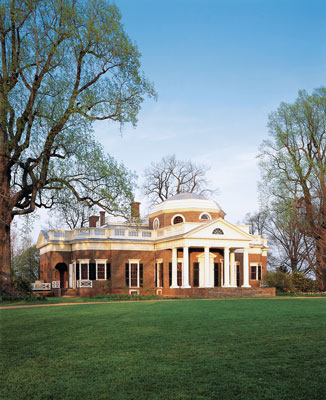
When you think of green builders, Thomas Jefferson probably isn’t the first name that comes to mind. But the Declaration of Independence author, governor of Virginia, and third president of the United States was also an architect who created an innovative home that maximized sun and wind power: Monticello near Charlottesville, Virginia.
“Monticello is one of the most sophisticated passive solar houses in the world,” says William McDonough, an architect known for creating buildings that are people- and environmentally-friendly. A principal of the Charlottesville-based firm William McDonough + Partners, McDonough is passionate about this subject. “Jefferson was very precise in his understanding of the way the sun moves around a building and how it would integrate with a house,” he says.
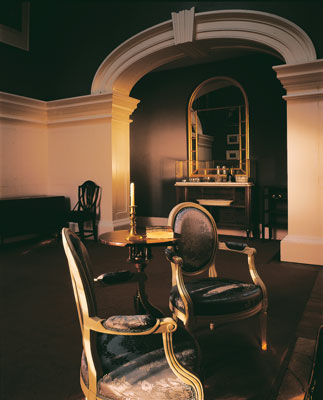
According to McDonough, Monticello, built in the Roman neoclassical style and featuring 43 rooms and 11,000 square feet of living space, is small when compared with the great mansions of the time. He considers the home’s mountaintop location–which allowed Jefferson to look to the west, in the direction of the Louisiana Purchase and the Lewis and Clark expedition–to be his one act of hubris.
Living with the elements
Much of the subtlety and elegance of Monticello’s design comes from Jefferson’s study of Renaissance humanist Andrea Palladio. Palladio rediscovered the classical architecture of first century b.c. Roman architect Marcus Vitruvius Pollio, who described where to locate rooms relative to the sun’s movement. However, McDonough believes a basic understanding of how to live in relation to the sun and the wind was common to almost everyone in Jefferson’s time. “Jefferson was a farmer, and farmers are intensely connected to the land,” he says. “Jefferson happened to have a grand, eloquent perspective on the world, yet anybody who lived on a plantation or farm at that time would have done similar things.”
McDonough points out that Monticello’s main rooms–the east entrance portico, Jefferson’s bedroom suite, and the dining room and tea room–are positioned to take advantage of passive solar gain based on what times of day and in which seasons the rooms were in use. “The east entrance portico could use a little warm-up as you greet the day and doesn’t necessarily need to be heated in the winter for evening,” he explains. The western-facing living room, shaded in summer by its portico, allows late-afternoon winter sun to warm it for evening use.
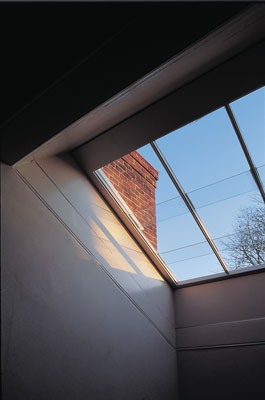
William Beiswanger, the Robert H. Smith director of restoration at Monticello, says the home is built so that cold air is brought in through the cellars and hot air is vented through the skylights. During Jefferson’s time, the skylights in the third-floor bedrooms could be opened via a pulley system, and it’s assumed the skylights over the stairwells worked the same way.
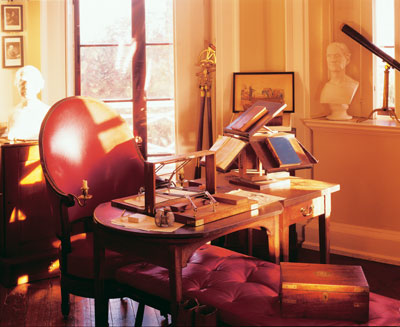
Jefferson’s personal suite–bedroom, library, and study–on the home’s southeast side includes passive solar design elements such as a glass-walled orangerie (greenhouse) and a “breathing” skylight in which the panes of glass are separated from each other by one-sixteenth of an inch, allowing air to leak out. This slowly moves warm air from the greenhouse through the bedroom suite and vents it through the skylight.
“I’m now doing that at the Ford Rouge plant–designing the building as a duct–moving the air through the building by controlling how it leaks out,” McDonough says. “It’s very elegant.”
Other green features include bricks crafted from mud on the building site, woodwork made from trees felled nearby, double- and triple-sash windows for greater flexibility in controlling air flow and heat, double-glazed (storm) windows in the west-facing dining room, and sliding glass double doors that keep heat in the north-facing dining room without losing light.
Permaculture before its time
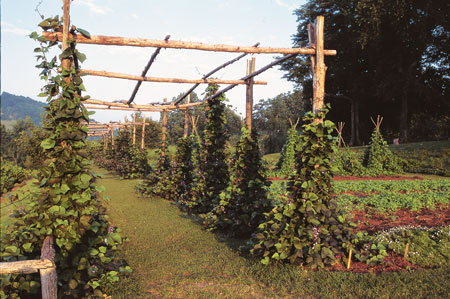
It appears that Jefferson used very little water to sustain Monticello’s extensive gardens; there is no written account of his watering plants even though he was a meticulous record keeper, says Peter Hatch, Monticello’s director of gardens and grounds. The mountaintop landscape offers a variety of natural microclimates, which Jefferson organized brilliantly. He placed an ornamental forest on the steep north side of the mountain, where nothing could be cultivated, and located his kitchen garden on the southeast mountainside. This 1,000-foot-long vegetable garden functioned as a source of food for the family and as a laboratory where Jefferson experimented with 330 varieties of more than seventy vegetables. It was hewed into the mountainside and supported with stone walls that also provided radiating heat for warm-weather fruits such as figs.
“The microclimate of this garden orchard had a Mediterranean effect that enabled Jefferson to grow tender plants such as French artichokes, figs, pomegranates, grapes, and peaches very successfully,” Hatch says. “It enabled him to extend the growing season, and he would plant greens in November and December to eat during winter months.”
Jefferson also loved native species at a time when Europeans were belittling American flora and fauna, and he had a holistic view of gardening. He believed that plants grown in rich soil would “bid defiance” to insects, diseases, drought, and all the pests that plague gardeners today. “Sometimes we think of gardening as a war, so it’s nice to look back upon Jefferson’s more balanced belief in the inevitable tension that exists between nature and the garden,” Hatch says.
These days Monticello’s gardens, including the organic kitchen garden, function as a seed bank. Hatch and his staff now grow many of the plants that Jefferson cultivated in the hope of preserving and disseminating varieties such as Blue Prussian peas, Newtown Pippin apples, Painted Lady pinks, and Keizerskroon tulips. Many of these heirloom varieties are available to the public through the Monticello garden shop or through its seed catalog and online store.
Jefferson’s legacy
In Monticello, McDonough points out, Jefferson taught us invaluable lessons about connecting with the sun and celebrating local culture and materials. “This Renaissance man didn’t only consider, ‘Does it work, can I afford it, do I like it?'” he says. “His mansion was a celebration of the abundance of his own creative imagination, and I think that’s really what a house can be.”
Today, we are Jefferson’s seventh generation, and McDonough believes it’s time to revisit what he stood for. “If Jefferson were here today, he’d call for a Declaration of Interdependence, including life, liberty, and the pursuit of happiness,” McDonough muses. “And, instead of a bill of rights to pollute, he’d call for a bill of responsibility.”






