

When we think about air pollution, most of us think about smoke stacks or trucks spewing exhaust. Although these sources are certainly a threat to human health, indoor levels of air pollution are typically two to five times greater than outdoor levels, according to the U.S. Environmental Protection Agency. In fact, many of our daily activities and possessions can degrade the air quality in our home: Cooking produces particles, while paint, carpets, furniture and cleaning products can off-gas toxins.
With people spending 90 percent of their time inside, indoor air quality ranks as one of the top five environmental risks to human health. As most new homes have tighter building envelopes with less air infiltration, indoor air quality deteriorates without proper ventilation. This is especially true during winter months when less outdoor air typically enters the home through windows and doors, and concentrations of indoor contaminants may rise.
“As homes get tighter, there is certainly a higher risk to indoor air quality, but we do have the tools for reducing exposure to indoor air contaminants, as well as designing proper ventilation systems, including tight ducts and filtration, that can mitigate that risk and improve indoor air quality,” says Iain Walker, a scientist for Lawrence Berkeley National Laboratory.
One of the primary strategies for ensuring fresh air indoors is through proper ventilation. Let’s explore in more depth the two most common forms of ventilation.
Exhaust-Only Ventilation
One of the main strategies for boosting indoor air quality is to reduce pollution at the source. Exhaust-only systems use exhaust fans to remove moisture, contaminants, odors and stale air, and are commonly found in bathrooms and kitchens. Although exhaust fans cannot effectively mitigate the impact of water leaks on your indoor air quality (from mold and mildew), they can remove excess moisture resulting from activities such as showering and particles from cooking. It’s important that these systems vent to the outside: Exhaust-only ventilation systems rely on air leaks in the building envelope to bring makeup air to replace the air vented from the home.
This is often a lower-cost ventilation option that can be effective in removing contamination at the source, but it has significant drawbacks. Conditioned air is vented out of the home, and unconditioned makeup air leaks into the home, which is not energy efficient and makes your heating or air conditioning system work harder to compensate. In more airtight homes, a negative pressure is created as air is vented out of the house. Makeup air is looking for a path into the home, which can cause air to enter through the flue of a woodstove, furnace, fireplace or gas hot water heater, resulting in unwanted emissions back drafting into your home.
Balanced Ventilation Systems
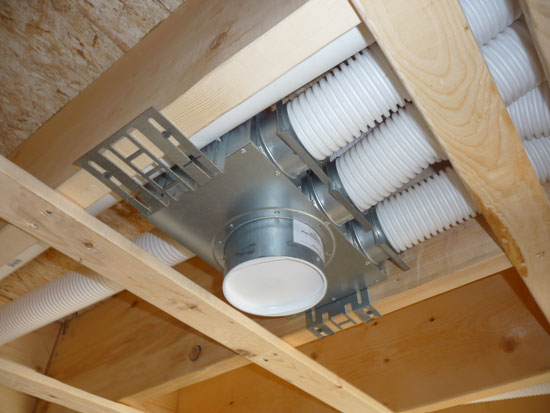
These systems encompass a variety of systems, including single-point or multiple-point supply; single- or multiple-point exhaust; heat recovery ventilation (HRV) systems; energy recovery ventilation (ERV) systems; and ventilation with a central air handler and partial HRV or ERV systems. Balanced ventilation systems result in more thorough and planned ventilation, especially when you consider your house as a whole, but do typically have a higher upfront cost.
HRV and ERV systems recycle the heat from the outgoing air to the incoming air, ultimately saving money. Zehnder HRV systems are up to 95 percent efficient in transferring heat before the air exits the home. A constant stream of fresh air is often supplied to living spaces, while an equal amount of air exits the home, typically from the bathrooms and kitchen. Such systems boost air quality by removing contaminated air and replacing it with fresh, filtered air.
Most balanced ventilation systems filter intake air, however these filters need to be cleaned or replaced regularly to be effective. Using a filter with a higher MERV rating ensures that finer particles such as dust and pollen are filtered out, boosting indoor air quality.
“If you are building a really great home and want high indoor air quality, a good filter [on the ventilation system] is really important,” Walker says. “Instead of using a cheap filter, which doesn’t do much for particles and only protects the [ventilation] equipment, use one with a filter with a MERV 13 rating, which removes a lot of what we are concerned about for health.”
Sarah Lozanova is an environmental and health journalist with an MBA in sustainable management. She lives in a net-zero house in Belfast Cohousing & Ecovillage in midcoast Maine with her husband and two children.





