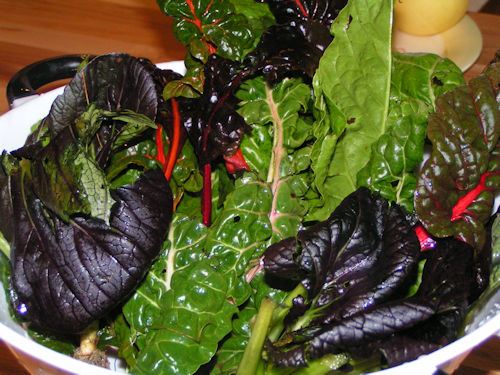
Bright Lights Swiss Chard fresh from the garden
Growing up, I was never a picky eater. Many or our summer meals consisted solely of our day’s garden harvest and I willingly ate everything on my plate. When schoolmates turned up their noses at the home-cooked veggies featured in our rural school’s cafeteria, I was right there, ready to vacuum up their leftovers. But I never ate Swiss chard. I’d never even heard of chard.
One day at our local farmers’ market several years ago, I overheard a fellow shopper say to a vendor, “Is that Swiss chard? That’s the one I never know what to do with.” I passed it by. I certainly didn’t know what to do with it, and she made it sound hard. Really hard.
Then I found myself in a workshop at the Mother Earth News Fair. The incomparable Niki Jabbour was telling an overflow crowd about year-round gardening. As she listed her favorite vegetables, my ears pricked up at the mention of Swiss chard. How she praised it. She was particularly fond, she said, of Bright Lights chard with its multi-hued leaves and stems.
I decided to give it a go and ordered my own Bright Lights seeds for my spring gardening. Am I ever glad I did! In fact, chard quickly surpassed kale, my former go-to, as my favorite leafy green. I’d long been a big kale fan—it’s versatile, it’s nutritionally dense, it starts early and grows late. It can withstand frost and freezes. Harvest kale and it keeps producing. What’s not to love?
Well, cabbage worms, for one. No matter how diligent my husband and I were at pest surveillance, we always managed to miss a few of those always well-camouflaged cabbage worms. They can destroy a kale plant almost overnight. Swiss chard, on the other hand, hasn’t been on our cabbage worms’ menu. And chard has all the virtues as kale, except more and better.
Easy to Cook With
I would never disparage kale. It’s good raw or cooked. It makes delicious chips. And it’s a nutritional powerhouse. But so is chard, I discovered. When compared, chard regularly outstrips kale for its nutritional density. What’s more, you can eat every inch of chard’s colorful stems. Not only does that make chard a no-waste vegetable; it also makes preparation a breeze: give it a quick wash and a rough chop—stems and all, and it’s ready to use in your favorite recipe. That’s it. I can’t imagine why that farmers’ market shopper was flummoxed by chard.
And the taste! No matter how many times we’ve said it, when Swiss chard is what’s for dinner, neither my husband nor I can resist exclaiming over its tastiness. Always tender, its soft texture practically melts in the mouth. Its flavor is mild with an ever-so-slight hint of citrus. It’s a perfect addition to almost any meal.
In my opinion, the easiest and all-around best way to eat chard is sautéed in the tiniest bit of olive oil. It only takes a couple of minutes to cook. You can toss in some chopped onion for a more complex flavor profile, but it’s delicious plain. Preparing chard this way takes no longer than brushing your teeth.
But there are other just-as-easy ways to make chard a regular part of your diet. Chard is a mild, yet super-wholesome, ingredient in smoothies. Add it to some pan-fried potatoes for a nutritional boost. And when scrambled eggs are served on a bed of leftover sautéed chard, breakfast gets even more healthful.
I happen to love chard as a quiche vegetable, and when I serve my chard quiche to guests, it always gets rave reviews. (See here for quiche recipe).
If, like me, you’ve been scared off from Swiss chard, fear no more. Trust me, it’s an easy vegetable to grow and an equally easy—and delicious—one to prepare and eat.
Carole Coates is a gardener and food preservationist, family archivist, essayist, poet, photographer, modern homesteader. You can follow her Mother Earth News blog posts by following this link.You can also find Carole at Living On the Diagonal where she shares her take on life, including modern homesteading, food preparation and preservation, and travel as well random thoughts and reflections, personal essays, poetry, and photography.
All MOTHER EARTH NEWS community bloggers have agreed to follow our Blogging Guidelines, and they are responsible for the accuracy of their posts. To learn more about the author of this post, click on their byline link at the top of the page.