

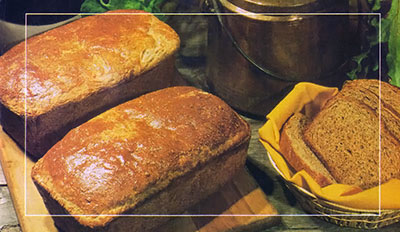
Although many North American cooks have never even
heard of diastatic malt, this healthful
sweetener is one of the most important ingredients in just
about every loaf of bread baked in Europe and indispensable if you want to make leavened sugar-free bread. Despite its
imposing name, the substance is simply sprouted wheat or
barley. It would be hard to imagine a better
substitute for sugar or honey!
As you probably know, “sweets” do a lot more than just add
flavor to breads. Such ingredients provide a necessary
feeding medium for the yeast and act as browning
agents, as well.
Diastatic malt handles these chores efficiently and is
economical (and easy to make! ) in the bargain. In
fact, the flavorful grain even increases the nutritional
value of bread by adding enzymes and vitamins and helps
loaves retain their freshness. When malt is used in proper
amounts, it improves both the taste and texture of “the
staff of life” while providing another means of
cutting down on the use of heavily refined white sugar.
Malt Mixin’
Non-pearled barley (the grain used in “traditional”
diastatic malt) is difficult–if not
impossible–for the home baker to obtain, so you’ll
probably want to make your sprouted sweetener from wheat.
Simply place one cup of the grain In a sprouting jar (any
container with a capacity of five cups or more–topped
with nylon net–will do) and cover the kernels with
four cups of tepid water. After the wheat has soaked for 12
hours, drain It. (And as always, save this nutritious water
for use in soups or in your bread.)
The sprouting process will take a day and a half to two
days. During this time, make sure to rinse the tiny shoots
three times a day to prevent molding. (If you set the jar
by the kitchen sink, you won’t forget to perform this chore
when preparing or cleaning up after your meals.)
When your sprouts reach the “rootlet” stage (they’ll be
about as long as the wheat kernel itself), it’s time to
dehydrate ’em. Just spread the little plants out on a
cookie sheet and put ’em in a 150°F oven for eight
hours or until they’re completely dry. Then
grind the sweetener-to-be in a grain mill (or in a powerful
blender): The end result will be inexpensive diastatic
malt. (You can, of course, purchase ready-made malt
commercially, but why pay someone else to perform such
an easy task?)
The prepared sweet grain should be stored in a
refrigerated, well-covered jar. One “sprouting’s” worth
will last you a good long time because just one
cup of malt is enough to sweeten approximately 150
loaves of bread! The basic rule is to use a single
teaspoon of the dried sprouted wheat in place of all
the sugar or honey that’s normally requiredin any four-loaf batch of bread. (In fact, too much of the
potent sweet will overpower your mixture’s yeast buds and the dough will become sticky and unmanageable.)
Quick Whole Wheat Malt Bread
Measure 5 1/2 cups of lukewarm water into a large
(six-quart) container. Add 4 tablespoons of yeast and let
the mixture stand until the leavening begins to dissolve.
Then add 1/2 cup of oil, 1 teaspoon of malt, 1/2 cup of
gluten flour (optional), 2 tablespoons of salt, 1/4 cup of
lecithin (optional), 3/4 cup of whey powder or dried milk,
and 6 cups of unsifted whole wheat flour. Beat the
ingredients thoroughly with a spoon or an electric
mixer until a “spongy” consistency is reached, and
let the dough rest for 10 to 15 minutes before stirring in
7 or 8 additional cups of unsifted whole wheat flour. Knead
the mixture on a floured breadboard. Let it rest
again while you grease your loaf pans.
Divide the dough and form it into 4 or 5 loaves (smaller
pans will produce more “reliable” whole wheat bread). Cover
the containers with a towel and put them in a warm spot to
rise. Never allow the loaves to reach more
than 3 1/2 inches in height. If time permits,
remold each loaf–allowing the dough to rise
again after each shaping–one or two additional times.
This process will produce a more finely textured bread.
Bake the delicious and healthful treats in a preheated
oven at 350 to 375 °F for 35 to 40 minutes.
Remove the finished loaves from their pans immediately … and try to avoid eating the whole batch while
it’s still warm and fragrant.






