Add flavor to your food and self-reliance skills to your repertoire by learning how to render lard and use tallow, lard, and poultry fats at home.
When you render animal fat at home, you’ll not only save money, but you’ll also add a wide variety of flavoring options to your pantry. Batch size doesn’t matter. Render a little at a time, or render in big batches — whatever works for you. The only real drawback to fat rendering at home is the time it takes.
Luckily, regardless of the type of fat you work with, the process will be pretty much the same. First, chop the fat into small pieces (1-inch dice or smaller), place the pieces in a heavy pot, and add a small amount of water to prevent scorching until the fat begins to melt. Melt the fat over low to medium heat, stirring frequently; don’t let it bubble furiously. When the solid bits start to color, begin removing and straining the fat through a fine-mesh strainer into storage containers. Ideally, the fat will be entirely neutral in taste, but the longer the melted fat remains with the solid golden or browned bits, the meatier the fat will taste. If your fat tastes too “porky” or “beefy” to you, it’s probably been allowed to sit with the browned bits for too long. So be vigilant and watch for browning, especially if you’re working in large batches.

When cutting up tallow or lard, it’s helpful if the fat is very cold – even frozen. For smaller pieces, use a meat grinder or food processor. Some people like to render in a covered roasting pan in an oven at 250 to 300 degrees Fahrenheit. This way, they avoid the necessity of keeping watch over the animal fat rendering process. However, the process takes longer in an oven, and more odors accumulate. It’s also hard to judge when to start pouring off the rendered fat, so there’s more danger of letting the fat develop the meaty flavors I try to avoid.
Beef, pork, or poultry odors will accumulate in your house when you render animal fats. If you don’t have good ventilation in your kitchen, you can render the fat in a slow cooker set outside on a porch or deck, as I do sometimes. I start it at high heat, and then reduce the heat to low once the fat starts to render. Leave the lid off so condensation doesn’t drip back into the fat.
I find that rendering on a stove is quicker than in an oven, resulting in less odor. The only disadvantage to stovetop fat rendering is that, occasionally, a miniature steam explosion will “pop,” causing a spatter of grease that can burn you if you happen to be standing near.
Add 1/4 to 1/3 cup of water to the pan when rendering chopped-up suet and lard in order to prevent the fat from scorching or sticking to the bottom of the pan. (With its low melting point, poultry fat doesn’t need this.) As the fat renders, the water will evaporate completely. Note that this isn’t “wet rendering,” which is a commercial process used in an animal fat rendering plant with giant steam kettles.
Essential Equipment
If you plan to render fats on a fairly regular basis, here are the tools I recommend you have on hand:
- Cookware. Whether you’re rendering on top of a stove or in an oven, use heavy cookware. Avoid lightweight pots, which can allow the fat to scorch. A slow cooker will work fine.
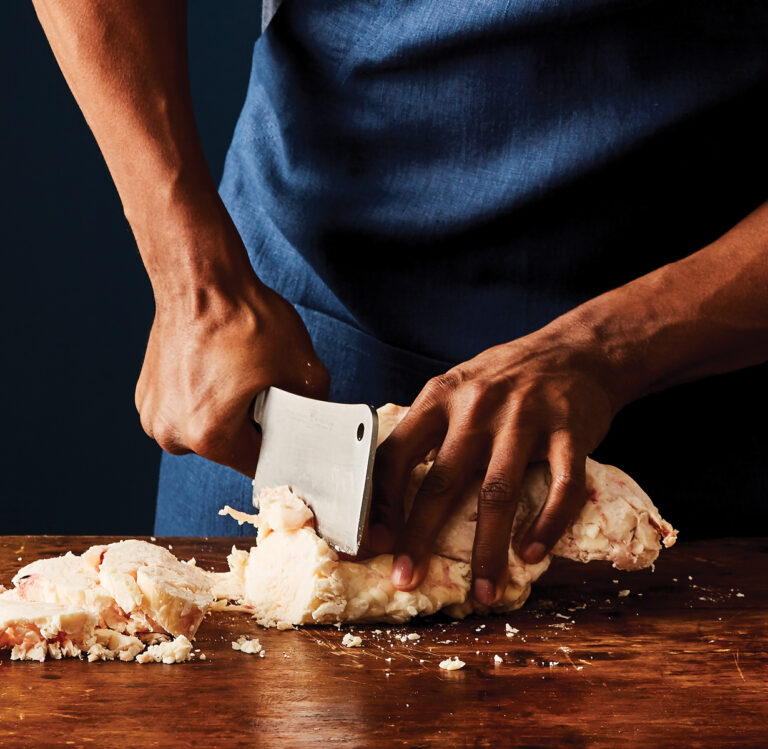
- Knives or cleavers. To get the purest, most neutral-tasting tallow or lard, you’ll want to start with the smallest pieces possible; this will enable you to quickly melt the fat and get it off the solid bits before they start browning and flavoring the fat. So before you start, first consider how to get your fat into small, quickly melting pieces. You can use a knife or cleaver on a cutting board. I use a cleaver and a cutting board for my chopping — and it takes me about an hour to chop up 8 pounds of suet, because it’s so hard. Chopping lard goes faster. When cutting up tallow or lard, it’s helpful if the fat is very cold or even frozen. I line my counters with old newspapers to make cleanup easier; when I’m chopping, pieces of fat tend to fly around.
- Food processor or meat grinder. Some people use a food processor with a grating disc, and some use a meat grinder that’s either free-standing or attached to a stand mixer. The food processor or meat grinder should be well chilled before using; even then, the works will get gummed up, and the more moving parts, the greater the cleanup time. However, the fat will melt much faster if it’s ground or grated, thus reducing the chance of picking up any meaty flavors.
- I’ve found that a powerful, free-standing meat grinder works best. The grinder attachment on my stand mixer tends to get gummed up, and the tough collagen plugs up the works. (You’ll still need a cutting board and cleaver to chop the suet or lard small enough to fit into the chute.)
- Ladle, spoon, and strainer. You’ll need some sort of ladle to transfer the melted fat out of the pot and into a strainer. You’ll also need a spoon for occasionally stirring the melting fat, and something to rest the spoon on. If your strainer isn’t fine mesh, you can line it with paper coffee filters, but you’ll go through a lot of filters as they become saturated. Don’t strain through cheesecloth or butter muslin for the simple reason that the cloth will have to be hand-washed in scalding water, and the wash water dumped outside; you can’t wash fat-coated cloth in your washing machine unless you want to ruin your plumbing.

Storage containers
Consider what sort of container will hold the strained fat — and how easy it will be both to store the containers and to extract the fat as you need it. Because tallow is so hard, I pour the melted fat into a glass 9-by-13-inch baking dish. Once the fat is solid, I slice it, and then remove it in strips with a spatula and store it in a flat plastic container. Lard and poultry fats can be scooped up with a spoon, so I put them into plastic deli containers or wide-mouth canning jars.
If you use glass canning jars, keep them warm in a 200-degree oven, as you would if you were canning jams or pickles. My canning jars are old, and some have been used in the freezer, therefore they’re more prone to breakage than brand-new jars. Once, I had a canning jar break after filling it with hot goose fat. I don’t know what was more painful: losing 2 cups of goose fat, or the cleanup that followed. So now, I hold my clean jars in a warm oven.

Cleanup Strategies
Finally, consider how you’ll clean everything before you begin, because you won’t want the fat or fat residues to go down the kitchen sink and through your plumbing. Fat that turns solid at room temperature will solidify in the pipes, causing all sorts of problems. Try to keep dripping to a minimum to avoid having to clean up many different surfaces.

To clean the pot and utensils I’ve used, I heat a large pot of water to a boil. I dip all the utensils in the hot water, rub them clean with paper towels, and then wash them. The pot in which I rendered the fat gets the remaining hot water sloshed in and then dumped out outside. I rub it clean with paper towels, and then wash it. I do use a lot of paper towels when I render fat. Otherwise, I take great pride in avoiding paper towels in my kitchen.
Everyday Uses for Animal Fats
Any recipe or technique that requires oil can easily be adapted to use animal fats, as long as the dish is baked or served hot. Here are a few ideas.
Note that the cracklings from chicken and pork are delicious and can be crisped in a skillet, seasoned with salt, and eaten. Discard the cracklings from tallow, or feed them to pets.
- Roasted vegetables. Place a sheet pan in the oven and preheat to 425 degrees Fahrenheit. When the pan is heated, add the fat, using three-quarters of the amount of oil you usually use. Poultry fats add extra flavor, but any animal fat can be used. Turn and tilt the pan until the fat is melted. Add the veggies, and toss with silicone spatulas to get the veggies evenly coated. Roast, turning or shaking the pan periodically. Roasting root vegetables and potatoes in any poultry fat is particularly scrumptious.

- Fried vegetable chips. Slice any root vegetable on a mandoline, or shred with a spiralizer. Deep-fry at 350 degrees, drain, and sprinkle with salt.
- Any potato recipe. Poultry fat can replace butter in mashed potatoes; it’s also wonderful with roasted potatoes. Pan-fry for non-greasy pancakes, hash browns, or home fries. Tallow is excellent for deep-frying.
- Sautéed vegetables. Use about three-quarters of the amount of oil you usually use. Sauté vegetables in poultry fat over high heat for extra flavor.
- Eggs, any which way. Use poultry fat instead of butter for a rich flavor.
- Rice pilafs and risottos. Substitute any animal fat. Poultry fats add a depth of flavor and complement any recipe that uses chicken broth as the cooking liquid. Mexican (or Spanish) rice should be made with lard.
- Stir-fries. Lard and tallow withstand the high heat of wok cooking and result in nongreasy dishes.
- Pan-seared meats and fish. Match the meats with the animal fats. Use poultry fats or bacon grease with fish.
- Pie pastry. Short-crust pastry can be made with any animal fat. Leaf lard pastries handle like a dream. Tallow requires grating or chopping with some flour in a food processor to get the texture fine enough to mix with the flour, but it makes pastries as flaky as those made with lard. Pastries made with poultry fats can be a little harder to handle than those made with lard or tallow, and the pastry dough will be softer and less rigid. Chill pastry made with poultry fats until firm.
- Quick breads. Substitute melted fat for the oil the recipe calls for.

Goose Fat Is Pure Gold
Every once in a while, I buy myself a goose. Goose meat is good; it tastes like duck. Goose bones make a fine stock, and goose liver makes a fine pâté. But I buy the goose for the fat, which is pure gold.
Goose fat is a good all-purpose cooking fat that adds a luxurious, silken savoriness to everything it comes in contact with, especially vegetables. Its smoke point of 375 degrees Fahrenheit means you can use it for deep-frying or high-temperature cooking. Melt a few tablespoons and toss in vegetables for roasting, or sauté kale and other winter greens in goose fat instead of oil; you’ll notice the flavor difference.

When sautéing or roasting with goose or duck fat, use less fat than you normally would oil. If your food cooked in poultry fat seems greasy, you used too much fat. Poultry fat tends to stay on the surface and be less absorbed than oils; this has the advantage of browning foods more quickly and evenly.
I find it’s almost impossible to roast a goose so that all the parts are equally cooked and tender, but removing the backbone and roasting the bird flat — a technique known as “spatchcocking” — will help. Plus, it’ll give you access to even more fat to render. For example, from a pasture-raised 8-pound bird, I was able to free about 9 ounces of fat by reaching into the rear end of the goose and pulling out great gobs of fat. But when the bird was spatchcocked, I found another 7 ounces of fat. And after I roasted the breast, I was able to pour off another cup, for a total of 3 cups of indescribably delicious cooking fat.
Andrea Chesman has written more than 20 cookbooks. She gives cooking demonstrations and teaches classes at events across the United States. This is an excerpt from her book The Fat Kitchen, used with permission from Storey Publishing.
Frequently Asked Questions
Q. What does rendering fat mean?
Rendering fat means slowly heating raw animal fat so it melts and separates from connective tissue and impurities, resulting in a clean, stable cooking fat that can be stored and reused.
Q. Is rendering of animal fats safe to do at home?
Yes, the rendering of animal fats is safe at home when done over low heat with proper ventilation, clean equipment, and careful handling to avoid splattering.
Q. How is home animal fat rendering different from an animal fat rendering plant?
Home animal fat rendering is a small‑scale process done on a stove, oven, or slow cooker, while an animal fat rendering plant uses industrial steam kettles and machinery to process fats in large commercial quantities.
Q. What types of animal fat are best to render?
Common fats used to render animal fat include pork fat (lard), beef fat (tallow), chicken fat (schmaltz), duck fat, and goose fat, all of which work well for cooking when properly rendered.
Q. How long does rendered animal fat last?
Properly rendered and strained animal fat can last several months in the refrigerator and up to a year in the freezer when stored in airtight containers.
Q. Can rendered animal fat replace vegetable oils in cooking?
Yes, once you render animal fat, it can replace vegetable oils in most hot cooking methods such as frying, roasting, sautéing, baking, and pan‑searing.