
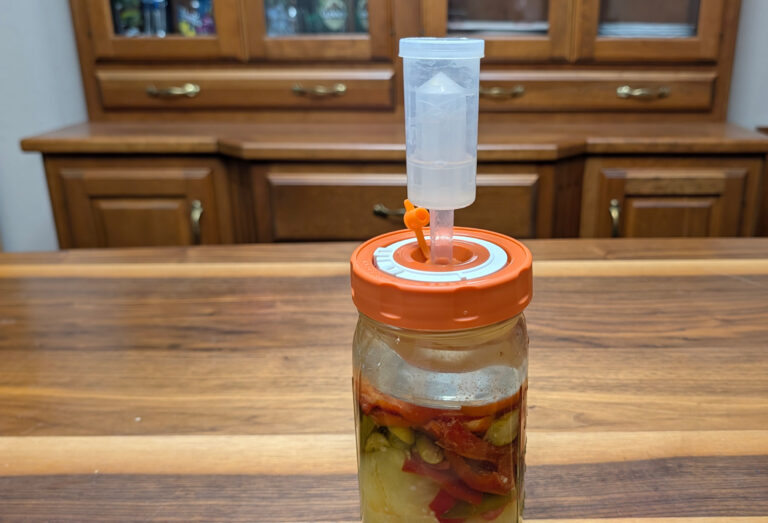
Depending on your Internet prowess, your social media connections and your inbox, you may have noticed the last few years have brought about a number of new products for fermentation — more specifically, for fermenting in a mason jar.
Browse the Fermenting Tools and Supplies in the Mother Earth News store.
All you need for lacto-fermentation is salt, a vessel, and some time. It is a pretty simple, ancient technique for processing and preserving our food — after all, humans came up with clay pots some time ago. For tens of thousands of years those clay pots served us well with very little improvement or innovation.
At some point, a potter or a fermenter figured out a water seal crock. This is a ceramic crock with a moat in the rim that holds a bit of water and the lid. This creates a one-way door for the carbon dioxide (created by the fermentation process) — it can leave but air cannot come back in. This helps to produce the anaerobic environment necessary for successful fermentation.
It is crucial that the vegetables are kept submerged in the brine, but for some the question is should the whole system be anaerobic? It doesn’t have to be — think of regular crocks (not the fancy ones with the water trough), Korean Onggi pots and all the vessels that have an open top with just a weight and a towel.
However, many people prefer not to deal with the yeasts and molds that can take up residence on that exposed top layer of the brine. This can be diminished with the use of a system that allows the carbon dioxide gas, which is created as the bacteria break down the sugars and starches, to escape the fermentation vessel without letting new air into the environment.
Fermenting in a Mason Jar
Fermenting in a big crock can be daunting and unwieldy so most people now-a-days choose to ferment in a mason jar. Fermenting in a jar is great for a number of reasons beyond the approachable size.

The biggest benefit is you can see what is going on with your ferment, which is especially handy if you are teaching yourself this craft. For example, it is important to keep the ferment under the brine. You may wake up and see a huge layer of brine on top of your veggies and think “cool, my ferment is making brine.”
However, in the glass jar, you can see what is actually happening: Is the brine getting pushed out due to the trapped CO2? This is called a “heave” or a “surge.” When you see this in the jar you will see the trapped air pockets in the ferment where the brine used to be. If you are using an open fermentation method it is critical that you press on your ferment allowing the brine to sink back down into the ferment, submerging the vegetables.
This becomes less critical with a system that allows the carbon dioxide to escape without letting air in because those air pockets are generally CO2 and not air. That said the flavor can be affected and it is best to press everything back down when this happens, regardless of the system.
Fermentation works in many environments — that is part of what makes it so incredible. If you ferment without a system that allows the air to escape, you have to burp your jar manually during the process, because the CO2 gas molecules wiggle free from the liquid and have no place to go. They are held in by pressure that is released as soon as they shake free.
This actually takes a bit of energy, which we all know from when we were kids and shook a soda before opening the can. This is what creates that fizz that you get when you open an airtight container without an airlock as the millions of CO2 are molecules rushing to get out the door. (If they were bigger it would be a stampede.)
The systems that we are looking at here all do the same thing in that when the pressure builds up as the carbon dioxide is produced, the air already in the vessel gets pushed out — making the whole environment inside the jar anaerobic. The difference is simple in how this is achieved.

Do You Have to Use an Airlock When Fermenting?
As mentioned above, fermentation is a process that is ancient and very low tech and forgiving, so the answer lies with you and what you are comfortable with. Fermentation should be a fun and relaxing process — yes, relaxing. There should be no fear of killing your loved ones. (Don’t worry — you can’t. If it is bad, you will know.)
What a fermentation system will do for you is take some of the babysitting out of monitoring for air pockets and allow you to “forget” about your little jar temporarily while the good bacteria are processing your veggies.
Also, there is less waste because these systems reduce the chances of discolored kraut or scum on top of the ferment that needs to be thrown away, which can happen with open ferments.
Mara Rose, of Hatch Lab, collaborated to review some of the more popular jar systems out there. Here you will meet the ceramicist, the classically trained chef and nutritionist, the former ad sales exec, and the reformed business analyst who left all that behind to build a better fermentation lid.
Kirsten K. Shockey is a post-modern homesteader who lives in the mountains of Southern Oregon. She writes about sauerkraut and life — but not necessarily in that order. She’s written a complete book of Fermented Vegetables.
All MOTHER EARTH NEWS community bloggers have agreed to follow our Blogging Guidelines, and they are responsible for the accuracy of their posts. To learn more about the author of this post, click on their byline link at the top of the page.






