
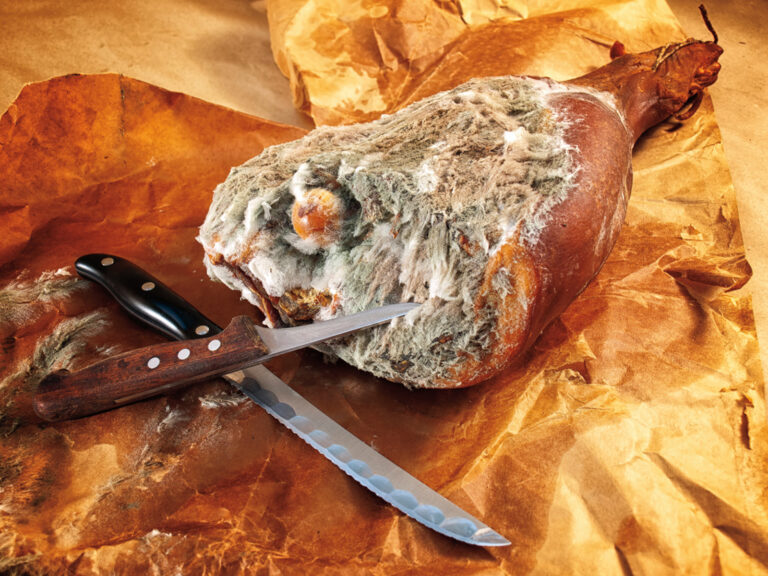
From the hills of Italy to the Spanish plains, dry-cured pork has been an essential (and delicious) food source for many cultures. Microorganisms are a crucial part of dry-curing meats. Using culture for white mold on meat to get the process started can keep your meat healthy and plentiful.
All dry-cured meats are populated with an ecosystem of microorganisms, which are responsible for many of the characteristics of dry-cured meats. You may feel nervous about encouraging mold on a food that you’re ultimately going to eat, but if you want delicious dry-cured meats, you’ll need to embrace microorganisms as an important part of the process.
Without the use of chemicals to inhibit their growth, an ecosystem of mold, yeast, and bacteria will populate the outside of all drying meat. While yeast and bacteria are always present, and a salami relies on an entire ecosystem of microorganisms, mold is what you will spend most of your time managing on any piece of drying meat. As undesirable mold can be very toxic, mold management is an unavoidable part of the dry-curing process. Unwanted mold can be controlled through vigilant removal from the meat with a vinegar-soaked towel.
While you’ll usually find only a handful of different species of mold populating any piece of meat, the range of possible species is significant. Penicillium nalgiovense is the standard salami mold, with its growth easily promoted with a purchased starter culture, but it’s just one of 300 diverse molds found in the Penicillium genus. The Penicillium molds are a very important group, not just in dry-curing, but also in cheesemaking and the production of chemicals; perhaps most important, they are the original source of penicillin, the first antibiotic. Fortunately, Penicillium nalgiovense produces penicillin in such low quantities that the mold coating a piece of dry-cured meat is not a
concern to those with penicillin allergies.

Using a Mold Culture While Dry-Curing Meat
The easiest, and recommended way of controlling the growth and species of mold on your dry-curing is through the use of a purchased mold culture. The most common mold culture is Bactoferm Mold 600, produced by Chr. Hansen, which contains a freeze-dried culture of Penicillium nalgiovense. This culture will produce a traditional flat, white mold that, when applied correctly, will outcompete most undesirable molds. A healthy layer of desirable mold will also have the advantage of slowing the drying process, allowing for more flavor development. And it will contribute its own flavors, aspects of which you may recognize from other dry-cured meats and many cheeses. In addition to these influences, certain molds will reduce the acidity of the outside layer of salami.
Apply the mold culture to the meat after casing, but before any drying or fermentation has occurred. Follow the instructions of the manufacturer to rehydrate the mold in distilled water, and then apply the mold with a spray bottle or dip the meat into the culture. I recommend filling a wide and shallow baking dish with a thin layer of the rehydrated culture, then rolling the meat in the liquid. In a couple of days, this should produce a healthy population of white mold on the meat without wasting too much of the culture.
If you are cold-smoking your meat, the smoke will inhibit most mold growth, and using a mold culture is unnecessary.
While many commercial producers encourage controlled mold growth during the drying of their salamis, the white coating found on most purchased salami is often not mold but rather rice flour or a similar white flour/powder. In these cases, either the mold coating has been removed–mold growth can be unpredictable over time and doesn’t hold up to packaging well–or no mold was ever allowed to grow. In both cases, the salami is rolled in the rice flour to maintain the traditional white, powdery appearance.

Populations of Mold on Dry-Cured Meat
If left alone, with no added mold culture, your meat may naturally become coated in a nice white, powdery, flat layer of mold. For those of us who work hard to cultivate our local flavors, this can seem like an ideal development, and something to be encouraged. While many people will tell you this mold is okay, the reality is that any unknown mold, regardless of what it looks like, carries potential risk.
To learn more about the negative effects of unknown molds, I contacted Benjamin Wolfe, who has made a name for himself through his writing, teaching, and research concerning the ecosystems of microbes inhabiting various foodstuffs.
The concern with unknown molds is that different molds produce a wide range of toxins, specifically called mycotoxins, and mycotoxins can have severe and long-lasting effects, which may or may not be immediately noticeable. Unlike the immediate feedback you get from eating spoiled food, certain mycotoxins can be slow acting, with no feedback indicating their ability to cause harm–the fact you don’t get sick after eating a mold doesn’t mean that regular consumption will not have long-term effects.
As a follow-up question, I inquired about the safety of slicing off the outer layer of meat to remove the mold. Mold requires oxygen to grow, and the interior of any drying meat is relatively oxygen-free, so this is a somewhat effective method, but again, without knowledge of specific mold species, it is impossible to say if this is a safe option.
European scientists have studied in detail the mold that populates aging foods, but each region’s molds are different, and in the United States the research is not as detailed. Without this specific background knowledge about indigenous mold species, I am unable to recommend the promotion of local mold species on your dry-cured meat.
Preventing Mold Growth on Dry-Cured Meat with a Mold Inhibitor
As an alternative to using a purchased mold culture, you can prevent mold and yeast growth with the use of potassium sorbate, which is a common mold inhibitor and food preservative. Potassium sorbate can be purchased from sausage supply companies; use it according to the manufacturer’s recommendations. It’s made using standard industrial manufacturing methods, and is not available in naturally occurring forms. Although potassium sorbate is commonly used in many foods and drinks, there are potentially serious health concerns surrounding its use.

More from Dry-Curing Pork:
• The Basics of Salting and Preserving Meat
• Dry-Cured Pork Belly: Pancetta Recipe
This excerpt has been reprinted with permission from Dry-Curing Pork, by Hector Kent, and published by The Countryman Press, 2014.







