

Although you’ve no doubt noticed the riotous display of
color that can often be found in pastures, woods, and
fields at this time of year, you may not know that there’s
another way to enjoy summer’s wildflowers … in
tasty dinner dishes! The alert forager can find an abundance of edible and delicious flowers, particularly in many members of the lily family–several of which bloom in late
summer.
The classification Liliaceae–an enormous and diverse
family–provides an especially rich variety of wild food …
in addition to such domesticated delicacies as leeks,
onions, garlic, chives, and shallots. The group includes
the so-called “true lilies” (members of the genus
Lilium ) and many other genera as well. (Even
though some of the 20 Lilium species native to
North America are being threatened by the expansion of
agricultural land or by excessive harvesting for ornamental
purposes, not all lilies are in danger of
extinction … and the abundant varieties can
tempt foragers with tasty bulbs, shoots, leaves, and
blossoms.)
A Lily a Day
The familiar day lily (one decidedly unendangered species)
will make a delicious contribution to any meal of wild
foods. Chances are there’s a bumper crop of the flowers
within a short walk from your home … so why not use the
surplus plants to enliven your family’s dinner menu? Such
thinning won’t hurt the flower stand at all, since the
hardy plants reseed and spread quite readily.
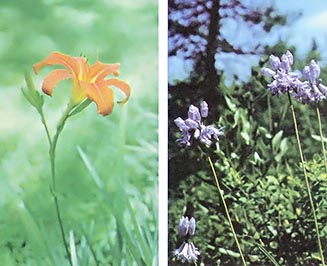
Hemerocallis fulva is a perennial
herb–native to an area stretching from New Brunswick
to Ontario, then southward across much of the United
States–which bears long, sword-like leaves and
trumpet-shaped orange blooms. Day lilies are a
“double-barreled” food source, too … since they have
edible portions that can be harvested during both warm and
cold seasons.
The early spring shoots are delicious when eaten raw in
salads … and, some months later, you can gather the
nearly full-sized unopened buds, cook them in boiling
water, add butter and seasoning, and serve them like green
beans. Furthermore, the fully opened blossoms–which, because
they last only one day, give the flower its name–make
delicious fritters when dipped in a rich egg batter and
quick-fried to a deep golden brown. You can also add the
flavorful buds and blooms (or even the withered flowers) to
soups and stews.
Many wild food enthusiasts claim that lilies actually taste
better after they’ve been dried … and it’s quite easy to
dehydrate the buds and blossoms in your own attic (or in
any warm, arid room). Simply spread the freshly gathered
flower parts on sheets of newspaper for about one week …
or string them on heavy thread and hang them up. After
they’ve completely dried, you can store the buds and
flowers in separate airtight containers. Then–when
you’re ready to use them in recipes–regenerate the
dehydrated blooms by soaking them in warm water (to cover)
until they’re soft and pliable again.
You can dig up day lily roots during any season of the
year, as long as the ground isn’t frozen … but the best
“harvests” will occur in the fall and winter, when the
tinybulbs’ flavor matures to the sweetness of whole-grain
corn. To prepare the roots, wash and scrub them, then boil
them in salted water for about 15 minutes before serving.
(They can also be baked or roasted- like potatoes-until
they’re tender.)
Try These Lilies, Too
Many of the “true” lilies are too rare to be collected as
food … but the Canada lily (Liliumcanadense)
and the Turk’s-cap lily (L. superbum) each provides
good -and abundant fare. The stems and leaves of
the two plants–both of which produce large orange-red blooms
in the late summer–can be cooked like green
vegetables and served with melted butter.
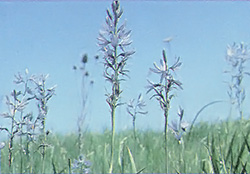
The famous northwestern camass–an edible member of
the genus Camassia–grows from a bulb which can be
boiled to produce a thick molasses. The plant attains an
average height of two feet, and often covers the moist
meadows of Washington, Oregon, and northern California with
early-summer carpets of blue blossoms. In the past, the
delicious, nut-like bulbs of the camass served as a major
barter crop for the Nez Perce and other Northwest Indian
tribes … and the plant reportedly saved members of the
Lewis and Clark expedition from starvation, after the
group’s more conventional supplies were exhausted.
The Indians steamed the small bulbs of Camassia quamash–in an underground pit—for one or two
days until the soft tubers were oozing with sticky sweet
syrup … and then pressed them into cakes to dry in the
sun. Camass bulbs can be eaten raw, dried, baked, or
roasted … although they should be used in small
portions, since the plant tends to have an emetic effect if
consumed in excess.
One eastern species of the camass, C. scilloides, is
commonly called wild hyacinth (because of the shape of its
pale lavender flowers), although–like its western
cousin–it’s actually a member of the lily family. The
herbaceous plant–growing in meadows and woods from
Wisconsin to Pennsylvania–springs from a solid corm
root … which can be eaten raw, boiled for 20 to 30
minutes, or baked in foil at 350°F for 45 minutes. The
seed pods of the eastern camass are also edible … and are
tasty raw (in salads) or cooked as a green vegetable.
Erythronium Edibles
Approximately 15 species of the genus Erythronium
are native to North America: Four are found east of
the Mississippi, while the rest grow in the western
mountains and northward to British Columbia. These edible
lilies, which are often known by such unlikely names as
adder’s-tongue and dogtooth violet, can provide prime
foraging material, since most of the species spread readily
… and are not in danger of becoming rare or extinct.
The most well-known eastern Erythronium species
is E. americanum (commonly called the trout lily),
which grows in moist woody regions of central North
America. Its deeply buried solid roots are edible year
round, but are more easily found in late spring when the
flowers appear. You can eat the roots boiled for 20 to 25
minutes and served with butter … or you might like to try
the green leaves and seed pods raw in salad. Keep your
portions moderate, however: The trout lily may act as a
laxative when eaten in quantity!
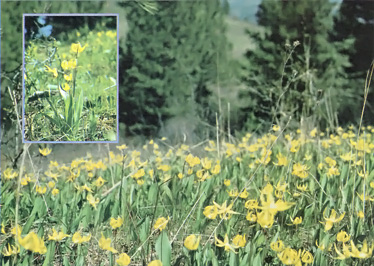
The western E. grandiflorum–which is most
often referred to as dogtooth violet–prefers the
cool, damp soil of the Rockies … and starts blossoming
soon after all the snow is gone. Its new spring leaves make
excellent additions to salads, as do the peppery seed pods.
Dogtooth bulbs (which can be boiled and dried for later
use) are also edible in the raw state. In fact, one of my
favorite wild food salads combines uncooked dogtooth tubers
and seed pods with a mixture of fresh day lily shoots, wild
hyacinth pods, watercress, chives, wild onions, sheep
sorrel, and dandelion greens.
Forage With Care
Although–as this article points out–there are many
lilies available to every novice forager, you can’t simply
go out and bring home just any species you find. It’s
important that you make sure the plant is not endangered
before you remove it. (Such information is
available from local garden clubs or the state’s natural
resources agency … and the latter office can provide you
with a list of wildflowers that are rare in your area.)
When foraging, you must also be extremely careful not
tocollect apoisonousplant … and several
members of the Liliaceae family do contain dangerous
toxins. (For example, the deadly Zygadenus–“death
camass”–closely resembles its edible relative: However,
normal camass blossoms range from blue to white, while the
death camass bears cream-colored blooms. Every part of the
death camass is virulently poisonous … and the toxic
plant causes great losses of livestock annually.) In many
cases, only an expert–or a comprehensive field
manual–will be able to help you positively identify
the growth … sodon’t dig up or eat any part
of a plant unless you’re totally sure of its identity.
But–as long as you stick to familiar plants and take
advantage of the advice of a good field guide or an
experienced forager–you should be able to put
together many exciting, tasty summer meals with
wildflowers. Using a little caution and a pair of sharp
eyes (the essential tools of any wild food gatherer),
you’re sure to harvest a bucketful of lilies that are not
only beautiful but also deliciously edible!
EDITOR’S NOTE: Both beginning and expert foragers
may be interested in these excellent
field guides and cookbooks:
[1] Feasting Free on Wild Edibles by Bradford
Angier.
[2] Color Field Guide to Common Wild Edibles by
Bradford Angier.
[3] A Field Guide to Edible Wild Plants of Eastern and
Central North America by Lee Peterson.
[4] Stalking the Wild Asparagus by Euell
Gibbons.
[5] Billy Joe Tatum’s Wild Foods Cookbook and Field Guide,
edited by Helen Witty.





