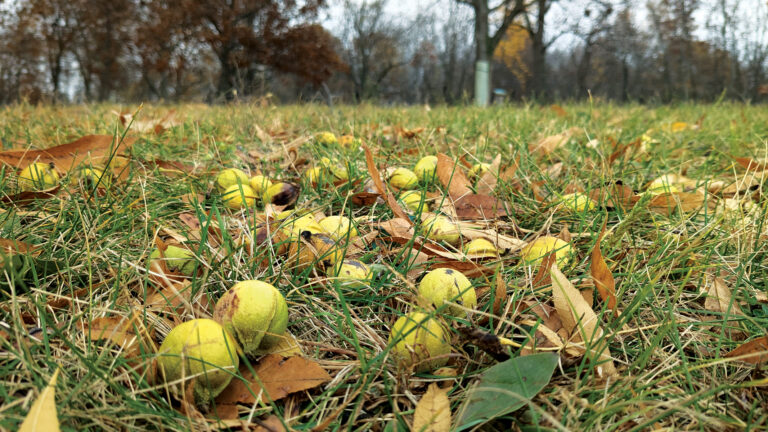
Learn about the Carya cordiformis, AKA the Yellowbud hickory tree. Get to know the hickory tree leaf, its bark, where it grows and the oil it produces.
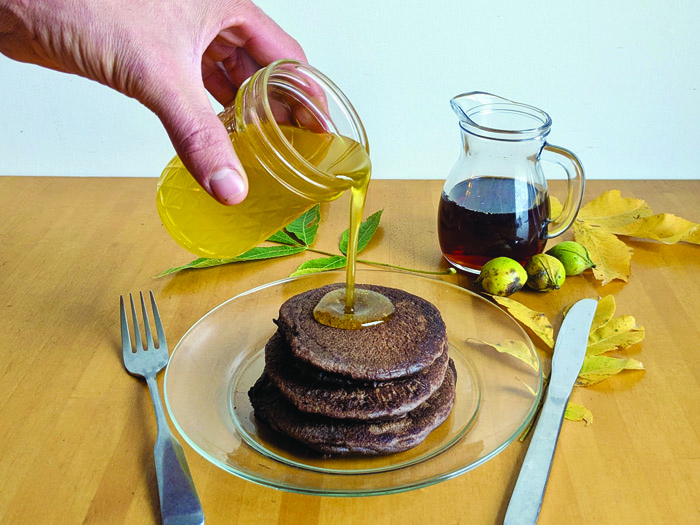
Oil is a versatile and high-energy food staple, but healthy oils can be hard to grow or source locally and sustainably. Fortunately, there’s a new option in town, from a tree that’s been sidelined for centuries. Enter hickory oil. This cold-pressed oil has not only a fatty-acid profile comparable to olive oil, but also a milder, nutty flavor and a smoke point of 405 degrees F. My partner, Sierra, and I use about half a gallon every month to sauté vegetables, mix salad dressings, roast squash and potatoes, and bake bread and desserts.
Hickory Tree Leaf and Bark
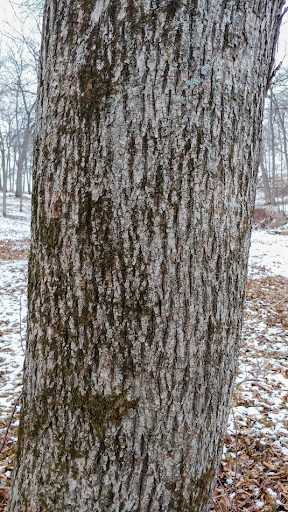
Yellowbud hickory (Carya cordiformis) is the best hickory for oil pressing, and, fortunately, it’s one of the most abundant. The tree’s broad range encompasses most of the eastern U.S., and it grows in a variety of soils and conditions. It can easily be identified by its pointy sulfur-yellow buds in spring. If those are out of reach, look for gently ridged bark with an interlacing diamond pattern, compound leaves with 7 to 11 pinnately compound leaflets, and thin-shelled nuts under the tree with adhering green or brown husks. The nuts are so packed with oil that you can squeeze it out of the kernel with your fingers. It only takes three 5-gallon buckets of nuts (with the husk on) to make a gallon of oil, and I can harvest 1 to 3 buckets per hour under a good tree.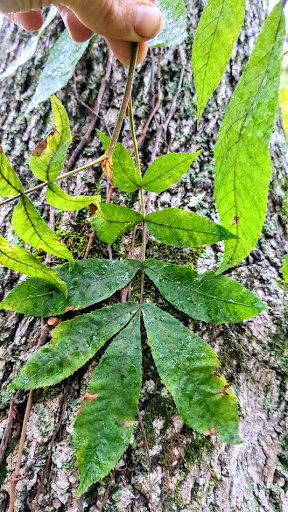
I found hickory oil while searching for ways to grow food more sustainably. A 2021 study by Thaler et al. found that a third of the topsoil in the Corn Belt has been eroded, and, in my home state of Iowa, we’ve plowed under 99 percent of the native prairie. I live in a sea of corn and soybean monocultures. If we continue the current trend, we’ll be left with barren soil and fewer people tending the land. We need an alternative vision.
Toward a Sustainable Future
My vision is to plant trees. Tree crops offer a number of inherent benefits: soil stabilization, carbon sequestration, minimal input once they’re established, and the opportunity to integrate other crops or livestock while producing abundant staple foods. I’d love to see my state covered in rotationally grazed pastures with scattered oaks, hickories, and chestnuts. Several groups I’m involved with, including the Savanna Institute and the Northern Nut Growers Association, share this vision and are working to make it a reality.
But it’s slow progress. There’s evidence that Native Americans used hickory oil for thousands of years, but this knowledge is no longer as common as it once was, a story that’s happened with many foods native to this country. Fortunately, some people are working to recover this lost food knowledge. One of these is Samuel Thayer. Thayer has written four books about foraging edible wild plants, including his latest masterpiece: Sam Thayer’s Field Guide to Edible Wild Plants of Eastern and Central North America. He’s spent over a decade working with yellowbud hickory nuts and developing a process to extract their oil, and he generously shared this knowledge with me and others.
All Together Now
The hickory oil industry is unique in that there are no real trade secrets. All the producers communicate regularly to share knowledge and ideas, building on Thayer’s foundational work. Jesse Marksohn and the crew at Yellowbud Farm have observed thousands of wild trees to select the best genetics for propagation. Zach Elfers and the members of Keystone Tree Crops Cooperative are educating and involving their community in harvesting and pressing at their processing hub. My business, Fancy Twig Farm, has researched new processing equipment and procedures for husk removal, drying, crushing, pressing, and oil purification. All of us are working together to move the industry forward.
In addition to a nationwide community of oil producers, my business relies on my strong local community. Many of the sites I harvest from are private property, so I have to get permission. Luckily for me, rural people tend to be friendly and don’t want to see food go to waste. Most of the time, people just ask a few questions about what I’m doing. Even with people I already know, it’s a good excuse to stop by and chat. At the end of the year, I invite all the landowners to a party with free bottles of oil and lots of nut-themed food.
Rarely am I turned away by landowners, but it happens occasionally. My spirits were low one week in October 2025, a year with a poor harvest. Most nut trees have low years and high years, but even in low years, a few trees produce good crops – usually pampered trees with no competition and plenty of water. Sierra and I had been driving from town to town, hoping to find trees like this in yards or parks, but with little success. Suddenly, we saw them: two large trees in a horse pasture, their branches bowed low with an enormous crop. After admiring them for a minute, we hurried to talk to the landowner. We found her walking her dogs in front of a nice house with two gleaming pickups in the drive. But the conversation didn’t last long. “I don’t want you on my property,” she said bluntly, and then waited for us to leave. This was the first time anyone had given us an outright “no.” At the end of the day, we came home with little to show for our hundred-plus miles of driving.
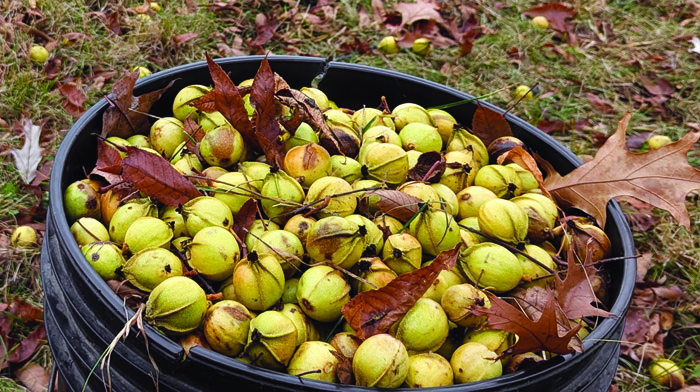
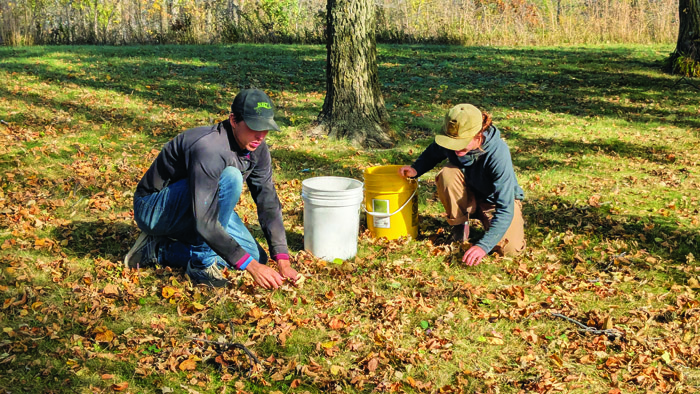
The next day started out the same. We drove around all morning and didn’t find many nuts. I was getting discouraged. Then, Sierra interrupted my thoughts. “Hey! I think I saw one!” We turned around and pulled over to the side of the road. Sure enough, there was a tree with plenty of nuts under it. We picked up a handful and then went to ask permission for the rest, driving down a gravel lane toward a small farmhouse. We found the farmer lying under a rusty old Ford. “Go ahead,” he said when we asked, hardly looking up as he worked. “Just watch out for the bulls.” We filled several buckets of nuts, battling thorny brush and dodging poison ivy. We thanked the farmer and gave him a bottle of oil.
Where do Hickory Trees Grow?
These trees are often found on the margins, just like the knowledge of how to use them. It’s disappointing to see a park filled with large oak trees, carefully pruned and regularly mowed under, but without a single yellowbud hickory, only to find the woods next to the park full of yellowbuds. This happens again and again. It seems like nobody cares about the tree. It’s not even offered by the Iowa Department of Natural Resources’ State Forest Nursery, despite being a common and ecologically important native tree. Some sources claim that wildlife don’t eat the nuts, but I’m constantly finding piles of nuts that rodents have been nibbling on or nuts broken in half by deer. I don’t know of anyone in my area who has planted them intentionally.
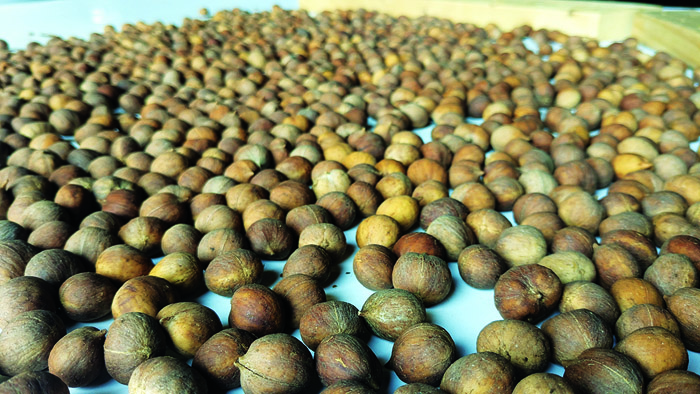
Let’s rebuild our relationship with C. cordiformis and spread the word about its generous gifts. A great first step would be to stop calling the tree by its most common name, “bitternut hickory.” The nuts are indeed bitter, but the bitter tannins are of no concern to oil producers. The tannins aren’t oil-soluble, so they’re naturally removed during the pressing process. This tree is also sometimes referred to as “pignut hickory,” but another species, C. glabra, is commonly known by the same name. Our community of oil producers is promoting C. cordiformis‘ other common name, “yellowbud hickory.” It’s much more appealing, and it’s a helpful reminder of how to identify the tree.
Mutually Beneficial
One way to get to know this tree is to manage the forests where yellowbuds are found. At first, I was hesitant to alter the woods for my own interests. After all, these patches of forest are some of Iowa’s few remaining intact ecosystems, and it was in the name of food production that the prairie was destroyed. But I slowly learned that the relationship could be mutually beneficial.
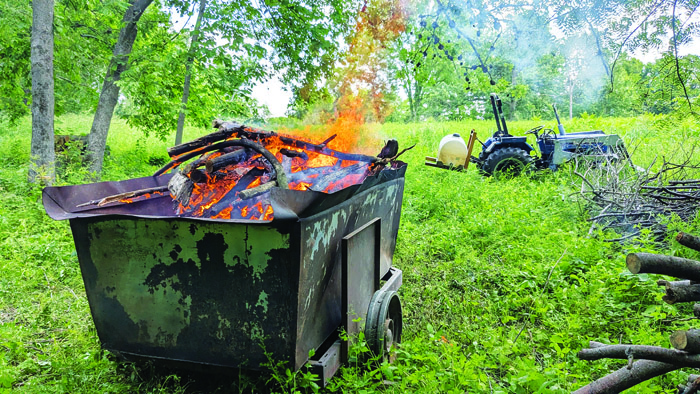
Iowa’s forests are often full of invasive honeysuckle and multiflora rose. These overcrowded, brushy forests aren’t ideal for nut production or forest health. Clearing the invasive brush not only makes it easier to pick up nuts, it also gives native plants a chance to thrive. Thinning some trees provides the yellowbuds more light and room to grow and creates patches where sunlight reaches the forest floor. Plus, I turn the trees I remove into biochar and add it to the soil under the trees, sequestering carbon and improving the soil’s water- and nutrient-holding capacity. The urine from our household gets applied under those trees too. I’m pampering the woods, and the resurgence of ramps, wild garlic, aniseroot, cutleaf toothwort, and other herbaceous plants is a sign I’m on the right track.
Another way I’m giving back to the trees is by planting them. People already like having trees in parks, yards, and pastures, so why not plant trees that produce food? Often, people know they’d like some trees on their land, but they don’t have the time, energy, or initiative to plant them. So, I make it easy by offering to do the work. I ended up planting over a hundred trees in spring of 2025 for my neighbors. I like that method because it gets people’s attention and gets them involved. I aim to plant 500 or more trees each spring going forward. There aren’t any strings attached: If people decide to remove the trees or don’t want to let others harvest the nuts, they can. My hope is that when the trees start producing nuts, the nuts will be used. What’s to lose? At worst, there’ll be more for the squirrels. At best, the community will learn to love a new food.
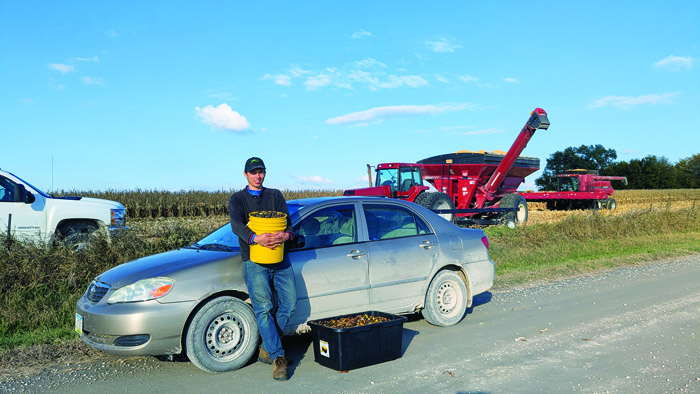
Until then, I’ll be squatting, kneeling, and bending under wild trees, picking up nuts in the ditches, forest edges, and back pastures of southeast Iowa. While I’m collecting nuts by the bucket, most of the state’s farmers will be harvesting grain by the ton. It’s a strange feeling to drive by huge combines and grain semis in my little Toyota Corolla packed to the brim with nuts. Could something so small really make a difference? Yes, in fact. It won’t be one billionaire or corporation who figures out how to bring human society back into balance with Earth’s ecosystems. It’ll be a bunch of little people, doing a lot of different things, each unique to their place, all working together.
I’m very thankful for everyone who lets me harvest nuts on their land and everyone who has supported me in the past three years. A few deserve a special thanks. My dad has helped me build specialty equipment that I need to make the oil. My friend and peer Alex Tanke is a true hickory nut who’s encouraged me since day one. Tom and Kathy with Red Fern Farm have been amazing mentors. My neighbor Elana, owner of Olivia’s Orchard, has been an ally in more ways than I can list. And, most importantly, it’s been amazing to have Sierra by my side.
Knowledge is meant to be shared, not controlled and exploited for profit. If you’re reading this and want to learn more, I’d be happy to teach you. However, there’s a procedure: First, collect 10 gallons of yellowbud hickory nuts. Then, get in touch with me, and we’ll find a time for you to come press them. My contact information can be found on my website: Fancy Twig Farm.
Levi Geyer is the owner and operator of Fancy Twig Farm, a small business in southeast Iowa focused on hickory-oil production. He’s driven to imagine and embody a more just and sustainable food system. His work is informed by his Mennonite heritage and perspective.
Originally published in the February/March 2026 issue of MOTHER EARTH NEWS and regularly vetted for accuracy.