1 / 2

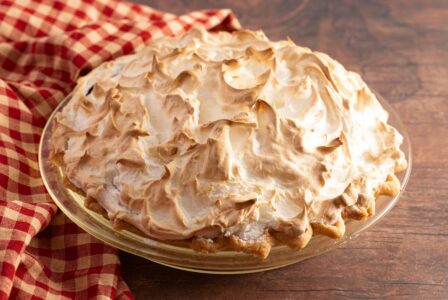
Rolling your dough to an almost transparent thickness is key for making blind-baked crusts.
Photo by Kathryn Gamble
2 / 2

“Ms. American Pie,” by Beth M. Howard, provides more than 80 crust and pie recipes.
Cover courtesy Race Point Publishing
Learn how to blind bake a pie crust for your cream pies by following this recipe and guidance for rolling out the dough.
A blind-baked crust is used for cream pies, where you cook the filling over the stove, and thus the pie crust doesn’t get a chance to bake in the oven unless you bake it by itself first.
Ingredients
- 1/4 cup (1/2 stick) butter, chilled and cut into large chunks
- 1/4 cup vegetable shortening, chilled
- 1-1/4 cups flour, plus at least 1/4 extra for rolling
- Dash of salt
- Ice water (fill a 1/2 cup but use only enough to moisten dough)
Directions
- In a deep, large bowl, work the butter and shortening into the flour and salt with your hands until you have almond- and pea-sized lumps of butter.
- Then, drizzling in ice water a little at a time, “toss” the water around with your fingers spread, as if the flour were a salad and your hands were the salad tongs. Don’t spend a lot of time mixing the dough, just focus on getting it moistened. Translation: With each addition of water, toss about four times and then STOP, add more water, and repeat.
- When the dough holds together on its own (and with enough water, it will), do a “squeeze test.” If it falls apart, you need to add more water. If it is soggy and sticky, you might need to sprinkle flour onto it until the wetness is balanced out. The key is to not overwork the dough! It takes very little time and you’ll be tempted to keep touching it, but don’t!
- Now form the dough into a disk shape.
- Sprinkle flour under and on top of your dough to keep it from sticking to your rolling surface. Roll to a thinness where the dough almost seems transparent.
- Measure the size of the dough by holding your pie plate above it. It’s big enough if you have enough extra width to compensate for the depth and width of your dish, plus 1 to 2 inches overhang.
- Slowly and gently—SERIOUSLY, TAKE YOUR TIME!—lift the dough off the rolling surface, nudging flour under with the scraper as you lift, and fold the dough back. When you are sure your dough is 100 percent free and clear from the surface, bring your pie dish close to it and then drag your dough over to your dish. (Holding the folded edge will give you a better grip and keep your dough from tearing.)
- Place the folded edge halfway across your dish, allowing the dough of the covered half to drape over the side. Slowly and carefully unfold the dough until it lies fully across the pie dish.
- Lift the edges and let gravity ease the dough down to sit snugly in the dish, using the light touch of a finger if you need to push any remaining air space out of the corners as you go.
- Trim excess dough to about 1 inch from the dish edge (I use scissors), leaving ample dough to make crimped, fluted edges.
- Prick the bottom and sides of the pie crust with a fork.
- Lay a large piece of foil over the top and fill with pie weights (or beans, rice, coins, chains, screws — anything to weight down the crust to keep it from puffing up or shrinking.)
- Bake at 425 degrees Fahrenheit for 15 to 20 minutes.
- Remove the weights and foil, turn oven down to 375 degrees, and continue baking for another 5 minutes or more, to brown the bottom of the crust.
Before Rolling Dough Out
- Flour is your friend when it comes to rolling dough. It’s what I like to call your “insurance policy.” Contrary to what other cookbooks will tell you, extra flour will not make your dough tough. Adding flour to your rolling surface will keep your dough from sticking–and will keep you from running to the store in frustration to buy pre-made pie crust.
- That said, always start from the center and roll out to the edges, rolling in one direction. You can push, you can pull, but don’t roll back and forth like a crazy person. I like to think of rolling dough as a dance; stay fluid in your motions. Also, put a little body weight into it so you can really stretch your dough. Too little pressure won’t get your dough to roll thin; too much pressure will mangle your dough. Try it out, get a feel, don’t be afraid to experiment.
- Keep your workspace clean. Take the time to scrape the gunk off your rolling surface as well as your rolling pin. This is another one of those “insurance policies” to keep your dough from sticking.
- When rolling dough, use your pie dish to calculate how big you’ll need it. Allow for enough extra width to account for the depth of the dish and make sure the extra inch or two of overhang from the dish has enough bulk for crimping the edge.
- Size isn’t the only goal when rolling dough. You want to aim for a certain “thinness.” My pie teacher, Mary Spellman, taught me what her mother taught her: Roll it thin enough so you can just start to see the stripes of the tablecloth through the dough. I always think about this transparency, even if there are no stripes on my rolling surface.
Baking Crust notes:
- The weights hold the crust in place as it bakes, keeping it from shrinking as the moisture evaporates. If it does shrink, it will rattle around in your pie dish, and though it will be smaller than you had hoped, it will still taste good.
- You don’t want to roll the dough more than once (okay, maybe twice) as it will toughen it, so if you don’t have the shape or size just right, it’s better to cut and piece the dough into the pie dish rather than wad it up and start over. Tough dough is not only hard to roll, it’s hard to chew.
More from Ms. American Pie
• Butterscotch Pie Recipe
• Sour Cream Raisin Pie Recipe
• Chocolate Cream Pie Recipe
Reprinted with permission from Ms. American Pie: Buttery Good Pie Recipes and Bold Tales From the American Gothic House, by Beth M. Howard, and published by Race Point Publishing, 2014.