Crunching on bright, tart apples, children scuffle through
heaps of fall crisped leaves . . . dreaming of the
snowdrifts soon to come. The harvest is in, the pantry and
root cellar are full and the garden begins its long
winter’s sleep.
Give thanks together for the year’s bounty and draw close
to the fire as winter’s first flakes fall from the
sky.
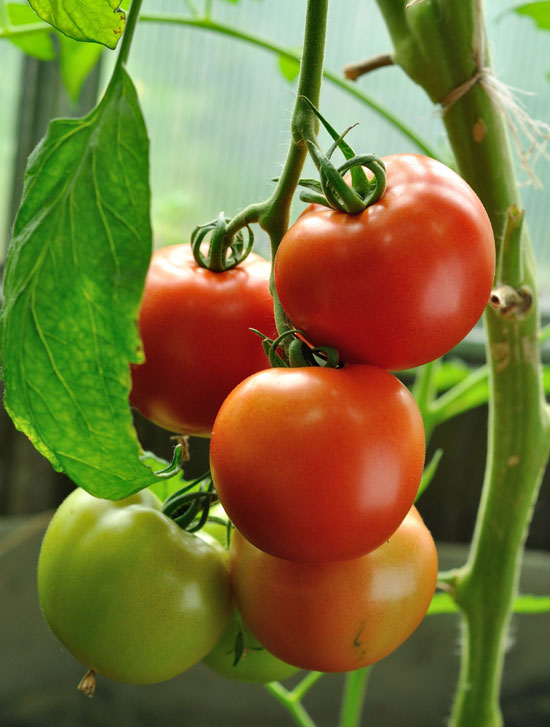
How many types of tomatoes do you grow? One? Two? If
you’re adventurous, perhaps you raise as many as five or
ten. Well, prepare to stand in awe of Lance Ladd, the owner
of an eastern Connecticut nursery. This year, Ladd grew not
25 . . . not 50 . . . not even 100 . . . but 145
different tomato cultivars!
You see, Lance’s business sponsors an annual weeklong
tomato festival in Windham, Connecticut. The event, held in
late August, brings together ‘mater lovers from all over
New England. Originally conceived of as a means of
publicizing the family nursery (Ladd, 26, returned the
horticultural enterprise to family ownership some 20 years
after his grandfather had sold it), the festival has taken
on a life of its own. It includes, in addition to a tour of
the gardens, a taste testing of all the varieties
and a vote to establish which is the most
delicious tomato. Also, prizes are awarded for the biggest
and smallest fruits, for the most strangely shaped ones,
and for the most uniform cluster from a single plant.
But the stars of the show are still the 145 test plantings.
Ladd started three years ago with fewer than 50 varieties.
This year he’s almost tripled that first planting, and for
1984, well, 200 would be a nice, round number. . . .
The test garden occupies about an acre, and is divided into
sections containing early, mid season, and late cultivars,
both determinate and indeterminate . . . cherry and other
small varieties . . . and plum and paste tomatoes. At least
six plants of every cultivar are set out, and some of each
are mulched with hay. Once the seedlings are in place, Ladd
practices modified benign neglect: He provides no water or
irrigation, and he uses no fungicides or pesticides. Some
5-10-10 fertilizer is incorporated into the soil when the
field is prepared, but no additional fertilizer is applied.
In fact, about the only attention the test planting
receives is an occasional hoeing and — time permitting
— handpicking of insects.
This year’s tomato test was instructive in a number of
ways. Connecticut, along with much of the rest of the
nation, suffered from a succession of hot, dry days all
summer long. Under these scorching near-drought conditions,
the value of mulching showed very clearly: Mulched and
unmulched plantings located side by side dramatized how
well the hay helped hold moisture in the soil. The
differences among the varieties Ladd grew were clear, too.
Plants with poor heat or disease resistance curled up and
died, while resistant varieties braved the heat and set
quantities of fruit.
Among the best producers in Ladd’s 1983 Tomato Sweepstakes
were Park’s Whopper . . . Monte Carlo, an indeterminate mid
season you could put your money on . . . Sweet-N-Early, a
very early and quite productive cherry tomato . . .
Glamour, an early indeterminate cultivar . . . Small Fry,
another cherry tomato . . . Napoli, a high yielding plum
tomato . . . and Burpee’s Jubilee, the best of the
yellow-fruited kind. And, at the end of a week’s tasting,
Sweet-N-Early was chosen the most flavorful, with Park’s
Whopper a close second.
Lance Ladd has already started planning next year’s
festival . .. while his mother, Norma, who shares the
family love of numbers (she raises 40 kinds of peppers), is
busy cooking up a lion’s share of this year’s crop. Given
the quantities she has to deal with, it’s understandable
that the Ladds have accumulated a considerable number of
recipes, and Norma has put together a festival cookbook
called Tomatoes With Love.
Handle With Care
According to a report in the September American
Horticulturist, there
well may be a health hazard involved in handling sphagnum
moss. A potentially serious disease called sporotrichosis,
spread by the fungus Sporotrichum schenckii, can
cause grave damage to the lymphatic system . . . and is
sometimes fatal. The fungus lives in soil and has been
found in sphagnum moss used to pack tree seedlings. It
enters the body through cuts or scratches in the skin, and
causes an inflamed blister that slowly enlarges. If not
caught and treated early, the infection can ultimately
involve the entire lymphatic system. Darroll D. Skilling,
principal plant pathologist at the North Carolina Forest
Experiment Station, recommends that gardeners avoid
handling trees that have been packed in sphagnum moss. If
you do have to work with the material, he suggests that you
wash your hands frequently and treat cuts and scrapes
promptly. (It seems to me that wearing gloves would be a
good prophylactic measure, too.)
Holiday Books for Gardeners
With the winter holidays rapidly approaching, a visit to
the Gardener’s Bookshelf seems very much in order. Ortho,
the producer of fine garden books as well as of
agricultural chemicals of questionable necessity
(especially for the home garden), has just issued
the massive Ortho’s Complete Guide to Successful
Gardening. The 504-page tome, which is available at
most bookstores and garden centers, and is
profusely illustrated with color photos. While the volume
covers all aspects of home gardening, the most extensive
section is devoted to shrubs and hedges.
From Sterling Publishing comes a trio of superb garden
books originally published in England by Blandford. My
favorite is Plant Propagation for the Home
Gardener by John I. Wright, an exhaustive
treatment of the subject. After chapters on cuttings,
seeds, division, layering, grafting, budding, greenhouses,
frames, and propagators, the last 150 pages are devoted to
details on reproducing what appear to be well over a
thousand different cultivars. For each, Wright gives the
plant’s scientific and popular names. the method of
propagation, the treatment required, the appropriate time
of year for planting, and specific notes on culture. I
wouldn’t be without it.
For lovers of indoor plants, Brian and Wilma
Rittershausen’s Orchids as Indoor Plants is a most
useful volume. The paperback is illustrated in
color and black and white, and covers both
choosing orchids for the home and caring for the plants.
And yet another delectable holiday gift would be Gunter
Andersohn’s Cacti and Succulents.
Completely illustrated in color, this book describes, and
gives information on culture for, nearly every cactus under
the sun (which is, after all, just where they prefer to
be). I can’t think of a better present for folks interested
in the desert plants.