For the past few years at our southern Oregon organic
flower farm, we’ve grown hundreds of flower species and
cultivars that we sell — both fresh and dried — to
florists, supermarkets, businesses, offices and
individuals. Naturally, we continually seek to maximize the
returns from our limited garden space, so we are always
looking for any crop that is easy to grow and sell. One
such discovery is statice, a plant whose several varieties
are in the genus Limonium .
Having also been involved in a vegetable truck farm, we’ve
had the opportunity to compare dollar yields per acre of
the usual vegetables to those of our flower crops, and
flowers, among them statice, rate much higher than
vegetables in dollars earned. In addition, growing statice is easy, it’s a cinch to sell, and it offers little risk because
it’s easily dried. In other words, we think it’s the ideal
crop for the small-scale grower.
Choosing Statice Seeds
Statice seed can be purchased in single colors or as a
mixture. The best colors, from the viewpoint of customer
preference, are the roses, pinks, blues, apricots and
purples, with yellows and whites being the least desired.
We plant half of our area in the individual colors and the
other half in a mixture, giving us a usable proportion of
yellows and whites.
You’ll find that statice seed comes either “clean,” called
easy-grow, or still embedded in the dried flower heads,
which we crush as finely as possible with our fingers.
We’ve grown many strains from a lot of different seed
producers without developing any particular preferences.
However, because some colors are peculiar to particular
strains, we grow small quantities of as many types as we
can find, with the exception of dwarf varieties. These we
avoid, since — as flower sellers — we need plants
with long stems.
Seed catalogs may offer annual and perennial types of
statice. Limonium suworowii, for example, is an
annual that produces valuable blooms for dried
arrangements, though it’s more fickle to grow than
Limonium sinuata. Limonium lacifolia and
Statice tatarica are both hardy perennials that
produce very airy, delicate blooms for fresh and dried
arrangements, and as fillers, they are often considered
superior to the popular gypsophila. Both of these varieties
are relatively uncommon and in great demand, but they
require a year before the first blooms are produced.
Limonium sinuata, on the other hand, blooms its
first year and has a number of attributes that make it our
favorite. First, it withstands frost quite well, thriving
in our garden a month before the last spring frost and
giving blooms a month after the first fall frost. Second,
its very dense, broad-leaved, low foliage helps control
weeds. In fact, it literally smothers them. Third, the long
stems grow from the base of the plant and open their
individual florets slowly, giving the grower a period of a
week or more to cut each bloom in its prime. (Most cut
flowers must be harvested every two days.) Fourth, statice
has no insect enemies and no special requirements other
than rich soil, full sun and plenty of water. And, fifth,
the plant produces blooms (here in southern Oregon) from
July to November, giving the grower a steady supply from a
single planting.
How to Plant Statice
We start our seeds in an unheated greenhouse about eight
weeks before the last frost date, sowing them very thickly
in a tray filled with 1 inch of commercial potting soil and
covering them with 1/8 inch of potting soil or vermiculite.
Though the germination rate is always good, it varies
somewhat with each variety and color. Therefore, just to be
sure, we always sow many more seeds than we need. As soon
as they’re big enough to handle, the emerging seedlings are
transplanted into standard nursery four-or six-packs filled
with potting soil. (Compost can be used, but its high
variability in nutrient proportions, pH and panicle size
and the presence of weed seeds can make it more trouble
than it’s worth.) New transplants are protected from the
sun for two days and then returned to normal light
conditions.
In a few weeks, the seedlings are about an inch in diameter
and resemble a lawn weed. We place these in cold frames to
harden for another two weeks before setting them out in the
garden around April 1. In order to take maximum advantage
of the fact that statice has a long period of production,
it’s essential that the plants be given an early start.
However, since the statice is planted in the garden long
before the earth warms, we start it out by fertilizing with
a 50/50 mix of blood meal and meat meal, which promotes
both immediate and longer-lasting release of nitrogen until
the soil warms up in late spring.
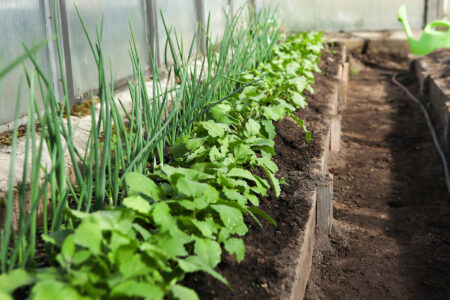
To make the most efficient use of garden space,
fertilizers, compost and water, we grow statice in raised
beds 5 feet across and 60 feet long. (Since we place the
plants 15 inches apart, with a leeway of 7 inches to the
edge of the path, each bed holds 188 plants.) In this way,
70 percent of the garden space is used for beds, and the other 30 percent is taken up by pathways, which are the width of the rotary
cultivator plus 2 inches, allowing for easy maintenance.
We’ve also found that using beds minimizes the tendency of
the blooms to fall or bend, as their density allows them to
support one another. Along the edges of the beds, we
construct a simple string fence to keep the flowers from
drooping into the walkways.
Watering can be done by overhead methods or by drip
irrigation. Sprinkling the plants from above increases the
chance that the blooms will fall, though this problem is
not severe. Drip irrigation, then, is the perfect solution,
but that, of course, requires extra capital.
How to Harvest Statice
The blooms can be harvested at any time of the day, though
it’s best to avoid the afternoon heat if possible. We cut
the stems at ground level and immediately pack the flowers
for sale in units of 10 to 20 stems, keeping the flower
heads grouped together in an attractive bunch. We then cut
the stems to a uniform length with a sharp knife or
clippers, wrap them with a rubber band and place the
bundles in water out of direct sunlight. Unlike many cut
flowers, statice is actually harmed by being put in
refrigerated coolers. It does best in fresh water in a cool
corner and is among the longest-lasting of all fresh
flowers, remaining beautiful for two weeks or more. To dry
the blooms, hang them upside down in a dark, airy place.
(If placed upright, the flowers will wilt before they dry.)
How to Sell Statice
From May to November, we grow and sell many varieties of
flowers to many different customers, and they
all appreciate statice. Florists are a source of
information about competition and prices. Some may buy a
substantial amount, but most use too little to make an
extra stop on the delivery route worthwhile. Supermarkets
and farmers markets are our biggest customers.
When we approach a new store, we ask to see the manager or
produce manager, show the prospective buyer a basket of
statice and guarantee that the store will have to pay
only for what sells. These terms and a beautiful wicker
basket make it easy to get our product in the store. Our
display consists of the basket with a plastic bucket of
water set within and a small sign: “Fresh statice, dry by
hanging upside down, 2 dollars a bunch.” (If possible, we place
the display by the checkout counter.) Allowing for the
store’s markup, that price gives us a gross profit of $1.30
to $1.40 on each cluster sold. We figure on clearing at
least 10 cents a stem. A busy store or florist will buy 500
stems per week, or $200 worth per month, from July through
December. And, lucky for us, the statice sells so well and
lasts so long that we take back less than 1 percent of our
deliveries, and we dry that to sell later.
Depending on the type of store and the location of the
display basket, it may be worthwhile to wrap each bunch
individually in green floral paper. This simple marketing
technique can dramatically increase sales in locations
where flowers are likely to be bought as gifts.
At the beginning of the season, we’re happy to sell flowers
to anyone who wishes to buy. For efficiency, however, we
favor those customers who buy large quantities in a single
delivery, who pay cash and who will buy on a
regular schedule. With a minimum of effort, we soon have
more sales than statice and begin to drop the least
profitable accounts and continue to serve the best ones
throughout the year. There are, of course, our
friends — and friends of friends — who purchase
small amounts directly from us. And if we ever have too
much cut on a particular day, we simply dry it.
Prices and Yields
Though we normally wholesale fresh statice for 10 cents per
stem, sometimes we discount large cash orders — sometimes we sell to individuals at 12 ½ cents per stem — and we sell all dried statice at the higher price.
As far as yields are concerned, so much depends on the
fertility of the soil and on the weather that the amount
we’ll have available is very difficult to predict. We’ve
harvested 20 stems from some plants and expect to average
over 15 stems per plant. We plan to have ¼ acre
in statice, and we figure that area will hold 26 beds of
188 plants each. If the plants average 10 stems each, at
10 cents per stem, this plot will produce sales of $4,888.
If the average is 15 stems, we’ll reap $7,332. And should
we be lucky enough to harvest as many as 20 stems per
plant, we could expect a yield of around $9,776 worth of
statice.
Growing statice is easy, and we’ve seen no vegetable crop that can match these returns
for the space used!