

The Seasons of the Garden column shares seasonal gardening information and tips with MOTHER EARTH NEWS readers.
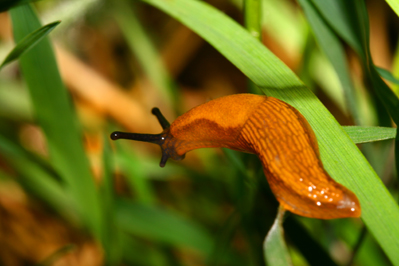
Slug it Out Safely With Slugs
You say you’ve been having a slugfest in your garden and
the organic slug remedies (like beer in saucers) aren’t
working? Is it time to give up and reach for a chemical
poison? No! Recent English experiments have shown that
aluminum sulfate, a natural inorganic material
widely used to acidify soil, works as well as — or
even better than — the standard methiocarb and
metaldehyde slug molluscicides (mollusk toxins).
Furthermore, aluminum sulfate costs less than the synthetic
substances and is quite easy to apply.
In the British tests, all the molluscicides evaluated
— natural and synthetic — provided adequate
protection for four days, then slug damage began to recur.
Hence, frequent applications may be necessary. However,
since aluminum sulfate seems to act more as a repellent
than a poison, slug populations might take a long time to
build resistance to it.
Aluminum sulfate powder is sold at most garden centers as a
soil acidifier. Apply five to 10 pounds per 1,000 square
feet for slug control. (About 50 pounds per 1,000 square
feet is needed to lower pH a point — and you can
always add lime to bring pH back up. )
Seasonal Gardening Research Briefs
Sterile Darrows. The Darrow is perhaps the
best thorny blackberry cultivar for the eastern U.S. But if
yours bear poorly or not at all, they may be victims of
Darrow sterility disorder. DSD seems to be
genetically based (even tissue-cultured plants can be
afflicted) and cannot be cured. So make sure your
blackberry suppliers obtain their propagation materials
only from highly fruitful plants.
Don’t microwave test soil. University of
South Dakota researchers report that using a microwave oven
to dry soil test samples significantly alters the results
for organic matter content, pH, nitrogen, potassium, sulfur
and cation-exchange capacity.
Low-mow lawn grass? Jan Wiejer, a
geneticist at the University of Alberta, has developed
several new grass cultivars — including fine fescues,
bluegrasses and wheatgrasses — that grow less than
six inches over an entire summer. However, some specialists
question whether the “miracle grasses” will work well in
the U.S.
Morels on the menu. That favorite of wild
mushroom foragers, the morel (Morchella species),
has finally been grown under artificial conditions.
Ants on the march don’t like to cross a
freshly drawn line of — powdered chalk. We’ve tried
it (redrawing the line every few days and after rains), and
it really reduced aphid-herding activities on our trees.
Heat-beating lettuce. When we accidentally
“cooked” a greenhouse flat of lettuce seeds last spring,
all the starts died but Anuenue (a tasty, new,
heat-resistant variety available from Johnny’s Selected
Seeds, Foss Hill Rd., Albion, ME 04910). This means Anuenue
is probably a good fall lettuce for areas with hot summers
(most other lettuces are hard to germinate in hot weather).
Biological brush control. Researchers in Vermont stocked a
brush-invaded hill pasture at densities of eight cattle, 32
sheep or 32 goats per five acres. After three years, the
cattle and sheep reduced the brush density by two-thirds.
The goats, though, completely wiped out invading
thorns, brush and trees in only two years.
Ready, set, grow! Currently, California
has the only major commercial grower of edible flowers for
the restaurant trade. We predict there will be dozens
within the next five years as the edible-flower fad spreads
eastward.
EDITOR’S NOTE: Greg and Pat Williams raise most of their own food on a small farm and publish HortIdeas, a fine newsletter on gardening research and products (available for $10 a year from G. & P. Williams, Gravel Switch, KY).






