

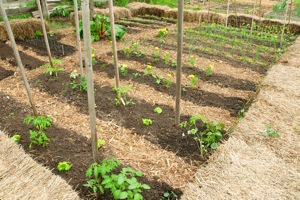
I’ve come to the smug conclusion that many home gardeners
(I have in mind those folks who spend as many as 100 hours
of labor to grow $100 worth of produce) are somewhat akin
to masochists. And I’m convinced that most people
would — if they were to keep complete records of the
total time and expense their gardens require — be
amazed at how much those homegrown vegetables actually
cost!
I, on the other hand, can afford to be smug because, after many years of planning, I’ve gradually
whittled my garden work routine down to a pleasurable size.
I put in no more than eight hours of toil, and spend less
than $25, over an entire season! Here’s how I do it.
Preparing the Ground for the Garden
First, I got rid of my rototiller. For my purposes the tool cost too much money
(you should be sure to include the price of such a machine,
and its upkeep, in any gardening expense records), was
excessively noisy, jerked my arms off, burned
expensive gasoline, made my plant rows too wide
(forcing me to work a larger-than-necessary plot) and, when used for weeding, sometimes actually damaged
roots and slowed down the plants’ growth. My tools now
consist of an old stone rake and a hoe. That’s it!
My
second step was to cut my plot to a manageable 18-by-38-foot
size, which — I’ve found — is plenty large enough
to supply my family’s needs if it’s planned and
planted properly.
Here in Virginia, I can begin gardening
during the last week of April. (I could start earlier, but
most of the seeds would just lie in the ground, waiting for
more warmth, anyway!) At that point, I call a neighbor’s
son who has a rototiller, and in about an hour the lad can
work my plot twice in opposite directions, turning under
all the ashes and manure I’ve thrown on top of the soil
during the winter. For his efforts, he receives $10 —
after which I don’t see him or the tiller for another year.
Then, starting at one end of my garden (I alternate each
year), I begin to form the first bed across the 18-foot
dimension. By putting in rows in this direction, I’m able
to stand along the garden’s 38-foot edge and use the rake to
reach out to the middle of the plot, leveling the earth and
drawing the clods and stones toward me (I ignore anything
less than the size of a marble). I rake about a 3-foot swath at
a time from one side, and then repeat the process from the
other completing one 3-by-18-foot area. This way, all the
larger lumps end up along the plot’s length, where they’re
left.
Planting Crops
I prepare a very rough seed-bed in this manner for each vegetable. Then I
merely hold the rake upside down and drag the handle’s
rounded end through the dirt to lay out my first row. (The
depth of the trench will, of course, depend on the amount
of downward pressure exerted on the handle as I walk across
the plot.) Next, with my size-nine shoe, I measure over one
foot and draw another furrow — or two, depending on how
many rows are desired for that particular crop.
It’s not
necessary to slow things down by marking
prospective rows with string. Straight lines please
gardeners, not plants! Besides, with 18-foot rows running only
a foot or two apart, it’s pretty easy to keep them parallel.
After dropping the seeds into the trenches,
I reverse my rake — so its head is on the soil with the
points facing up — and use the flat back to pull a
small amount of earth over them. Finally, I just walk
heel-to-toe down the furrows to pack the seeds in.
My first
three rows are usually made up of spring onions, which I
plant two inches apart. Later, when I start to use a few
each day for salads, I simply pull every other one, leaving
an additional space for the remaining plants to mature.
Then, as the season progresses, fewer onions are needed
daily because the bulbs get progressively larger.
I follow
the same simple process for sowing beans and beets. When
starting the tomatoes and peppers, though, I don’t even
bother with raking, since the transplants don’t seem to
mind a clod here and there. I just use the hoe to make
holes and set them in . . . and it doesn’t take more than 10 minutes to plant the lot. It takes me another 20
minutes (at the most) to rake a bed for the corn, drag the
handle across the plot five times, drop the seeds in every
four inches, and cover them over.
At that point I’ll have
planted everything but my squash, cucumbers and pumpkins.
Again, I don’t bother to rake out rows for these. I just
walk across the garden and drop the seeds about every 12
inches, right on the top of the soil, then stand off
to see whether they’re approximately where I want them and
return to push each one into the earth with my index
finger.
With that, the garden is planted. The entire
job doesn’t take more than two hours, and can be
accomplished easily in an evening after work.
Adding to the Garden
Now, let’s see just what that couple of
hours of labor has accomplished. Besides my 300 onions, I
plant about 200 beet, 200 bean and 250 corn seeds . . .
plus 18 tomato, six pepper and a total of 36 pumpkin,
squash, and cucumber plants. (Different vegetables could be
substituted, but my family likes these and I’ve
come to rely on specific varieties that grow well in our
area.)
During the late winter my wife usually starts some
punch-and-grow marigolds, which — come spring — are
transplanted into the finished garden’s borders. Besides
helping to keep the insects in check, they provide color
clear into November.
After my crops are sown, I drive a 7-foot
piece of pipe into the middle of the plot, tie my
water sprinkler to its top and connect the hose. This
setup allows the waterer to cover all the rows from its
central location, clearing the corn (which, last year,
reached 9 feet and 6 inches) later in the season. As soon as the
sprinkler’s in place, I give the garden a good initial soak
to set the seeds to germinating.
For the next 30 days or
so, I don’t do anything to the plot except turn on the
water when it’s needed (an inexpensive plastic rain gauge
helps me make sure that the crops get at least half an
inch to one inch of water each week) and
watch the garden grow. Then, around the first of June, I
weed the whole thing and — in the process — remove
one of every two cornstalks and two of every three
cucumbers, pumpkins, and squash. I always save the ones
that appear to be the hardiest.
Once that hoeing is
finished, I mulch the tomatoes, peppers, squash, cucumbers,
and pumpkins with hay. Next, I gather up some old ladders
(picked up at the local dump) to which I’ve attached legs
and place them horizontally over the tomatoes.
I’ve never found anything less expensive or easier to use
to support these plants, and it takes about five minutes to
put the ladders out each spring and the same to pick them
up in November (they store very nicely against a tree all
winter, too).
My next step is to place some blood meal
(it’s available at any garden shop) every two feet or so
along the edges of the garden, by tying two or three
spoonfuls into each of a number of small cloth bags and
fastening these to the V-shaped wire wickets that I use to
designate the rows. (Such wickets are an improvement over
wooden stakes, as they push into the ground more easily,
don’t deteriorate, and can be hung over a nail — inside
or outside — for winter storage.)
Despite the fact that
I live within 100 feet of a large wooded area teeming with
wildlife, I’ve never had any critter-caused crop damage
since I began using blood meal in this manner. Often, at
night, we actually see deer grazing in the yard, and
raccoons and skunks also show up regularly . . . but the
animals never enter the unfenced garden. I replace the
natural deterrent monthly, and sprinkle the old meal from
the wicket bags over those plants (young corn, for
instance) that are most susceptible to attack by wild
nibblers.
Simplistic Upkeep
Within 45 to 60 days after planting, most of my beans and beets will
already have been eaten, canned or frozen. In their place
I put in a row of winter squash. Again, I do this just pushing
the seeds into the soil with my index finger.
I’ve found
that onions will tolerate a few weeds in their rows, but my
tomatoes, peppers, cucumbers, pumpkins, and squash don’t
have to face such intrusions because they’re mulched. So
hoeing takes up only about 15 minutes every two weeks . . .
usually just before dark to avoid both bugs and heat. Other
than that — and, of course, the pleasant task of
picking the fruits of my labor — my garden chores are
over after the first of June!
My records indicate that I
invested $24.75 and seven and one-half hours of work in my garden last
year. And by planting close, mulching, and sticking to
vegetables that are sure producers, I harvest as much from
my compact eight-hour garden as some folks get from plots
twice the size.






