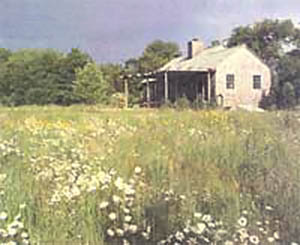
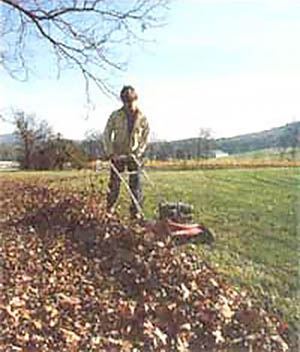
You might known planting a lawn during the autumn months is in fact the best thing for your domesticated grassland. But first, a confession: Like more and more homeowners these days, I’m letting the edges and corners of our once-postage stamp-square front and back lawns go back to nature. The objectives are to promote plant diversity, attract wildlife, create a barrier to block winds that blow past the house sucking out heat energy in winter… and to minimize the noise and air pollution, repetitive sweat labor, and downright boredom of pushing a power mower back and forth over the same ground every week from May to September.
Lawn Grasses
Not to put down the grasses. They are marvelous plants uniquely capable of surviving destruction down to ground level. Grass grows up from the stem, not out from the tip. If a grassland is continually trimmed short — as are what remains of the savannas of Africa by gazelles, zebras, and wildebeest, and as once were the once-Great Plains of North America by antelope, deer, and bison, as are your lawn and mine by Lawnboys and Sears Eager Ones —seedlings of herbaceous plants and trees are continually trimmed out, creating a “sea of grass.”
The dense underground mat created by millions of individual grass plants’s interlocking roots serves to hold soil particles together — making the difference between good land and a dirt pile. Mice and bugs and worms can burrow in it around tilling and aerating, your kids can dig forts in it, and you can chew it up with the tractor or 4×4, but the grass-root-filled soil will hold together. Plus, the fibrous roots absorb water, storing it between rains, and parsing it out as plants get thirsty. Roots also store energy to regenerate the plant following winter dormancy and after mowing, fire, or grazing animals remove the tips.
Natural grasslands are continually fertilized and built up by droppings, but — especially if you collect and burn, discard, or compost the mowing — your sod can be sapped and diminished by the end of each growing season. This is the best time to condition a lawn. When the cold fall rains threaten, but well before ground freezes, you should add lime to sweeten the soil, fertilize, condition bare patches, and reseed.
But first, initiate a controlled burn that will kill bug eggs and weed seeds, and convert the thatch — a half-inch-thick mat of dead stems and roots just under the green growing plant tips — that will self-perpetuate by making grass leaves stretch for light. Too thick a hatch lets water escape, harbors insects and disease, and encourages bare patches. Best to thin it, at the same time converting it into ash which will filter down over winter where the alkaline potash it contains will sweeten soil and nourish the roots.
Pick a windless day when the upper layer of thatch is dry, but the sub sod is moist. With a garden hose on and quick to hand to keep the blaze from getting out of control, burn small segments of lawn at a time. If there is a chance of a pickup in the wind, light off at the downwind edge of the burn area lest wind get behind the fire line and spread it faster than you can handle it. If thatch is dry enough, the fire will move steadily across the lawn, consuming thatch but leaving green leaves browned around the edges but still alive. If the fire races and leaves smoldering hot spots that burn down to soil level, it is too dry. If the fire dies or sputters and won’t move right along, it is too wet. Either way, wait for better weather.
Next, unless your soil is naturally sweet, spread on finely ground limestone. A hopper-type lawn spreader is easiest, but you can fill a pail with the heavy, dry powder and spread it with a trowel or by hand if your lawn is small enough. This natural pH-lowering agent will react slowly and in proportion to the acids in the ground, so application needn’t be precise. You seldom need to lime more frequently than every other year. To check, buy a small pH test kit at any lawn and garden outlet and follow directions. Tip: Don’t cover the little test vial with a finger to shake it; the natural acids on your skin can bias the test results.
If the lawn is too large to lime by hand, you can rent or buy a spreader for your truck or tractor. Or you might consider hiring the local farm bureau to lime it with a big hopper-truck carrying a field spreader. But, if you want a naturally grown lawn, do not call in one of those lawn-chemical firms. They’ll want to dope your sod so that every living creature in it turns belly up (if worms have bellies, that is). Some states require them to poke little Chemical Hazard signs around the lawn’s perimeter following applications.
Sod in bare and yellow spots caused by beetle larvae, the dogs, crabgrass, or another noxious weed should be burned twice, dug out as deep as your shovel will reach, turned bottom-side up, stomped, and raked smooth.
Now apply fertilizer. Best by far is a good half-inch of compost, raked out evenly. If you have com posted your clippings, you are just returning nutrients (that you could have left in place by using a clipping-chopper-type composting mower). Compost is always in short supply, so apply it first to dead spots and problem areas. If compost or stable manure is commercially available, a truck load will do your lawn a world of good.
Lacking compost or manure, you should spread a hi-nitrogen fertilizer. Natural materials such as cottonseed meal are best, but expensive to apply to a large lawn. However, if I had to compromise organic principles and use chemicals, I’d rather do it on the lawn than in the vegetable garden. Plus, chemical fertilizers such as 10-5-5, formulated for lawns, are easy and cheap. The most effective dissolve in water to be sprayed on with an applicator attached to the garden hose. Be sure to spread any granular chemical lawn food evenly or you can burn the sod.
Applying Grass Seed
Like sod, grass seed and seedlings can survive about any temperate-zone weather conditions except extended periods of standing water. However, seed will get the best start if spread several weeks before the temperature falls below freezing. Plan to reseed before spreading compost, or after newly spread manure or chemical lawn food has been rained on several times.
Don’t indulge in false economy by buying a plastic bag of cheap no-name lawn seed from the grocery or a mall store. Brand-name seed such as Scotts is more expensive (often a great deal more), but lawn seed firms thrive only if their seed performs. You can be sure that it is fresh, packed for high germination in mixes formulated for your climate and lawn type, and with guaranteed viability, trueness to type, and top quality.
Hand-throw or use a spreader to sow the seed thinly and as evenly as possible, following container directions. Rake vigorously to distribute seed and work it down into what remains of the thatch.
Finally, rent a water-fill, drum-type lawn roller and compact the new-spread materials so the seed is encapsulated and firmed securely in growing medium.
Then lean back and wait for the seasons to run their course. All plant growth slows when days shorten and temperatures fall, but grasses are remarkably frost-resistant. During any warm snap, exposed leaves will begin turning sun energy into sugar, and your new seed will put out roots (but not top-growth) so the lawn will be set to join your fall-planted garden seeds, flowering bulbs, and trees in the renewal of life with the first warm days of spring.
For more about fall planting see the following:
Fall Planting Guide for the Garden
Planting an Orchard in Fall