
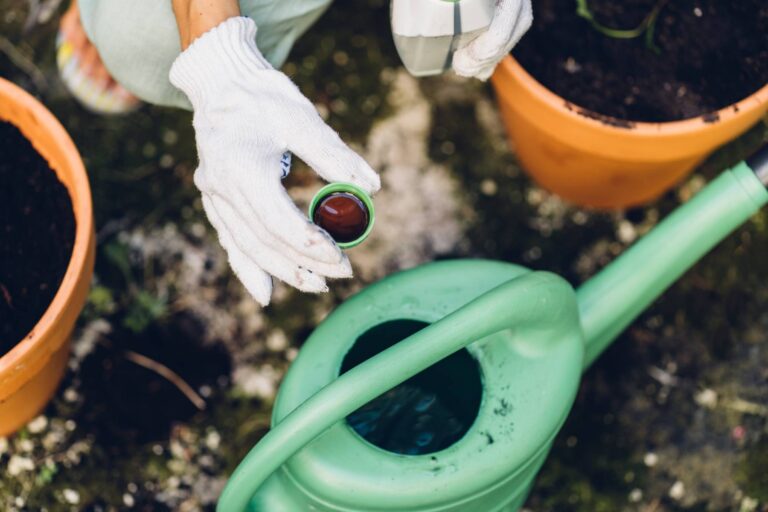
Learn how to make your own homemade liquid fertilizer and how to fertilize plants to give them the quick boost of nutrients they need. Many organic gardeners keep a bottle of liquid fish fertilizer on hand to feed young seedlings, plants growing in containers, and any garden crop that needs a nutrient boost. But liquid, fish-based fertilizers are often pricey, plus we’re supporting an unsustainable fishing industry by buying them. So, what’s a good alternative?
MOTHER EARTH NEWS commissioned Will Brinton — who holds a doctorate in Environmental Science and is president of Woods End Laboratories in Mt. Vernon, Maine — to develop some water-based, homemade liquid fertilizer recipes using free, natural ingredients, such as grass clippings, seaweed, chicken manure, and human urine. His results are summarized on our chart of Homemade Fertilizer Tea Recipes.

Why and When to Use Homemade Liquid Fertilizer
Liquid fertilizers are faster-acting than seed meals and other solid organic products, so liquids are your best choice for several purposes. As soon as seedlings have used up the nutrients provided by the sprouted seeds, they benefit from small amounts of fertilizer. This is especially true if you’re using a soil-less seed starting mix (such as a peat-based mix), which helps prevent damping-off but provides a scant supply of nutrients. Seedlings don’t need much in the way of nutrients, but if they noticeably darken in color after you feed them with a liquid fertilizer, that’s evidence they had a need that has been satisfied. Liquid fertilizers are also essential to success with container-grown plants, which depend entirely on their growers for moisture and nutrients. Container-grown plants do best with frequent light feedings of liquid fertilizers, which are immediately distributed throughout the constricted growing area of the containers.
Out in the garden, homemade liquid fertilizers can be invaluable if you’re growing cold-tolerant crops that start growing when soil temperatures are low; for example, overwintered spinach or strawberries coaxed into early growth beneath row covers. Nitrogen held in the soil is difficult for plants to take up until soil temperatures rise above 50 degrees Fahrenheit or so, meaning plants can experience a slow start because of a temporary nutrient deficit in late winter and early spring. The more you push the spring season by using cloches and row covers to grow early crops of lettuce, broccoli, or cabbage in cold soil, the more it will be worth your time to use liquid fertilizers to provide a boost until the soil warms up.
Water-soluble homemade fertilizers are short-acting but should be applied no more than every two weeks, usually as a thorough soaking. Because they are short-acting, liquid fertilizers are easier to regulate compared with longer-acting dry organic fertilizers, though I like using both. With an abundant supply of liquid fertilizer to use as backup, you can use a light hand when mixing solid organic fertilizer into the soil prior to planting.
Remember: If you mix too much nitrogen-rich fertilizer into the soil, you can’t take it back. As soil temperatures rise, more and more nitrogen will be released, and you can end up with monstrous plants that don’t produce well. In comparison, you can apply your short-acting liquid fertilizers just when plants need them — sweet corn in full silk, peppers loaded with green fruits — with little risk of overdoing it. Late in the season, liquid fertilizers are ideal for rejuvenating long-living plants, such as chard and tomatoes, which will often make a dramatic comeback if given a couple of drenchings.

How to Fertilize Plants by Making Your Own Fertilizer Tea
To explore the art of making fertilizer tea, Brinton began by trying various ways to mix and steep grass clippings, seaweed and dried chicken manure (roughly 33 percent manure mixed with 66 percent wood shavings). The best procedure he found was to mix materials with water at the ratios shown in the Homemade Fertilizer Tea Recipes chart, and allow the teas to sit for three days at room temperature, giving them a good shake or stir once a day.
“By the third day, most of the soluble nutrients will have oozed out into the water solution,” Brinton says. Stopping at three days also prevents fermentation, which you want to avoid. Fermented materials will smell bad, and their pH can change rapidly, so it’s important to stick with three-day mixtures and then use them within a day or two. Brinton also studied human urine, which is much more concentrated than grass, manure, or seaweed teas, and doesn’t need to be steeped.
The lab analyzed the four extracts for nutrient and salt content. Salts are present in most fertilizers, but an excess of salts can damage soil and plant roots. Brinton found that chloride and sodium salts were so high in urine that they needed to be diluted with water at a 20-to-1 ratio before being used on plants. In comparison, the seaweed extract could be used straight, and the grass clipping and chicken manure extracts needed only a 1-to-1 dilution with water to become plant-worthy. Read the full report from Woods End Laboratories.
As a general guideline, most vegetables use the three major plant nutrients — nitrogen, phosphorus and potassium — in a ratio of roughly 3-1-2: three parts nitrogen, one part phosphorus, and two parts potassium. This means that an N-P-K ratio of 3-1-2 is more “balanced” in meeting plants’ needs than 1-1-1, the ratio many gardeners assume is best. Because liquid fertilizers are a short-term, supplemental nutrient supply secondary to the riches released by organic matter and microbes, they don’t need to be precisely balanced. The teas made from grass clippings and urine come closest to providing the optimum 3-1-2 ratio.
Nitrogen helps plants grow new stems and leaves. Phosphorus is essential for vigorous rooting, and is usually in good supply in organically enriched soils. Potassium is the “buzz” nutrient that energizes plants’ pumping mechanisms, orchestrating the opening and closing of leaf stomata and regulating water distribution among cells. The grass clipping and poultry manure teas are rich in potassium, which should make for sturdy plants with strong stems when used to feed young seedlings. Blending some grass or manure tea with a little nitrogen-rich urine would give you a fertilizer to promote strong growth in established plants. I like to add a few handfuls of stinging nettles, comfrey, lambsquarters, or other available weeds to various mixtures, which probably helps raise the micronutrient content of my homemade concoctions in addition to providing plenty of potassium.

On the practical end of liquid-fertilizer making, you may need to use a colander to remove some of the grass clippings before you can pour off the extract. If you haven’t completely used a batch of fertilizer within two or three days, pour it out beneath perennials or dump it into your composter.
It’s important to relieve drought stress before doling out liquid fertilizer. Watering before you fertilize helps protect plants from taking up too many salts. Also keep in mind that continuous evaporation in containers favors the buildup of salts. By midsummer, a patio pot planted with petunias or herbs that are regularly fed with any liquid fertilizer may show a white crust of accumulated salts inside the rim. Several thorough drenchings with water will wash these away, making it safe to continue feeding the plants with liquid fertilizers.
There is no doubt human urine can be a valuable fertilizer for garden plants. The average adult produces about 1-1/2 quarts of urine per day. Diluted 1-to-20 with water, this would make about 7 gallons of high-nitrogen liquid fertilizer, so a family of four could produce enough high-nitrogen fertilizer for an average garden and lawn. As Brinton suggests, when we think of N-P-K, we should also think N-Pee-OK!
Maybe it’s all the diapers I’ve changed, but I don’t like minding pails of pee. In winter at my house, we have a bucket of sawdust stationed on the deck to help us capture this valuable resource, and we keep a designated bale of hay out in the garden for urine deposits. If you do the same, you can use the urine-enriched sawdust and the hay from “pee bales” as nutrient-rich mulches in your garden.
Whatever materials and methods you choose, you’ll be pleasantly surprised by the simplicity of making your own no-cost homemade liquid fertilizers.
Former contributing editor Barbara Pleasant gardens in southwest Virginia, where she grows vegetables, herbs, fruits, flowers and a few lucky chickens.





